• Christopher Dodds LIVE in Public
  • Workshops
  • About Me
  • Portfolio
  • Blog
  • Testimonials
Menu

Nature Photography Blog

  • Christopher Dodds LIVE in Public
  • Workshops
  • About Me
  • Portfolio
  • Blog
  • Testimonials
×
No results found
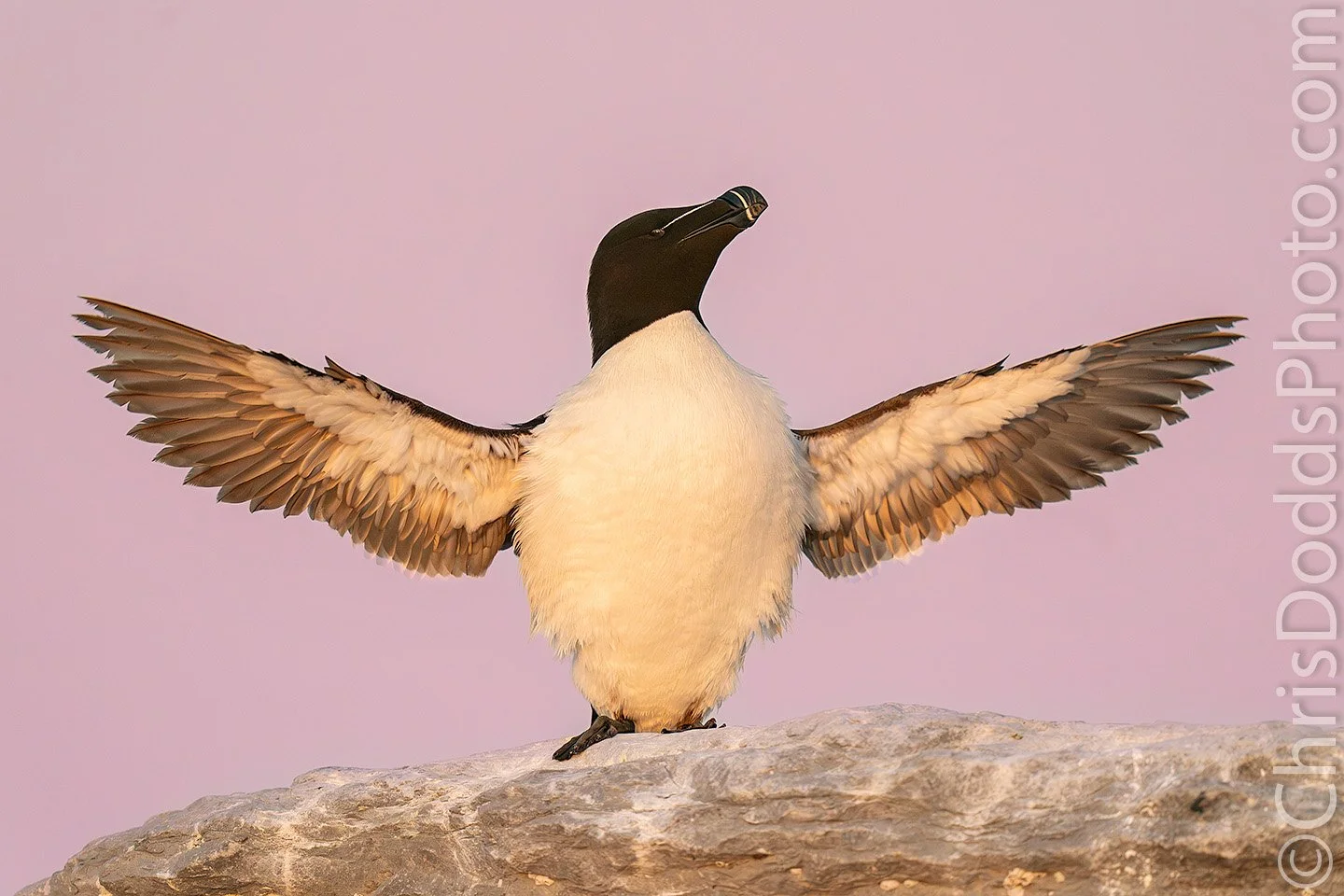
Razorbill stretching its wings at last light on Île aux Perroquets, photographed at ISO 10,000 with an OM SYSTEM OM-1 Mark II and 150–400mm lens.

Razorbill sunset wing stretch — Île aux Perroquets, Québec (Alca torda, Petit pingouin, Alca común, RAZO) from my Deluxe Puffins Galore Workshop, Mingan Archipelago National Park Reserve, Quebec, Canada. Image Copyright ©Christopher Dodds. OM System OM-1 II Mirrorless camera &  M.Zuiko Digital ED 150–400mm F4.5 TC1.25x IS PRO @500mm (same angle of view as 1,000mm on full-frame camera). ISO 10,000, f/5.6 @ 1/5,000s, manual exposure. Full-frame image.

OM-1 Mark II at ISO 10,000: Is It Ready for Professional Bird Photography?

Christopher Dodds September 6, 2026

There is something undeniably joyful about a Razorbill throwing its wings open at last light.

I made this image during my Deluxe Atlantic Puffins Photography Workshop on Île aux Perroquets while setting up and optimizing a client’s OM SYSTEM OM-1 Mark II and M.Zuiko Digital ED 150–400mm F4.5 TC1.25x IS PRO for birds in flight.

This is something I often do during my workshops. Camera menus and autofocus options have become increasingly complex, so I help clients configure their own equipment for the subjects and action we expect to photograph. I have extensive experience with all the major camera brands and can usually help clients get the best birds-in-flight performance from whichever system they use.

I worked through the OM-1 Mark II’s most important bird-photography settings on the fly, activated Bird Subject Detection, continuous autofocus and SH2 at 50 frames per second—and started photographing.

The Razorbill was standing quietly on a rock when it suddenly opened its wings. Because the camera was already optimized for birds in flight and fast action, I was ready when the unexpected happened.

My exposure was 1/5,000 second at f/5.6 and ISO 10,000. The lens was set to 400mm with its built-in 1.25× teleconverter engaged, producing an actual focal length of 500mm and the same angle of view as a 1,000mm lens on full frame.

Is the OM-1 Mark II Ready for Professional Bird Photography?

That is the question I found myself asking after several promising sessions with the camera.

Autofocus technology has advanced enormously across all the major camera brands. Modern systems can recognize birds, locate their eyes and track them through flight with an accuracy that would have seemed extraordinary only a few years ago.

Differences remain—particularly during initial acquisition, erratic flight, poor light and tracking against complex backgrounds—but the gap between today’s best autofocus systems has become much narrower.

The OM-1 Mark II certainly has the right tools: Bird Subject Detection, continuous autofocus, blackout-free shooting and up to 50 frames per second with autofocus and exposure tracking.

My limited testing over several sessions has also been promising. The OM-1 Mark II’s autofocus acquisition and tracking performed well enough to get my attention.

The next question was how to configure it for birds in flight.

Essential OM-1 Mark II Settings for Birds in Flight

Rather than changing every possible option, I concentrated on the OM-1 Mark II menu settings that matter most for bird detection, autofocus and fast action.

AF Mode: C-AF

I used C-AF (Continuous Autofocus) with Bird Subject Detection. C-AF continuously adjusts focus as the bird changes distance, while Bird Subject Detection identifies and prioritizes the bird, including its head or eye when conditions permit.

Birds rarely announce what they are about to do. Continuous autofocus keeps the camera working with the subject when a quiet moment suddenly becomes a takeoff, landing, wing stretch or interaction.

Subject Detection: Birds

Selecting Birds tells the OM-1 Mark II what to look for and allows it to prioritize a detected bird, including its head or eye when conditions permit.

AF Target: All Targets

I used All Targets to give the autofocus system the best opportunity to find and acquire a bird anywhere in the frame.

For birds flying against rocks, vegetation, waves or a busy seabird colony, a smaller AF target can help direct the camera toward the intended subject.

C-AF Sensitivity: 0

I left C-AF Sensitivity at 0, its neutral setting. This provided a sensible balance between responding to changes in subject distance and remaining with the detected bird.

Drive Mode: Sequential SH2 at 50 fps

The OM-1 Mark II can record full-resolution RAW files at up to 120 frames per second in SH1, but autofocus and exposure are locked at the first frame.

For birds in flight, I would most often use Sequential SH2 at 50 frames per second. With compatible lenses—including the M.Zuiko 150–400mm F4.5 TC1.25x IS PRO—SH2 maintains continuous autofocus and auto-exposure tracking throughout the sequence.

That combination of autofocus tracking and 50 fps captures very small differences in wing position during takeoffs, landings, stretches and other fleeting behaviour.

The extraordinary is often unexpected and lasts only a fraction of a second. I want the camera configured to focus continuously and record enough frames to capture the exact instant when it happens.

Image Stabilization: S-IS AUTO

With the stabilization switch on the 150–400mm lens turned on, I selected S-IS AUTO in the camera.

EVF Frame Rate: High

Setting the electronic viewfinder frame rate to High makes fast movement appear smoother and helps when following small, erratic birds.

Image Quality: RAW

I recorded RAW files to retain the greatest flexibility for processing highlights, shadows, colour and high-ISO noise.

Those few menu choices gave me what I needed: continuous autofocus, bird recognition, a large acquisition area, 50 fps and a responsive viewfinder.

The rest came down to watching the bird and being ready.

Has Micro Four Thirds High-ISO Image Quality Come Far Enough?

My hesitation about adopting Micro Four Thirds has never been about size, weight or reach. Those are among the system’s greatest advantages.

Autofocus would once have been a larger concern, but the performance gap between brands has narrowed considerably. My larger reservation remains the relatively small Micro Four Thirds sensor and what happens to noise, shadow detail and fine feather texture as the ISO climbs.

This Razorbill gave me an interesting first answer.

By the time it stretched, the fading light required ISO 10,000 at f/5.6 and 1/5,000 second.

I could have lowered the ISO by sacrificing shutter speed, but that wasn’t a compromise I was willing to make. A resting bird can stretch, launch or interact without warning, and the extraordinary moment may last only a fraction of a second.

I used the noise reduction in Adobe Camera Raw within Photoshop beta when processing the image. In my opinion, it is currently the best noise-reduction software available—and I use it on most of my Sony images as well. This was not special treatment to rescue a Micro Four Thirds file; it is part of my normal workflow.

The finished ISO 10,000 image retains convincing feather detail, good colour and a remarkably clean background. It is far better than I expected from a Micro Four Thirds sensor at that sensitivity—and more than good enough for this photograph.

To be clear, this is not a straight-out-of-camera noise comparison. I am interested in the quality of the finished photograph I can produce using the same workflow I normally apply to my professional files.

My limited testing over several sessions does not settle the question, but the results are promising.

I still want to test autofocus acquisition and tracking much more extensively with fast, erratic birds against difficult backgrounds and in truly poor light. I also want to examine more high-ISO files containing deep shadows and subtle feather detail, and see how well they tolerate cropping, shadow recovery and large output.

But the OM-1 Mark II has reached the point where the question is no longer whether it is capable.

The question is whether its combination of autofocus, finished image quality, extraordinary shooting speed, equivalent reach and reduced size and weight is capable enough to replace some of the larger full-frame equipment I currently carry.

After several promising sessions, I genuinely want to find out.

Why the OM-1 Mark II and 150–400mm Combination Is So Interesting

The OM-1 Mark II and 150–400mm are relatively small and light for the reach they provide.

On the Micro Four Thirds OM-1 Mark II, the 150–400mm f/4.5 lens provides the same angle of view as a 300–800mm lens on full frame. Engage the built-in 1.25× teleconverter, and it becomes an actual 187.5–500mm f/5.6 lens—with the same angle of view as 375–1,000mm on full frame while retaining an f/5.6 maximum aperture.

That is particularly interesting when compared with the full-frame supertelephoto combinations I normally carry. A 500mm f/4 with a 2× teleconverter becomes a 1,000mm f/8, while a 600mm f/4 with a 1.4× teleconverter becomes an 840mm f/5.6.

The OM SYSTEM combination therefore reaches the same angle of view as 1,000mm at f/5.6 in a substantially smaller and lighter package.

There is a trade-off. At the same framing and subject distance, 500mm f/5.6 on Micro Four Thirds provides roughly the depth of field of 1,000mm f/11 on full frame. It cannot produce the same degree of background blur or subject isolation as a full-frame 1,000mm f/5.6—or an 840mm f/5.6 made by adding a 1.4× teleconverter to a 600mm f/4.

That difference is already understood. What I still need to explore is whether the OM-1 Mark II’s autofocus performance, high-ISO finished files, extraordinary shooting speed, reduced size and lower weight outweigh that loss of background separation for the kind of bird photography I do.

Add Bird Subject Detection, 50 fps with continuous autofocus, effective stabilization and an instantly accessible teleconverter, and the practical advantages for a travelling bird photographer become difficult to ignore.

Could this small, light and remarkably capable combination eventually replace some of the larger and heavier equipment I currently travel with?

I’m not there yet—but I’m no longer dismissing the possibility.

Do You Use OM SYSTEM for Bird Photography?

Do you photograph birds with an OM SYSTEM OM-1 Mark II?

What autofocus, subject-detection and drive settings have given you the best results for birds in flight?

I would be particularly interested in hearing from photographers who regularly use the OM-1 Mark II with the M.Zuiko 150–400mm lens. Please share your experience and preferred menu settings in the comments.

Photograph Atlantic Puffins and Razorbills in Quebec

The equipment may change, but understanding the fundamentals of photography, recognizing developing behaviour and staying ready are still what produce the photograph.

My workshops focus on teaching those fundamentals in the field—understanding light, exposure, autofocus, composition and bird behaviour—so clients learn to make better decisions for themselves. That also includes helping each photographer optimize their own camera for birds in flight, so the equipment supports those decisions and is ready when ordinary behaviour suddenly becomes extraordinary.

Join me for a small-group Deluxe Atlantic Puffins Photography Workshop on Île aux Perroquets, with opportunities to photograph Atlantic Puffins, Razorbills, and other seabirds in flight, at rest, and in the unexpected moments in between.

VIEW THE DELUXE ATLANTIC PUFFINS WORKSHOP
In Bird Photography Tags OM-1 Mark II, OM-1 Mark II settings, OM-1 Mark II autofocus, OM-1 Mark II high ISO, OM-1 Mark II ISO 10000, OM-1 Mark II bird photography, OM-1 Mark II birds in flight, best OM-1 Mark II settings, OM SYSTEM bird photography, Micro Four Thirds high ISO, Micro Four Thirds bird photography, OM SYSTEM 150-400mm, M.Zuiko 150-400mm, Bird Subject Detection, C-AF Tracking, SH2 mode, 50 fps bird photography, Razorbill photography, high ISO wildlife photography, Île aux Perroquets, Quebec bird photography
Comment
No results found

Subscribe

Sign up with your email address to receive news and updates.

We respect your privacy.

Thank you!

All content (including text, design, photos, layout, and graphics) are copyright ©Christopher Dodds www.ChrisDoddsPhoto.com