Photographing the Boreal Owl & Ultimate Owl Camera Kit

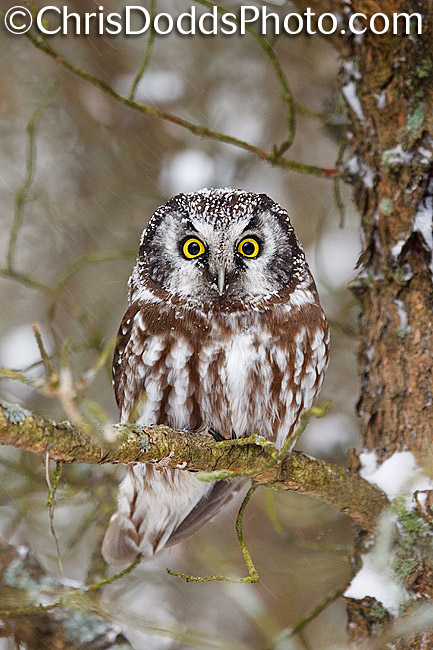
Boreal Owl  or Tengmalm's Owl (Aegolius funereus, Nyctale de Tengmalm) Owl Woods, Amherst Island, Ontario, Canada Image Copyright ©Christopher Dodds  www.chrisdoddsphoto.com All Rights Reserved. Canon EOS 50D, 100-400mm @ 285mm. ISO 400, F5.6 1/80s Manual. Purchase a print or license image for publication HERE.

The thick frost and -5°C temperature during my morning walk through the orchard with T-Bone this morning had me looking foreword to having my snow tires installed and the coming winter owl season.
Last year, I found that having a Canon 50D (with it's 1.6X crop factor) and my Canon 100-400mm zoom lens in a Lowepro Cirrus TLZ 25 Holster Style Case For Digital SLR & Telephoto Zoom Lens (Black) shoulder pouch was the ultimate owl kit to have with me at all times while scouting for roosting Saw-whet owls, Boreal owls, Long-eared owls and short-eared owls. I used to hike through the woods with my pro camera bodies and multiple lenses (including the 500mm F4 IS with matching Tele-converters) packed in my Lowepro Super Trekker. Both Boreal and Saw-whet owls are nocturnal and will probably stay on the same perch for most of the daylight hours, so if I decide I would like images with my 1DsIII and tripod mounted 500mm lens, I have plenty of time to go back to the car and get them. Long-eared and short-eared owls typically flush quite easily, so being ready with my ultimate hand-held rig is key to photographing them. This winter I will use Canon's new 7D with my 100-400mm zoom lens while hiking through the woods and I can't wait!
How do you get an image of a nocturnal owl with it's eyes wide open? - just wait as long as it takes for a birding group (often 10-20 people) to hike right up to you and the owl; there is often a thin layer of ice covering the snow or frozen swampland in the woods that makes quite a racket when that may people approach.

Known in North America as the Boreal Owl, Aegolius funereus, it is also known as Tengmalm's Owl, named after the Swedish naturalist Peter Gustaf Tengmalm.

SOLD: FOR SALE: CANON 1D MARK II

I have a used Canon 1D Mark II (not the 1D Mark IIN) for sale. This has been a much loved and used camera body that has many marks, scratches and little dings. It has been used professionally and it shows. 100% in working order and includes the original box , charger and contents. Also includes an extra battery. CAD$1,000.00 or best offer. Email me if interested: chris@chrisdoddsphoto.com

Comments welcome & appreciated.


Cerulean Dreams

Cerulean Warbler Vertical, Dendroica Cerulea, Paruline Azurée Kingston, Ontario Image Copyright ©Christopher Dodds www.chrisdoddsphoto.com All Rights Reserved. Canon EOS 1DsMKIII, 500mm F4 Lens with 2X II Tele-converter, Tripod & Wimberley Head II. ISO 800, F8, 1/125s Aperture priority (evaluative +2/3), Canon 580EXII Flash ETTL II -3. PURCHASE A PRINT OR LICENSE AN IMAGE FOR PUBLICATION HERE

Cerulean Warbler horizontal, Dendroica Cerulea, Paruline Azurée Kingston, Ontario. Image Copyright ©Christopher Dodds www.chrisdoddsphoto.com All Rights Reserved. Canon EOS 1DsMKIII, 500mm F4 Lens with 2X II Tele-converter, tripod & Wimberley Head II. ISO 800, F8, 1/320s Aperture priority (evaluative +2/3), Canon 580EXII Flash ETTL II -3 PURCHASE A PRINT OR LICENSE AN IMAGE FOR PUBLICATION HERE.

Environment Canada forecast heavy rain all day yesterday, with little chance of bright overcast conditions that would have been conducive to great warbler photography all day long. I decided to venture to the Kingston area of Ontario to give it a try anyway. Worst that could happen is a good birding day without images; sure beats being in the office.
My parents are visiting from Calgary, so I got them up early, loaded into the car and delivered to their friends home in Kingston before most are out of bed (did I mention it was a three hour drive?). From Kingston, I made my way to the Chaffey’s Lock area and spent a few hours in just about perfect photographic conditions. While there weren’t many birds, there certainly were great quality birds. The rain that did fall was light and misty, while it was mostly just dark and overcast. Considered a photographic nemesis bird by many, I had a blast photographing this gorgeous male Cerulean Warbler. I've photographed Cerulean Warblers many times there before, but Queen's University conducts research and most are banded - it was a dream come true to get a nearly perfect male without bands in Ontario. While using the Canon 1DsIII, I strive to keep the ISO under 400; however, there are times when I simply have to use a higher ISO. Properly exposing the image in the camera is the single best way to minimize noise.

The Cerulean Warbler (Dendroica cerulea, Paruline Azurée) gets its name from the vivid blue coloration of the male warbler's back and cheeks that makes this a difficult bird to find in the tree tops, where it lives and nests. Cerulean Warblers are forest-interior birds that require large, relatively undisturbed tracts of mature, semi-open deciduous forest. In Ontario, they are restricted to such habitats in the Carolinian Forest zone and the southern part of the Great Lakes St. Lawrence Forest zone. These birds begin their long migration to wintering grounds in northeastern South America in late summer. A species of special concern both Provincially and Nationally here in Canada, and in the United States, it is considered a species at risk by many. Recent studies suggest its population is only 30% of what it was only 20 short years ago; dropping faster than any other North American Warbler. On the North American breeding grounds, the chief threat to this warbler is habitat loss resulting from forest fragmentation and degradation. On the South American wintering grounds, forested tracts in mountainous regions are preferred, and these areas are considered to be under a high degree of threat from logging. Nest parasitism by the Brown-headed Cowbird (Molothrus ater) may become an increasing problem as cowbird populations increase in degraded forest habitats. The Cerulean Warbler is protected in a Schedule under the federal Migratory Birds Convention Act.

MORE KUDOS:

Point Pelee photography workshop participant, Michael Lyncheski (from Gladstone, NJ) emailed me this testimonial (thanks, Michael):

“I was impressed on how much Chris cared about making sure everyone was learning, engaged, and getting the most out of the trip. I look forward to my next workshop with Chris!”

Los Madrones Ranch - Texas Hill Country

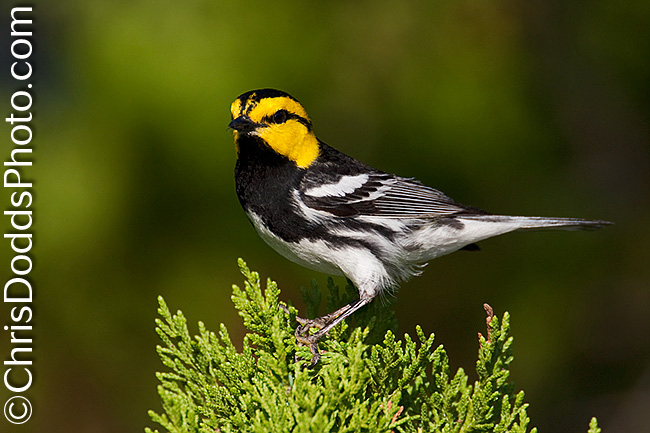
Golden-cheeked Warbler (male) Dendroica chrysoparia (Paruline à dos noir) Los Madrones Ranch (Texas Hill Country), Dripping Springs, Texas. Image Copyright ©Christopher Dodds  www.chrisdoddsphoto.com All Rights Reserved. Canon EOS 1DMKIII, 500mm F4 IS, 2X II Tele-converter, Gitzo 1325 Tripod and Wimberley Head II. ISO 640, F8 1/800s Aperture Priority mode (-1/3 stop).

On Tuesday, April 21 at 03:30 we got an early start and drove the 675 miles to Los Madrones Ranch in Dripping Springs, Texas. After avoiding a collision with a rogue wheel early on, the drive was relatively uneventful. Micheal Murphy greeted us around four o'clock, and showed us around the gorgeous Casita that we will call home until Friday, April 24. We spent the last hours of light photographing Black-Crested Titmouse, Carolina Chickadee and House Finch in prime breeding plumage. We also had some great looks at five great Sparrows (more to follow in another post).

The highlight of the trip so far was when Greg W. Lasley www.greglasley.com (Texas' premier birder) arrived and took us to photograph the endangered Golden-Cheeked Warbler. It was an amazingly productive and satisfying morning.

Special thanks to Greg W. Lasley and to Michael & Julie Murphy @ Los Madrones Ranch. If you are planning a trip to Texas, be sure to look them up www.losmadrones.com (512) 264-1741 

The Golden-cheeked Warbler Dendroica chrysoparia Paruline à dos noir is an endangered species of bird that breeds in Central Texas, from Palo Pinto County southwestward along the eastern and southern edge of the Edwards Plateau to Kinney County. The Golden-cheeked Warbler is the only bird species with a breeding range confined to Texas. Golden-cheeked warblers nest in ashe juniper and live oak trees in ravines and canyons. They use bark and spider webs to build their nests. Females lay three to four eggs. Warblers eat insects and spiders and the adult warbler can reach a length of 4.5 inches. They winter in southern Mexico (Chiapas), Guatemala, Honduras, and Nicaragua. The warbler is endangered as many juniper and oak woodlands have been cleared to build houses, roads, and stores or to grow crops or grass for livestock. Other woodlands were flooded when large lakes were constructed.