Knowledge: The Single Best Way to Improve Your Wildlife Photography

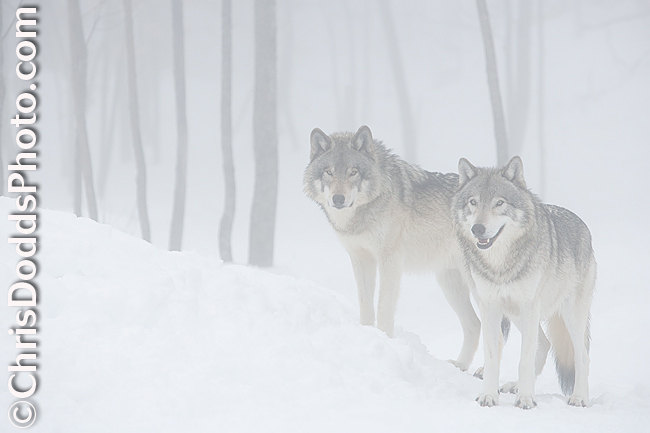
Timber Wolves Alpha Pair in Fog (Grey Wolves, Canis lupus, Loup Gris) Quebec (C) ©Christopher Dodds www.chrisdoddsphoto.com All Rights Reserved. Canon EOS 1DsMKII, 70-200mm F2.8 IS @ 200mm ISO 500, F5.6 1/200s Manual Mode. Hand Held. Full Frame. CLICK HERE TO BUY A PRINT OR LICENSE IMAGE FOR PUBLICATION.

Hearing Timber Wolves (Grey Wolves, Canis lupus, Loup Gris) howl while photographing them on a foggy January mourning was a hair raising experience; their reputation as ferocious enemies of man owes more to fiction and folklore than reality, in fact, they go out of their way to avoid contact with humans. Grey Wolves vary in colour from white on the arctic tundra (Arctic Wolves) to grey (Timber Wolves) or black in the forested regions of Northern wilderness regions. They  travel in packs, working co-operatively to bring down their prey; big game like deer, caribou and moose. Most regard wolves as unbeatable hunters, but they often fail to catch their intended prey. 

If I had to name a single way for anyone to improve their skill at wildlife photography, it would be to know your subject inside and out. I love to read, and I love books, so I was recently thrilled to get my hands on two simply outstanding books. I've caught myself getting lost in the pages of these marvels of the wild world far too often. Essential for the library of any nature photographer (or nature lover), The Princeton Encyclopedia of Birds and The Princeton Encyclopedia of Mammals have become the go to resource when I'm researching a specific species; or simply sitting here daydreaming of my next big adventure to some far corner of the world. Of all the natural history books in my collection, these two stand out amongst the best! ... and they are a bargain!


The Princeton Encyclopedia of Mammals

 (David W. Macdonald ISBN13: 978-0-691-14069-8) is the most comprehensive and accessible reference book on mammals available. Unsurpassed in scope and stunningly illustrated, this book covers every known living species, from aardvarks to zorros. The informative and lively text is written by acclaimed researchers from around the world and features a concise general introduction to mammals followed by detailed accounts of species and groups that systematically describe form, distribution, behavior, status, conservation, and more. There are superb full-color photos and illustrations on virtually every page that show the animals in their natural settings and highlight their typical behaviors. And throughout the book, numerous "Factfile" panels with color distribution maps and scale drawings provide at-a-glance overviews of key data. The Princeton Encyclopedia of Mammals is the definitive one-volume resource--a must-have reference book for naturalists and a delight for general readers.

  • Covers every living mammal
  • Describes form, distribution, behavior, status, conservation, and more
  • Features spectacular full-color photos and illustrations on virtually every page
  • Includes "Factfile" panels with color distribution maps and scale drawings for at-a-glance reference
  • Written by an international team of experts

David W. Macdonald is director of the Wildlife Conservation Research Unit and a fellow of Lady Margaret Hall at the University of Oxford. He is an award-winning documentary filmmaker and the author of several books, including Mammals of Europe (Princeton).

The Princeton Encyclopedia of Birds

 (Christopher Perrins ISBN13: 978-0-691-14070-4) is a comprehensive and lavishly illustrated reference to the world's birds. Accessibly written by renowned biologists and conservationists, and illustrated in color throughout, the book provides authoritative and systematic accounts of every bird family, covering form and function, distribution, diet, social behavior, breeding biology, and conservation and status. More than 1,000 superb color photos reveal the enormous diversity of birds in their natural habitats, from arctic tundra to tropical rain forest, and a wealth of beautifully detailed color and line illustrations depict representative species from each family and highlight characteristic behaviors. The main articles are complemented by detailed coverage of special topics, such as how ibises and spoonbills feed by touch, how pigeons find their way home, and how crows store food. And throughout the book, numerous "Factfile" panels with color distribution maps and scale drawings provide at-a-glance overviews of key data. The Princeton Encyclopedia of Birds is the definitive one-volume reference--an essential guide for amateur bird enthusiasts and professional ornithologists alike.

  • Covers all the bird families of the world
  • Describes form and function, distribution, diet, social behavior, breeding biology, and conservation and status
  • Features more than 1,000 spectacular color photos and illustrations
  • Includes "Factfile" panels with color distribution maps and scale drawings for at-a-glance reference
  • Explores special topics in depth
  • Written by leading biologists and conservationists

Christopher Perrins is a distinguished ornithologist, the author of many popular and scholarly books on birds, and a fellow of the Royal Society. A former professor of ornithology at the University of Oxford and former director of the Edward Grey Institute of Field Ornithology, he is currently a fellow of Wolfson College, Oxford.
Comments welcome & appreciated.

National Geographic Traveller rates Gaspé #3 Best-Rated Travel Destination in the world

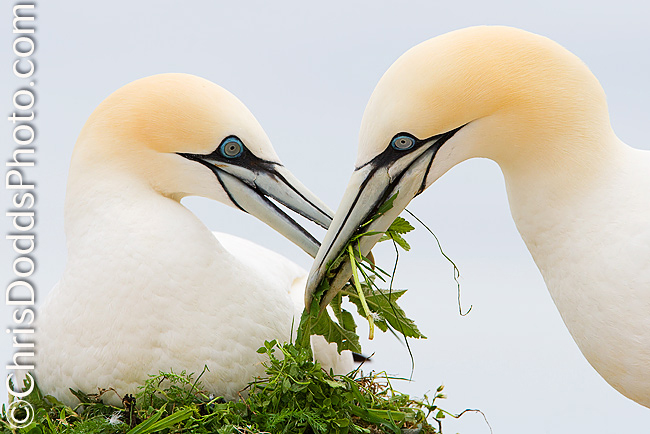
Northern Gannets LOVE, Morus Bassanus, Fou de Bassan Bonaventure Island, Quebec ©Christopher Dodds www.chrisdoddsphoto.com All Rights Reserved. Canon EOS 1DsMKII, 300mm F2.8 and 1.4XII Tele-converter  ISO 250, F8 1/800s Manual. CLICK HERE TO PURCHASE A PRINT or LICENSE AN IMAGE FOR PUBLICATION.

National Geographic Traveler Magazine rates Gaspé number 3 destination in the world:

Subject to development, mass tourism, pollution, globalization - are the world's great places still...great? Jay Walljasper writes on page 50 of the November / December 2009 edition of National Geographic Traveler Magazine, Gaspé ranks # 3 in the world - Congratulations Gaspé!
jutting into the Gulf of St. Lawrence, the colorful Gaspé Peninsula  offers "oceanfront, islands, and inland mountains" within "excellent parks and reserves," along with "authentic Francophone" villages. A big part of the area's appeal is "tourism development largely on a human scale." READ MORE HERE

Click HERE for more information on the Gannets of Bonaventure Island Photo Safari at The Parc National de l'Île-Bonaventure-et-du-Rocher-Percé and my very favorite bird photography location on planet Earth!

Testimonial

"I just returned from attending my first workshop, my first time in “the Gaspé” and my first experience with shooting birds in flight and I thought I’d share a bit about the experience…

The workshop was given by Christopher Dodds who is often referred to as one of the very best nature photographers in Canada. We were going to spend three days shooting Gannets on L’Ile Bonaventure, Québec (about 30 minutes off the Percé harbour and close to the famous Percé Rock). The Island is a protected habitat for Gannets and access to the Island is only allowed when the Parks Canada staff are there from about 9am to 5pm.

It’s a long uphill climb from the wharf to the top where the birds are, and Park staff say most people take about 45 minutes to an hour. Chris and I made it in about 30 minutes the first day (and got it down to about 25 minutes the following days but if he wanted to, I’m sure Chris could do it in 15!). We could hear the Gannets long before we got to the top and the first view of them – literally thousands and thousands of them – was breathtaking. The unofficial current estimate is at over 500,000 Gannets, now making this the largest colony in the world!

I can't speak highly enough about the experience of shooting with Chris Dodds. Chris is absolutely amazing. He's got tremendous experience and a great eye. The whole experience was way better than my expectations. He’s a far better photographer and workshop leader than I expected. Not only does he produce incredible work, he has the technical knowledge and experience to make this a really worthwhile learning experience. And he gives what is truly a “workshop”, in that he gives constant tips and coaching to make sure all participants are learning (no matter what their experience is or how stubborn and set in their ways they might be – like myself). He doesn’t just lead you to a subject (as many other workshops do), but he gives all the technical support and training you could wish for; he makes sure you are learning the photo techniques needed to improve. Chris and I knocked heads quite a bit those first days (he was right – I was wrong) as he stuck with trying to get me to improve and get out of my comfortable rut.

I liked those three days (and the one pre-workshop day) so much that I decided to stay for a second three-day workshop and luckily Chris still had a spot available. Not only that, but I’m certainly going to return to shoot those Gannets again, hopefully with Chris. In fact I’d love to take any workshop Chris was leading.

We were shooting ALL day... from the time we got to the top until we had to leave. There was absolutely no shortage of birds or birds in flight and that's unlike any other avian photography venue in the world from what everyone was saying. Elsewhere you only have a few hours to shoot and then the birds are gone. We were always the first ones on the Island (with the Park staff) and the last ones to leave (again with the staff).

Chris is so well known there (and so highly regarded) that he and his group were certainly given privileges and access that someone on their own wouldn't get. If (I should say when) I do this again, I'm going to do it with Chris on one of his workshops.

And with Chris, everything was organized for us including lunches; access and transportation to the island, accommodations and of course the great training. I wouldn't do it any other way.

Believe me, if you took such a workshop with Chris you wouldn't regret it! And his repeat clients (of which there were many in both the 3-day workshops I attended) had nothing but raves for him.

An absolutely fabulous time!
"

Eldor Gemst | Montreal | QC | Canada

Comments welcome & appreciated.


Social Media Sites Strip Embedded metadata; Another Reason for Bold Watermarks!

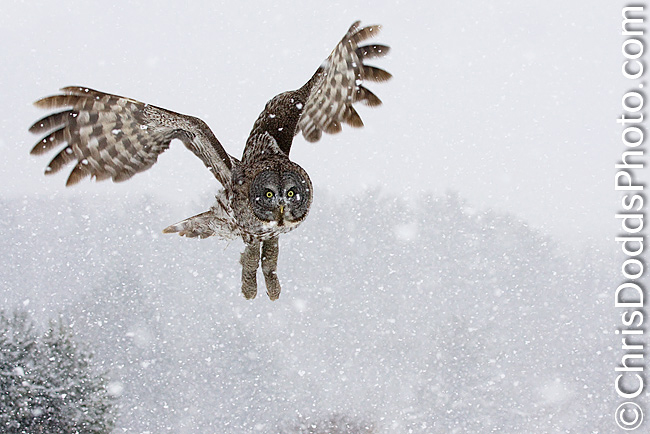
 Great Grey Owl Blizzard in White (Strix nebulosa Chouette Lapone) January 2005 Bracebridge, Ontario, Canada ©Christopher Dodds http://www.chrisdoddsphoto.com All Rights Reserved. Canon EOS 1D Mark II, 100-400mm @ 100mm. ISO 400, F6.3 1/800s Manual Exposure. Full Frame. CLICK HERE TO PURCHASE A PRINT or LICENSE AN IMAGE FOR PUBLICATION.

Technology & Art; get it out of the middle

Modern digital cameras are tools jam packed with not-so-often used features; remember to use focus selection points other than the centre - it makes for much more pleasing photographs. As amazing as it was for photography, the Great Grey Owl invasion during the winter of 2004-2005 was an amazing time for friendships. I had a great time in Bracebridge, Ontario with a great friend who continues to inspire me today.

The American Society of Media Photographers has released a report called "Best Practice Recommendations for Social Networking Sites" by Christopher J. Reese, Esq. Well written, this is must read for anyone posting images to the internet (amateur or professional): READ HERE

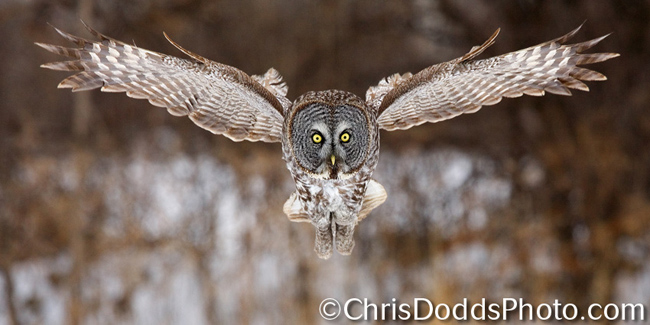
Great Grey Owl WIngs Wide Open (Strix nebulosa Chouette Lapone) December 2004 L'Île-Bizard, Quebec, Canada ©Christopher Dodds http://www.chrisdoddsphoto.com All Rights Reserved. Canon EOS 1D Mark II, 100-400mm @ 300mm. ISO 400, F6.3 1/640s Manual Exposure. Full Frame.

Recent infringements:

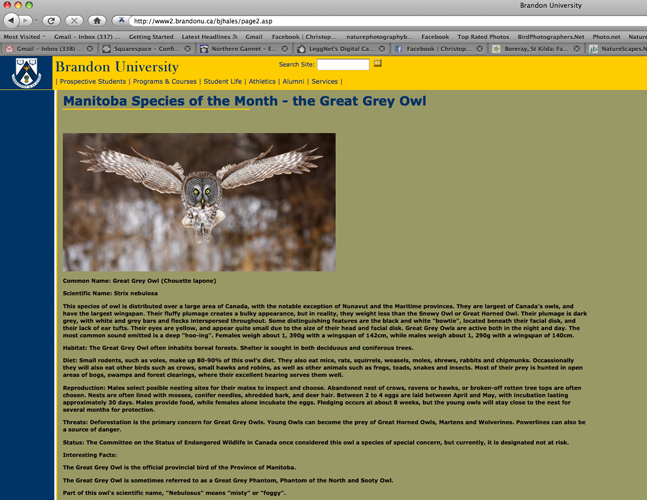
I am actively monitoring my image use, abuse and copyright infringements in an effort to keep you up-to date with infringements and resolutions. Here's an image of mine, stripped of it's metadata, and the copyright watermark was removed. While I'm flattered that they used my image, they should have asked & given credit! While the communications officer had agreed to replace the image with one that I provided with metadata and copyright watermark, they decided to remove the content instead.  From his last email to me: "I did some further digging to determine who looked after the site, and to put them in contact with you for other photos. That particular page and  site were run by a museum housed on campus but that museum is no longer at the university. We've removed the content, so your photo will no longer be on the BU website. I was unable to find a contact for the current curator of the museum, so I'm unable to pass along your information. Once again, sorry for the obtrusion."

I'm not against my images being used in high profile educational environments, but come on: It's about time that Universities and the Minister of Education audits image use on University websites! For crying out loud, these are the very institutions that educate our next generation of lawyers & scholars and they should set the example! I'm curious about Brandon University's view on plagiarism.

If anyone does know how to get in touch with the museum, please send me an email.

Comments welcome & appreciated.


Photographing the Ross's Geese of Bosque del Apache National Wildlife Refuge and kudos

Ross's Goose (Chen rossii, Oie de Ross) Bosque del Apache National Wildlife Refuge, New Mexico, USA ©Christopher Dodds http://www.chrisdoddsphoto.com All Rights Reserved. Canon EOS 1Ds Mark III, 500mm F4 IS, 2X II Tele-converter, Gitzo tripod and Wimberley Head II. ISO 250, F8 1/1000s Manual Exposure. Full Frame. CLICK HERE TO BUY A PRINT OR LICENSE IMAGE FOR PUBLICATION.

Pro Tip:

I worked very hard at capturing the above full frame image of a Ross’s Goose in it’s recognizable environment while visiting Bosque del Apache National Wildlife Refuge in New Mexico last fall. I worked equally hard to get the image of a Ross’s Goose against a blue sky for my stock files. Having the blue-sky flight image in my stock photography files ensures sales to regional publications outside of that recognizable habitat of high desert mountain.

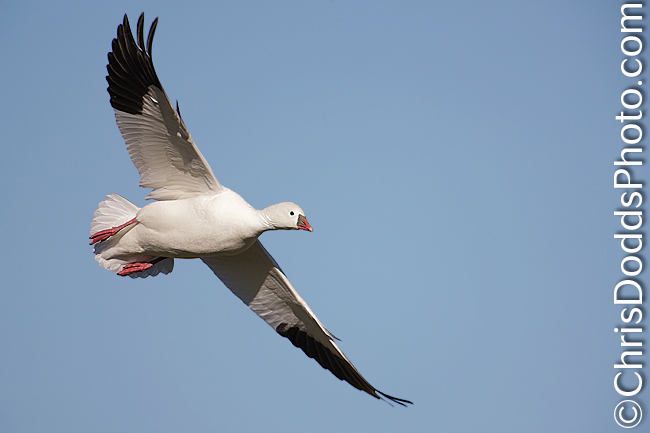
Ross's Goose (Chen rossii, Oie de Ross) Bosque del Apache National Wildlife Refuge, New Mexico, USA ©Christopher Dodds http://www.chrisdoddsphoto.com All Rights Reserved. Canon EOS 1Ds Mark III, 500mm F4 IS, 2X II Tele-converter, Gitzo tripod and Wimberley Head II. ISO 250, F8 1/1250s Manual Exposure. Full Frame. CLICK HERE TO BUY A PRINT OR LICENSE IMAGE FOR PUBLICATION.

Ross’s Goose facts:

A tiny goose with black wingtips, the Ross’s Goose (Chen rossii, Oie de Ross) is about 40% smaller than the more abundant white phase Snow Goose. The Snow Goose is larger and has a larger bill without the greenish base and has a black grin patch along it’s bill edge (black “lips”). It breeds in the central Arctic and winters primarily in central California, but it is becoming more frequent farther east. It is named in honor of Bernard R. Ross, a Hudson’s Bay Company factor at Fort Resolution in Canada’s Northwest Territories.

Kudos

After viewing your two excellent Nature presentations in the last year at our camera club, I have come to conclude that you are in that top echelon of truly outstanding nature photographers, creating art - rather than just photographs. When I see your presentations, I keep saying under my breath... AMAZING!
Best regards,
Frederic Hore,
Past Nature Chair,
Lakeshore Camera Club
Pointe Claire, Quebec, Canada

Thanks again for your superb presentation yesterday evening.  Your images are fantastic and you are definitively an inspiration for a lot bird photographers like myself.
Cheers,
Pierre Giard
Nature Chair
Lakeshore Camera Club
Pointe Claire, Quebec, Canada

Comments welcome & appreciated.

The Screaming Eagle & when not to use flash

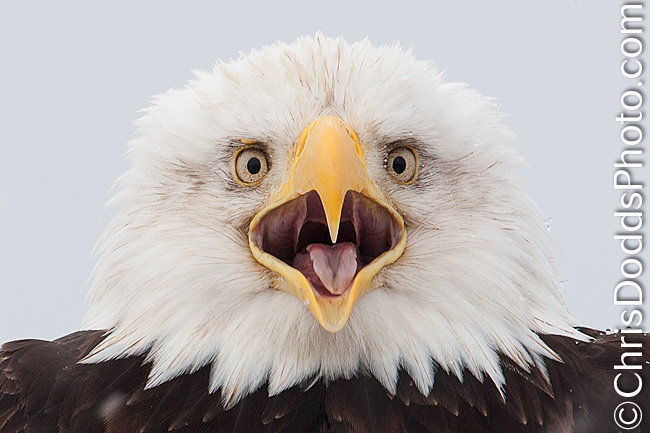
Bald Eagle (Haliaeetus leucocephalus Pygarge à tête blanche) Homer Alaska, USA. ©Christopher Dodds http://www.chrisdoddsphoto.com All Rights Reserved. Canon EOS 1Ds Mark III, 500mm F4 IS, 2X II Tele-converter,1.4X II Tele-converter, Gitzo tripod and Wimberley Head II. ISO 640, F20 1/80s Manual Exposure and Manual Focus. Full Frame. Click HERE to order a print or license image for publication.

I have been to Alaska to photograph Bald Eagles many times, and always wish for golden light during the first, and last, hour of light. It's often cloudy when I'm there, and my flash is always mounted and ready to go. Typically I would use some light fill flash on heavily overcast days; even when this bird looked to the side I used fill flash. The thing is, I was looking for a perfectly framed, tight portrait of a screaming eagle; and I wanted to see straight down it's throat without any shadows. The single best time to get this shot was during a snowstorm when the clouds and snow diffuse the natural light and bounce it around creating a virtually shadowless world.  It was hovering around freezing and the snow was changing to rain (as we'd endured for a couple of days). I saw this eagle singing and decided to dedicate some time to this shot. So, why no flash? Simple, It would have created a shadow from the front part of it's beak that is hooked downward.

Comments welcome & appreciated.


Northern Harrier & " Stressful Jobs that Pay Badly"

Northern Harrier   (Circus cyaneus, Busard Saint-Martin) Bosque del Apache National Wildlife Refuge, New Mexico, USA ©Christopher Dodds All Rights Reserved. Canon EOS 1Ds Mark III, 500mm F4 IS, 2X II Tele-converter, Canon 580 EXII Flash with Better Beamer, Gitzo tripod and Wimberley Head II  ISO 400, F8 1/800s Manual Mode. Full Frame. Click HERE to order a print or license image for publication.

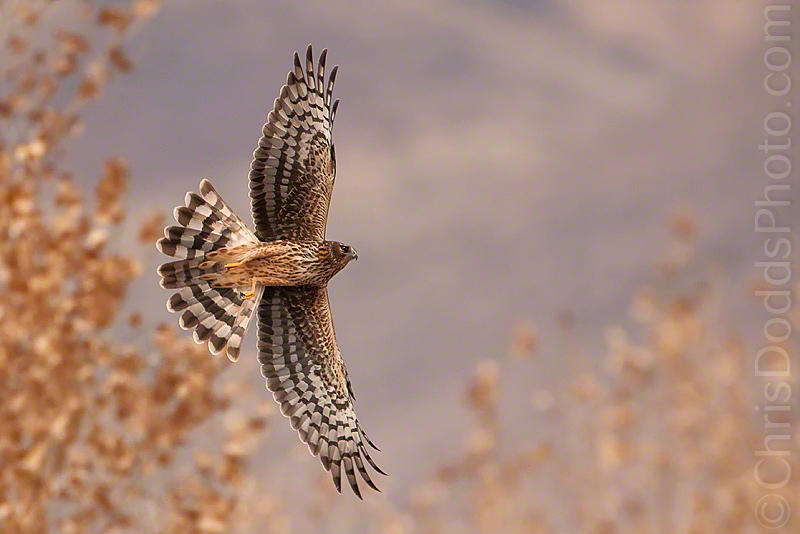
Northern Harriers have owl-like facial disks to help with directional hearing; unusual among hawks, they use their sense of hearing to locate prey.

This article from CNNMoney.com caught my eye when someone posted a link to it on FaceBook. They forgot to mention that no matter what your area of expertise, there is always a pile of people who don't depend on photography to earn their living; and those people will all do the job for 1/10 the price, or even free. I remember when I used to charge $5,000.00 for a wedding and there were always another ten "photographers" charging $500.00; you do get what you pay for. Most people think that the life of a professional photographer is glamorous and well paying....Sigh, smile.

Click on the image to go directly to the CNN article.


Comments welcome & appreciated.


Photographing the Pied-billed Grebe: light illuminates - shadows define

Pied-billed Grebe Reflection (Podilymbus podiceps, Grèbe à bec bigarré) Bosque del Apache National Wildlife Refuge, New Mexico, USA ©Christopher Dodds  www.chrisdoddsphoto.com All Rights Reserved. Canon EOS 1Ds Mark III, 500mm F4 IS, 2X II Tele-converter, Gitzo tripod and Wimberley Head II from VW Westfalia (thanks  Ethan). ISO 250, F16 1/320s Manual Mode. Full Frame. Click HERE to purchase a print or license image for publication.

Light Illuminates - Shadows Define

Though many try to take the credit for saying it, it was Howard Pyle who said, "Light illuminates texture and color - shadows define form" - though he was referring to painting, the same holds true for photography. Light is an incredibly important part of photography. Out in the field, or in the studio; it's quality, quantity and direction are all very important components in your final image. Many nature photographers advocate pointing your shadow directly at your subject, resulting in a direct, flat, frontal light source (the sun). While that is a good starting point, I strive to get my light source (the sun in this case) off to one side. As you can see in this image of a Pied-billed Grebe, the sun is off to my far right. The resulting image is full of light and shadow, creating a dramatic, detail rich image; every wet feather on the back of its neck is accentuated by both light and shadow. This method works incredibly well for white birds like Snowy Owls, that have a hollow feather structure.

The Bigger Pictures:

As promised when I started this Nature Photography Blog, I have been messing around with image sizes and page format. I do hope you like the new, bigger pictures and will try to get all of the older posts updatesd soon. Leave a comment to let me know how you like the new format.

Pied-billed Grebe facts:

Nicknamed dabchick, devil-diver, hell-diver and water witch, the Pied-billed Grebe, Podilymbus podiceps, feeds on fish (carp catfish & eels), insects (dragonflies, ants & beetles) and amphibians (frogs & tadpoles).
The most widespread of the North American Grebes, it is often found on remote ponds and marshes of Canada, parts of the United States and temperate South America. Preferring to escape danger by diving, this Grebe rarely flies.
Instead of having webbed feet like ducks, Pied-billed Grebes have lobes extending out the sides of it's toes to provide extra surface area for paddling.

Comments welcome & appreciated.


Photographing the Boreal Owl & Ultimate Owl Camera Kit

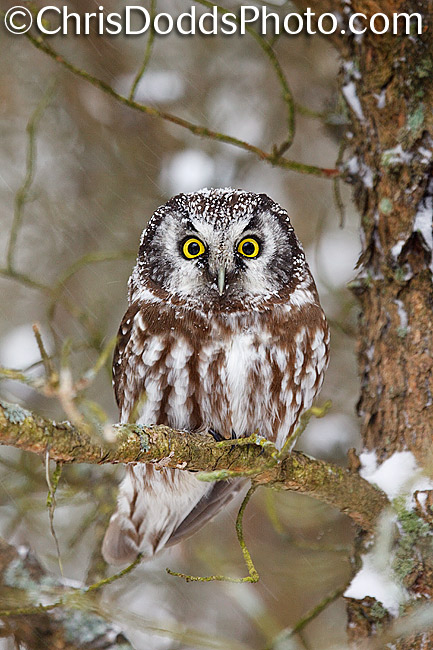
Boreal Owl  or Tengmalm's Owl (Aegolius funereus, Nyctale de Tengmalm) Owl Woods, Amherst Island, Ontario, Canada Image Copyright ©Christopher Dodds  www.chrisdoddsphoto.com All Rights Reserved. Canon EOS 50D, 100-400mm @ 285mm. ISO 400, F5.6 1/80s Manual. Purchase a print or license image for publication HERE.

The thick frost and -5°C temperature during my morning walk through the orchard with T-Bone this morning had me looking foreword to having my snow tires installed and the coming winter owl season.
Last year, I found that having a Canon 50D (with it's 1.6X crop factor) and my Canon 100-400mm zoom lens in a Lowepro Cirrus TLZ 25 Holster Style Case For Digital SLR & Telephoto Zoom Lens (Black) shoulder pouch was the ultimate owl kit to have with me at all times while scouting for roosting Saw-whet owls, Boreal owls, Long-eared owls and short-eared owls. I used to hike through the woods with my pro camera bodies and multiple lenses (including the 500mm F4 IS with matching Tele-converters) packed in my Lowepro Super Trekker. Both Boreal and Saw-whet owls are nocturnal and will probably stay on the same perch for most of the daylight hours, so if I decide I would like images with my 1DsIII and tripod mounted 500mm lens, I have plenty of time to go back to the car and get them. Long-eared and short-eared owls typically flush quite easily, so being ready with my ultimate hand-held rig is key to photographing them. This winter I will use Canon's new 7D with my 100-400mm zoom lens while hiking through the woods and I can't wait!
How do you get an image of a nocturnal owl with it's eyes wide open? - just wait as long as it takes for a birding group (often 10-20 people) to hike right up to you and the owl; there is often a thin layer of ice covering the snow or frozen swampland in the woods that makes quite a racket when that may people approach.

Known in North America as the Boreal Owl, Aegolius funereus, it is also known as Tengmalm's Owl, named after the Swedish naturalist Peter Gustaf Tengmalm.

SOLD: FOR SALE: CANON 1D MARK II

I have a used Canon 1D Mark II (not the 1D Mark IIN) for sale. This has been a much loved and used camera body that has many marks, scratches and little dings. It has been used professionally and it shows. 100% in working order and includes the original box , charger and contents. Also includes an extra battery. CAD$1,000.00 or best offer. Email me if interested: chris@chrisdoddsphoto.com

Comments welcome & appreciated.


Cerulean Dreams

Cerulean Warbler Vertical, Dendroica Cerulea, Paruline Azurée Kingston, Ontario Image Copyright ©Christopher Dodds www.chrisdoddsphoto.com All Rights Reserved. Canon EOS 1DsMKIII, 500mm F4 Lens with 2X II Tele-converter, Tripod & Wimberley Head II. ISO 800, F8, 1/125s Aperture priority (evaluative +2/3), Canon 580EXII Flash ETTL II -3. PURCHASE A PRINT OR LICENSE AN IMAGE FOR PUBLICATION HERE

Cerulean Warbler horizontal, Dendroica Cerulea, Paruline Azurée Kingston, Ontario. Image Copyright ©Christopher Dodds www.chrisdoddsphoto.com All Rights Reserved. Canon EOS 1DsMKIII, 500mm F4 Lens with 2X II Tele-converter, tripod & Wimberley Head II. ISO 800, F8, 1/320s Aperture priority (evaluative +2/3), Canon 580EXII Flash ETTL II -3 PURCHASE A PRINT OR LICENSE AN IMAGE FOR PUBLICATION HERE.

Environment Canada forecast heavy rain all day yesterday, with little chance of bright overcast conditions that would have been conducive to great warbler photography all day long. I decided to venture to the Kingston area of Ontario to give it a try anyway. Worst that could happen is a good birding day without images; sure beats being in the office.
My parents are visiting from Calgary, so I got them up early, loaded into the car and delivered to their friends home in Kingston before most are out of bed (did I mention it was a three hour drive?). From Kingston, I made my way to the Chaffey’s Lock area and spent a few hours in just about perfect photographic conditions. While there weren’t many birds, there certainly were great quality birds. The rain that did fall was light and misty, while it was mostly just dark and overcast. Considered a photographic nemesis bird by many, I had a blast photographing this gorgeous male Cerulean Warbler. I've photographed Cerulean Warblers many times there before, but Queen's University conducts research and most are banded - it was a dream come true to get a nearly perfect male without bands in Ontario. While using the Canon 1DsIII, I strive to keep the ISO under 400; however, there are times when I simply have to use a higher ISO. Properly exposing the image in the camera is the single best way to minimize noise.

The Cerulean Warbler (Dendroica cerulea, Paruline Azurée) gets its name from the vivid blue coloration of the male warbler's back and cheeks that makes this a difficult bird to find in the tree tops, where it lives and nests. Cerulean Warblers are forest-interior birds that require large, relatively undisturbed tracts of mature, semi-open deciduous forest. In Ontario, they are restricted to such habitats in the Carolinian Forest zone and the southern part of the Great Lakes St. Lawrence Forest zone. These birds begin their long migration to wintering grounds in northeastern South America in late summer. A species of special concern both Provincially and Nationally here in Canada, and in the United States, it is considered a species at risk by many. Recent studies suggest its population is only 30% of what it was only 20 short years ago; dropping faster than any other North American Warbler. On the North American breeding grounds, the chief threat to this warbler is habitat loss resulting from forest fragmentation and degradation. On the South American wintering grounds, forested tracts in mountainous regions are preferred, and these areas are considered to be under a high degree of threat from logging. Nest parasitism by the Brown-headed Cowbird (Molothrus ater) may become an increasing problem as cowbird populations increase in degraded forest habitats. The Cerulean Warbler is protected in a Schedule under the federal Migratory Birds Convention Act.

MORE KUDOS:

Point Pelee photography workshop participant, Michael Lyncheski (from Gladstone, NJ) emailed me this testimonial (thanks, Michael):

“I was impressed on how much Chris cared about making sure everyone was learning, engaged, and getting the most out of the trip. I look forward to my next workshop with Chris!”

Los Madrones Ranch - Texas Hill Country

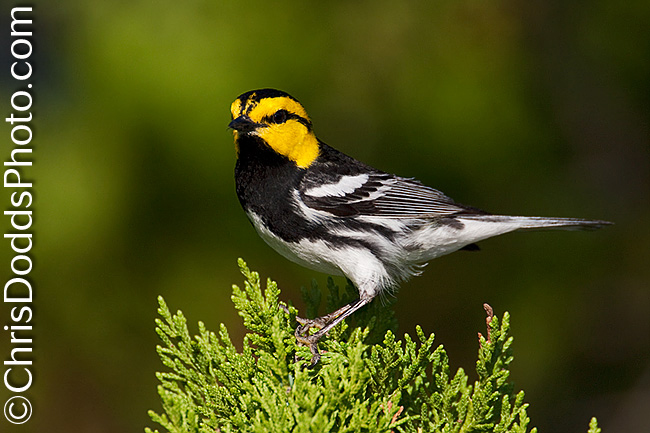
Golden-cheeked Warbler (male) Dendroica chrysoparia (Paruline à dos noir) Los Madrones Ranch (Texas Hill Country), Dripping Springs, Texas. Image Copyright ©Christopher Dodds  www.chrisdoddsphoto.com All Rights Reserved. Canon EOS 1DMKIII, 500mm F4 IS, 2X II Tele-converter, Gitzo 1325 Tripod and Wimberley Head II. ISO 640, F8 1/800s Aperture Priority mode (-1/3 stop).

On Tuesday, April 21 at 03:30 we got an early start and drove the 675 miles to Los Madrones Ranch in Dripping Springs, Texas. After avoiding a collision with a rogue wheel early on, the drive was relatively uneventful. Micheal Murphy greeted us around four o'clock, and showed us around the gorgeous Casita that we will call home until Friday, April 24. We spent the last hours of light photographing Black-Crested Titmouse, Carolina Chickadee and House Finch in prime breeding plumage. We also had some great looks at five great Sparrows (more to follow in another post).

The highlight of the trip so far was when Greg W. Lasley www.greglasley.com (Texas' premier birder) arrived and took us to photograph the endangered Golden-Cheeked Warbler. It was an amazingly productive and satisfying morning.

Special thanks to Greg W. Lasley and to Michael & Julie Murphy @ Los Madrones Ranch. If you are planning a trip to Texas, be sure to look them up www.losmadrones.com (512) 264-1741 

The Golden-cheeked Warbler Dendroica chrysoparia Paruline à dos noir is an endangered species of bird that breeds in Central Texas, from Palo Pinto County southwestward along the eastern and southern edge of the Edwards Plateau to Kinney County. The Golden-cheeked Warbler is the only bird species with a breeding range confined to Texas. Golden-cheeked warblers nest in ashe juniper and live oak trees in ravines and canyons. They use bark and spider webs to build their nests. Females lay three to four eggs. Warblers eat insects and spiders and the adult warbler can reach a length of 4.5 inches. They winter in southern Mexico (Chiapas), Guatemala, Honduras, and Nicaragua. The warbler is endangered as many juniper and oak woodlands have been cleared to build houses, roads, and stores or to grow crops or grass for livestock. Other woodlands were flooded when large lakes were constructed.