
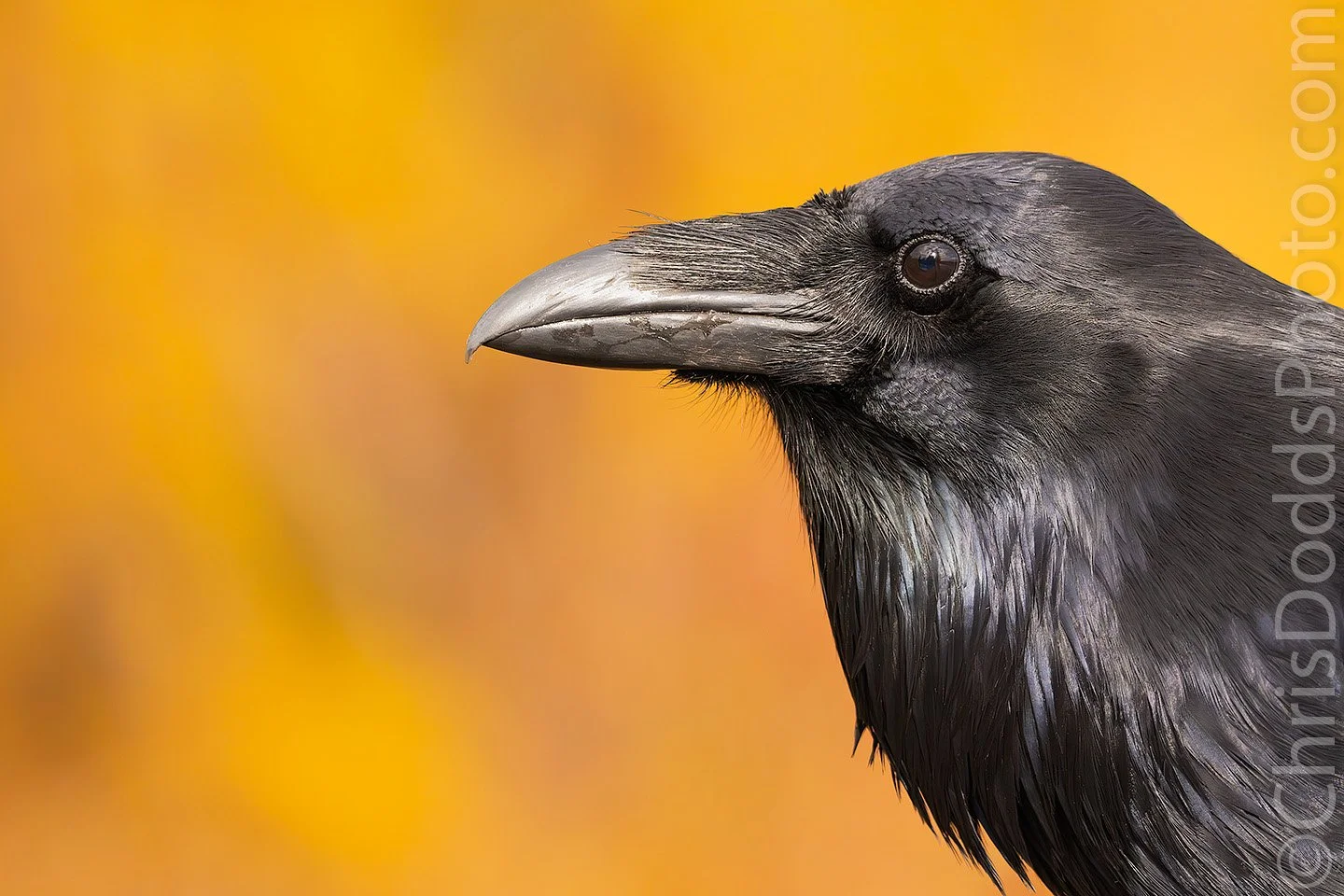
Raven Intelligence in Autumn Gold
Photographing One of the Most Remarkable Birds in the North
There are birds you photograph… and then there are birds that seem to photograph you back.
The Common Raven falls firmly into the second category.
While exploring the forests of Northern Ontario last autumn, the landscape was alive with deep golds and warm amber tones. The birches and poplars had turned the forest into a glowing canvas, and against that background a raven landed nearby — calm, watchful, and intensely aware of everything around it.
Ravens have a presence that is hard to describe until you experience it. They are among the most intelligent birds on the planet, capable of complex problem-solving, playful behaviour, and even recognizing individual human faces. When one looks directly at you, there is a moment where it genuinely feels like you are being studied.
This individual gave me exactly that feeling.
Rather than chasing flight shots or action, I decided to slow down and focus on a portrait — something that really revealed the bird’s character. With the rich autumn colours behind it, the raven’s glossy black feathers provide a striking contrast, but they also present a technical challenge for many photographers who don’t fully understand exposure theory.
Black birds are notoriously difficult to expose properly.
Getting the Exposure Right
When photographing dark plumage, the biggest mistake is relying too heavily on lifting shadows later in post-processing. If the exposure is even slightly under in camera, recovering those deep blacks can introduce noise and destroy the subtle feather detail that gives the bird its texture and depth.
This image was captured with the Sony A1 II and the Sony 400–800mm lens, a combination that provides incredible reach and resolution while maintaining exceptional feather detail.
With ravens in particular, the key is to protect detail in the blacks while still maintaining a natural look. Their feathers are not truly “black” — they contain subtle tonal variation, layered textures, and sometimes even hints of iridescence. If the exposure is too dark, all of that disappears into a flat silhouette.
How to Photograph Black Birds
Photographing black birds such as ravens, crows, grackles, or blackbirds can be surprisingly challenging. The deep tones in their feathers can easily fool a camera’s meter into underexposing the image, causing the plumage to lose detail and appear flat or muddy.
One technique I often use when photographing black birds is spot metering directly from the darkest part of the bird’s plumage. When doing this, the correct exposure typically occurs when the meter reads approximately –1⅔ stops, since black subjects reflect roughly 1⅔ stops less light than a midtone.
The easiest way to dial this in with your camera set to manual exposure mode is to adjust your exposure in a logical sequence.
First, choose your aperture based on the depth of field you want.
Next, set your shutter speed fast enough to stop any unexpected movement.
Finally, adjust the ISO.
In many cases, raising the ISO slightly to intentionally brighten the blacks during capture helps ensure the feathers are recorded with enough light to preserve their structure and texture. This allows the camera to capture far more detail while reducing the need to push shadows later in post-processing, where noise most often appears.
At the same time, it’s important to monitor your histogram and highlight alerts to ensure that brighter areas — such as the bill or reflective feather edges — are not clipping.
Getting the exposure right in the camera is always the goal.
When done correctly, black feathers reveal beautiful texture, subtle tonal variation, and even a slight sheen that gives the bird depth and life in the photograph.
The Quiet Magic of Ravens
What I love most about this image is the calm intensity of the bird. Ravens have a presence that feels almost mythical — something many northern cultures have recognized for centuries. They are playful, mischievous, brilliant problem solvers, and endlessly curious.
Standing there with this raven only a short distance away, it felt less like photographing wildlife and more like sharing a moment with another intelligence.
The bird watched me carefully for several seconds, tilting its head slightly as if trying to understand what I was doing.
Then, just as quietly as it arrived, it lifted off and disappeared back into the forest.
Moments like that are part of what makes wildlife photography so addictive.
You’re not just documenting nature.
You’re interacting with it.
And sometimes, if you’re lucky, the bird lets you see a little bit of its personality.
Moments like this are exactly why I love leading photography workshops. Spending time in the field, watching wildlife behaviour unfold, and learning how to capture those moments with the right exposure and technique is something that can’t really be taught in a classroom.
Join Me In The Field
If you’d like to experience moments like this yourself, consider joining one of my upcoming wildlife photography workshops. Whether it’s photographing owls in winter, songbirds at Point Pelee, Ospreys in Florida, or puffins along the Atlantic coast, the goal is always the same — helping photographers learn to see light, understand exposure, and capture meaningful images in the natural world.
You can see the full list of upcoming workshops here:
www.naturephotographyblog.com