
When most people think of Alaska's Katmai Coast, they picture close encounters with coastal brown bears. So do I. That's why I return year after year.
But one of the lessons wildlife photography has taught me over more than forty years is that you should never develop tunnel vision. If all you're looking for is a bear close enough to fill the frame, you can miss the bigger story unfolding around you.
On this morning at Hallo Bay, the bears were scattered across the vast sedge meadows, and none were particularly close. Rather than waiting for one to wander within range of a telephoto lens, I put the long glass away and looked at the landscape instead.
For this trip, I also brought the new Hasselblad X2D II 100C along with the exceptional XCD 20–35mm E and XCD 35–100mm E zoom lenses. My Sony system remained my primary wildlife kit—and it will continue to be—but when the opportunity presented itself to photograph the landscape rather than a close-up bear, the Hasselblad was the perfect tool for the job.
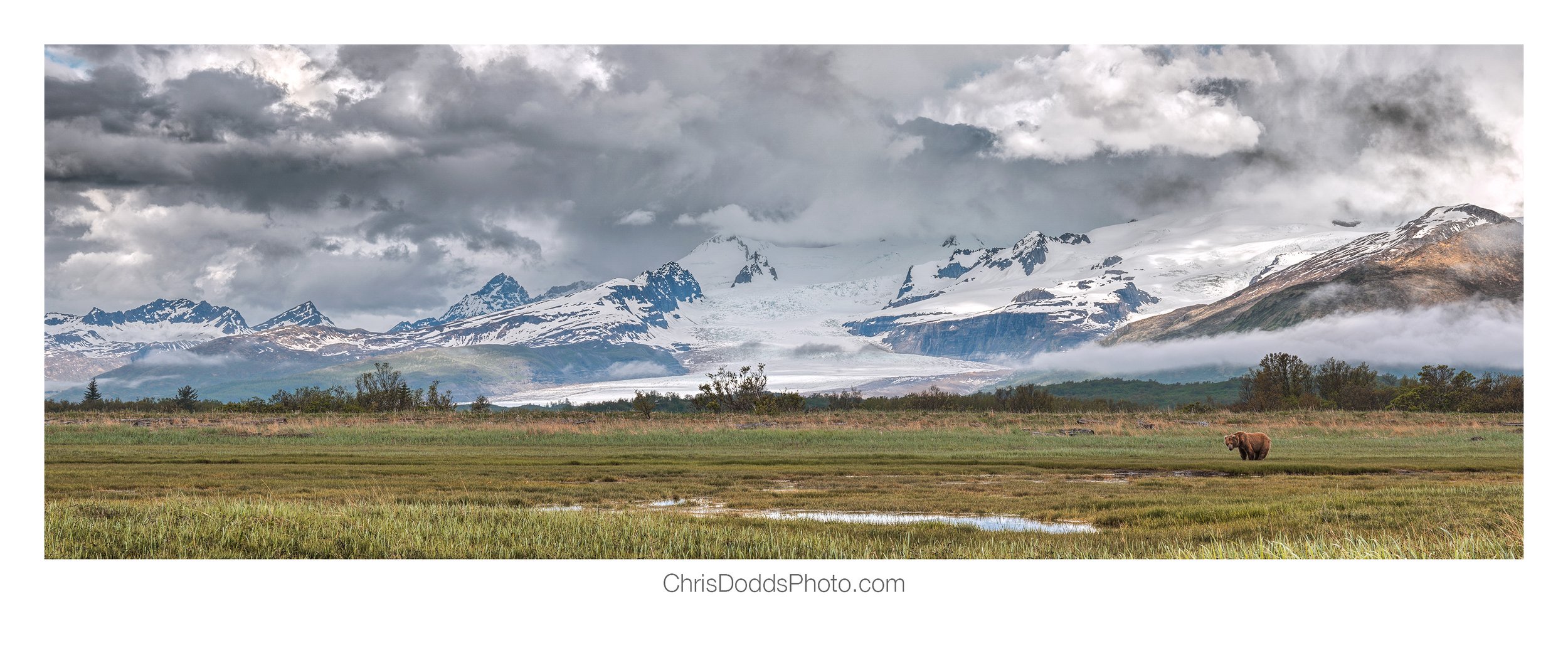
This image was photographed with the XCD 35–100mm E set to 75mm (approximately 59mm full-frame equivalent) at ISO 50, f/20 and 1/13 second. What makes that remarkable is that it was captured handheld while I was intentionally testing the camera's image stabilization. The results left me genuinely impressed and gave me the confidence to work at shutter speeds I normally wouldn't consider for a medium format camera.
The scene looks across Hallo Bay toward Douglas Glacier, flowing from the slopes of Mount Douglas in the Aleutian Range. Fresh snow clings to the volcanic peaks while heavy storm clouds drift overhead, periodically opening to allow shafts of sunlight to illuminate the glacier and surrounding mountains. A winding tidal channel leads your eye through the expansive sedge meadow to a solitary coastal brown bear quietly grazing in the distance.
The bear is intentionally small.
It isn't meant to dominate the photograph. Instead, it provides scale. Without it, the landscape would still be beautiful, but you wouldn't fully appreciate just how immense and wild this place really is. That single bear transforms the photograph into a portrait of one of North America's last great wildernesses.
One of the things I've enjoyed most about adding the Hasselblad system alongside my Sony wildlife kit is how naturally it encourages this style of photography. The remarkable 100-megapixel sensor captures extraordinary detail, while the XCD lenses render subtle tonal transitions with a beautifully natural look. Combined with surprisingly effective image stabilization, it invites you to slow down, think carefully about composition and create photographs that tell a story rather than simply document a subject.
As wildlife photographers, we naturally celebrate those unforgettable close encounters. They're exciting, dramatic and often become our favourite images. But sometimes the photograph that stays with you isn't the closest bear or the biggest eagle.
Sometimes it's the one that reminds you why these wild places matter in the first place.
Support Nature Photography Blog
If you enjoy the photographs, stories and free photography articles I share here, I'd appreciate your support. Purchasing through the affiliate links below costs you nothing extra, but it helps offset the considerable time and expense of travelling to wild places, creating new content and maintaining this site—all without subscriptions or paywalls.
Thank you for helping keep Nature Photography Blog free for everyone.
Gear featured in this post: