
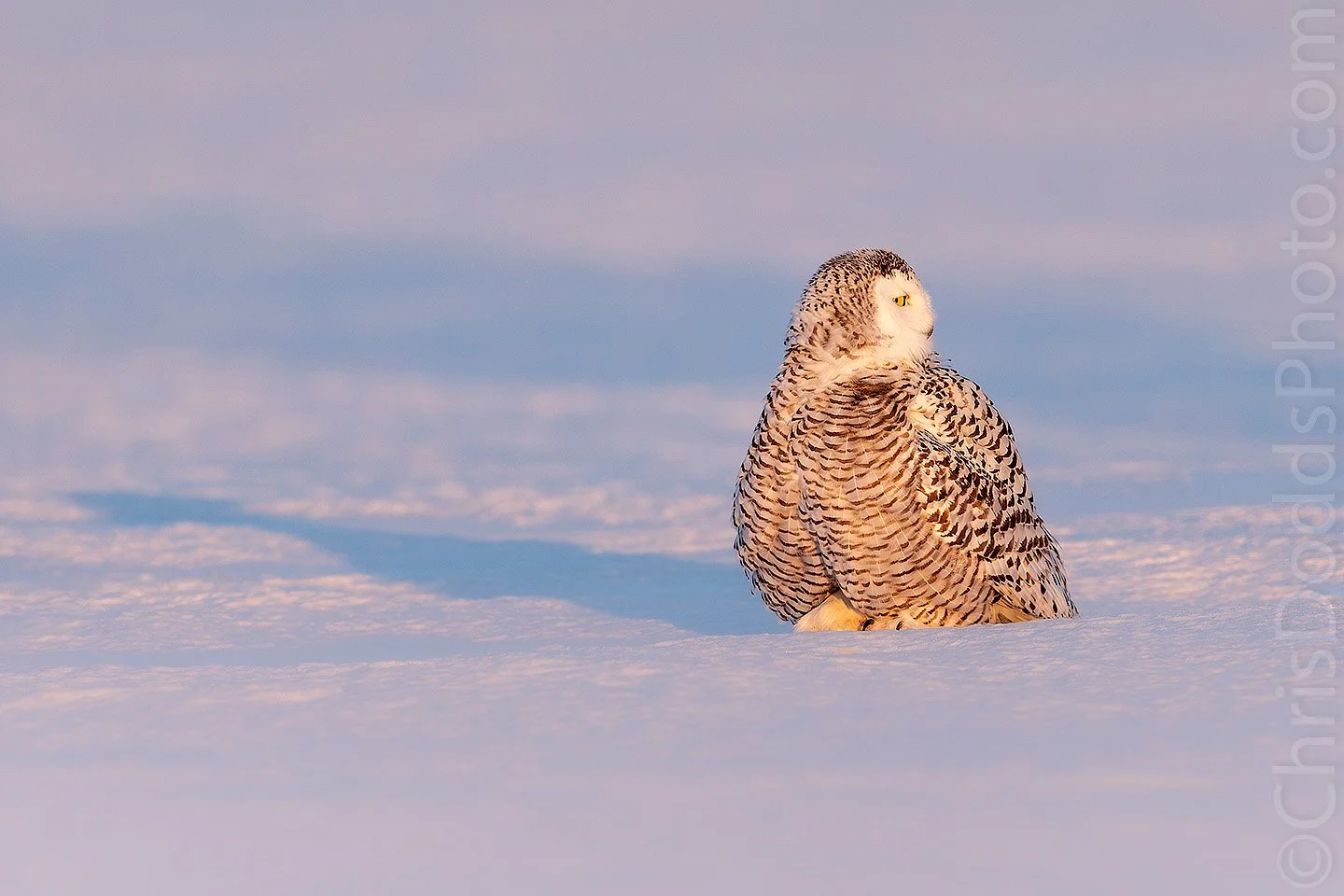
Snowy Owl in Winter Light and Shadow — Ontario, Canada (Bubo scandiacus, Harfang des neiges, Búho nival, SNOW) from my Winter Owl Photography Workshop. Image Copyright ©Christopher Dodds. 600mm f/4 lens with 1.4× teleconverter at 840mm. ISO 6,400, f/5.6 @ 1/5,000s. Manual exposure.
Give a bird room to look into the frame. It’s one of the first composition tips we learn in bird photography, and I teach it myself. It usually works.
With this Snowy Owl, I prefer the space behind the bird.
My last post featured a high-key, black-and-white Snowy Owl photograph, with no colour or shadows. In this image, the warm light, blue snow and long shadow are a large part of why the composition works for me.
The owl sits on the right, looking towards the nearest edge, with its shadow stretching left across the snow. Placing the bird farther left would give it more room to look into, but leave less room for the shadow.
That shadow needs somewhere to go.
I like the weight it gives the left side of the frame and the way it connects the owl to the field. The low sun catches the face and feather markings, while the shaded snow takes on blue tones. Little ridges catch warm light across the surface. A tighter composition would sacrifice those details.
When I look at this image, I see the owl and its shadow together. Both needed room.
There is a compromise. The owl’s gaze draws my eye towards the right edge, and I would normally leave more space in that direction. Someone else might find the arrangement uncomfortable. I can understand that.
For me, there is enough room between the face and the edge, and enough happening elsewhere to hold the photograph together. The bird feels settled into the snow. Its shadow spreads across the open space behind it. I keep coming back to the warmth of the plumage against those cool winter colours.
Try covering the left side of the photograph with your hand. You still have a lovely owl in beautiful light, but you lose the length of the shadow and much of the sense of space. That is why I would keep this framing.
After more than 40 years of photographing wildlife, I still find this a useful exercise when reviewing my own work: what would I actually gain by cropping, and what would I lose?
Making the subject larger can be tempting, especially when there is fine feather detail to show. But the empty-looking parts of a photograph deserve a closer look before we cut them away. Here, the snow carries colour, texture and the owl’s shadow. It contributes enough that I want to keep it.
The direction of the head matters, too. A bird can turn to look over its shoulder without moving its body, changing the balance of the whole image. A turn towards the shorter side of the frame doesn’t automatically spoil the composition. I judge it by what I see in the complete picture.
In the field, it is worth making a few wider compositions before reaching for more focal length. Look beyond the bird. Check where its shadow falls, how the light crosses the ground and whether those elements deserve space of their own. You can crop later; you cannot recover a shadow you left outside the frame.
Leaving room in front of a bird is still good advice. Understanding why you might choose otherwise is part of learning to compose.
For this photograph, I would miss the shadow far more than I miss the extra room on the right.
If you would like to work on exposure, composition and photographing owls in winter light, join me for an Ethical Winter Owl Photography Workshop in Québec and Ontario. We work through these decisions in the field as opportunities unfold, with the welfare of the owls always coming first. No baiting, feeding, luring, calling or disturbing the owls.