• Christopher Dodds LIVE in Public
  • Workshops
  • About Me
  • Portfolio
  • Blog
  • Testimonials
Menu

Nature Photography Blog

  • Christopher Dodds LIVE in Public
  • Workshops
  • About Me
  • Portfolio
  • Blog
  • Testimonials
×
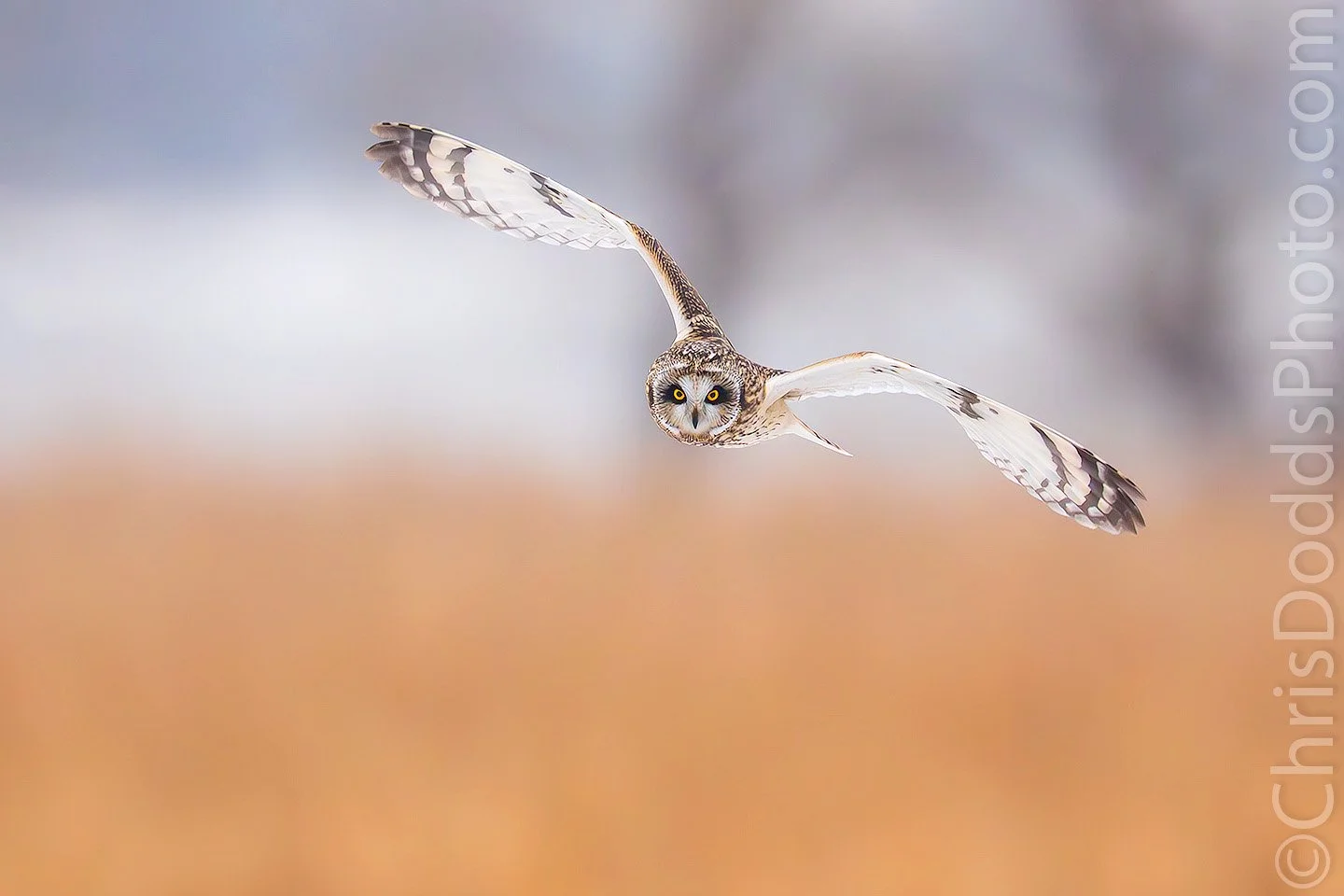
Short-eared Owl flying straight toward the camera with wings fully outstretched, yellow eyes bright, over a soft, blurred winter landscape with warm golden tones below and cool gray sky above.

Short-eared Owl — Silent Glide in Winter Light (Asio flammeus, Hibou des marais, Búho campestre, SEOW) Image Copyright ©Christopher Dodds All Rights Reserved. January 8, 2025, during week 1/8 of my Snowy Owl Workshops in Ontario, Canada. Sony a9 Mark III mirrorless camera body & Sony FE 600mm f/4 G Master OSS Lens with Sony FE 2X Teleconverter @1,200mm ISO 12,500, f/8 @ 1/5,000s. Manual exposure. Full frame image.

Why I Don’t Use Flash on Birds and Owls (and Why We Used To)

Christopher Dodds January 11, 2026

Why I Don’t Use Flash on Birds and Owls (and why we used to)

I’m occasionally asked why I don’t use flash for birds—especially owls. My answer is pretty practical: with modern cameras, I don’t need it, and it’s one more factor that can influence a bird’s behaviour.

That wasn’t always true.

A quick bit of history: film days, slow light, and the “Better Beamer”

In the film era, low light was a wall. Film was slow, usable shutter speeds were hard to come by, and you didn’t have today’s clean high-ISO files or low-light autofocus.

Flash became a solution—sometimes for exposure, and sometimes for aesthetics. A small catchlight can make a bird feel “alive” in the frame; without it, subjects photographed in flat light can look oddly lifeless.

That’s where the Fresnel flash extender came in: a simple lens that concentrates the flash beam so more of the light lands on the bird instead of being wasted across the whole scene. One of the best-known versions is the Better Beamer, which uses a Fresnel lens to narrow and concentrate the flash output.

And the Better Beamer has a name attached to it that matters to me personally.

Walt Anderson (RIP) and real innovation

My friend Walt Anderson (RIP) was the inventor/creator of the Visual Echoes Flash Extender—widely known as the Better Beamer.
He began exploring the then-new TTL flash systems in the early 1990s and founded Visual Echoes to produce and market the product.

It was a smart, practical innovation for the realities of that time. It helped many bird photographers produce better images when the tools simply weren’t what they are today.

What changed: modern cameras changed the need

Fast forward to now: modern sensors can handle ISO levels we wouldn’t have dreamed of in the film days, and autofocus can lock onto a subject in very low light. For most bird photography situations, I can make the image with ambient light and good technique—without introducing artificial light into the encounter.

So for me, flash has shifted from “useful tool” to “unnecessary tool” for bird photography.

Owls in particular

Most Owls are highly adapted to low-light environments. Their hunting and movement patterns are built around darkness and subtle contrast. Even if long-term effects of flash are debated in different contexts, the short-term reality in the field is that some birds react—blinking, flinching, shifting posture, or leaving a perch. If I can avoid introducing that variable, I will.

What the research says (a simple, measurable point)

There’s also a research-backed reason to be cautious with anything that increases disturbance.

A 2019 study in Biological Conservation looked at bird photography and quantified escape responses (flight-initiation distance). One of the headline findings: for most species, photographers triggered escape at greater distances than walkers, suggesting that photography can be a stronger disturbance stimulus than a normal passerby.

That doesn’t “prove” flash is always harmful—but it does reinforce a basic idea: our choices and behaviours around birds matter, and it’s worth minimizing anything that can add pressure.

The ethical baseline I follow

I try to keep my approach simple and consistent with widely shared best practices. NANPA’s Principles of Ethical Field Practices puts it plainly:

“If an animal shows stress, move back and use a longer lens.”

That line is easy to apply, and it works.

Where I land

I’m not interested in turning this into a debate. I’m interested in stacking the odds in favour of the bird.

So I work with available light, modern sensor performance, and field craft. And when the light isn’t there, I’d rather miss a frame than add a variable that I don’t need.

References

  • NANPA — Principles of Ethical Field Practices (Revised March 2018).

  • Slater et al. (2019) — “Camera shy? … avian responses to [bird photographers]” Biological Conservation(highlights include longer escape distances to photographers than walkers).

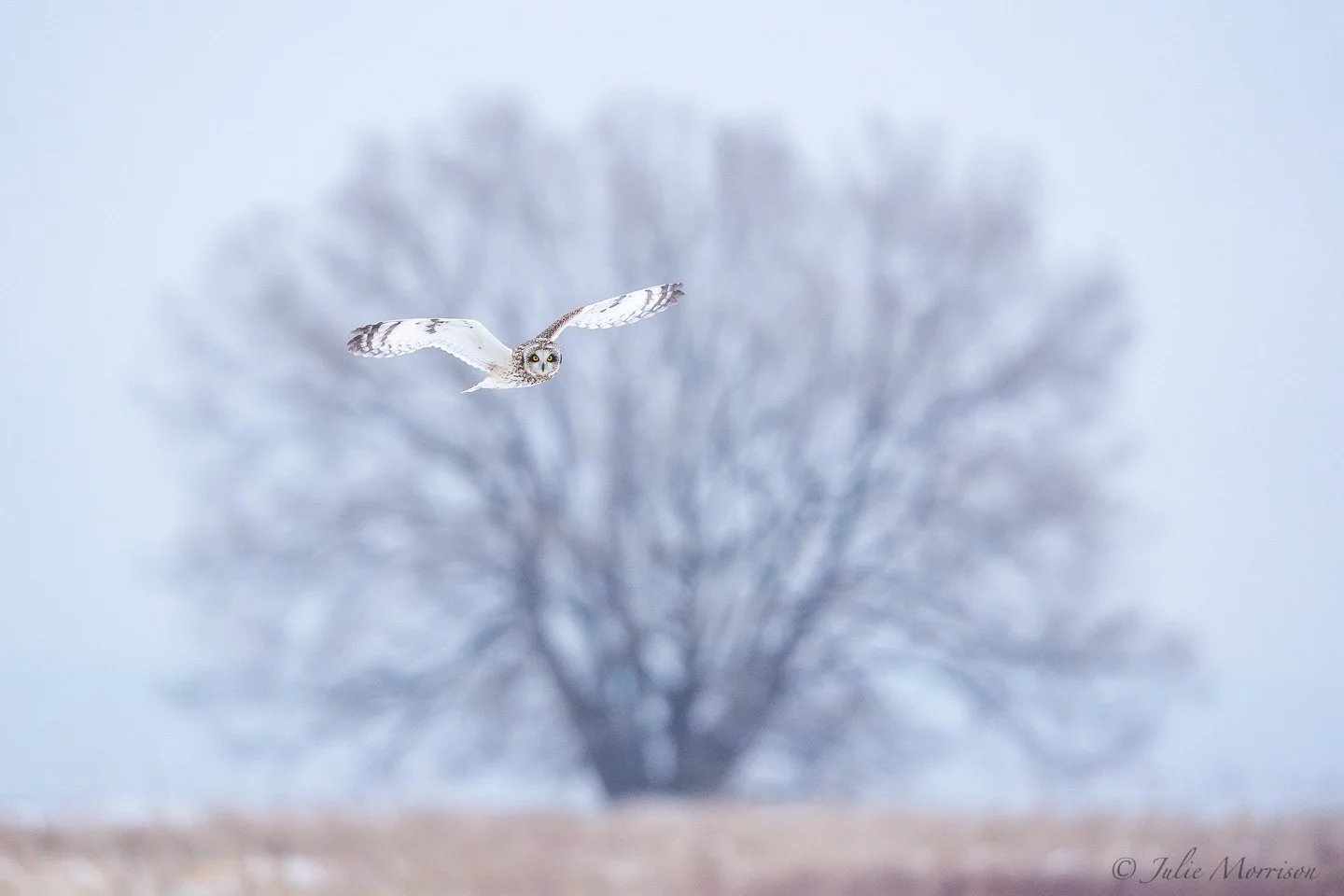
Short-eared Owl flying toward the camera in a pale winter sky, wings raised, with a large blurred leafless tree in the background and soft golden-brown fields below.

Short-eared Owl — Winter Flight with Lone Tree by Julie Morrison (Asio flammeus, Hibou des marais, Búho campestre, SEOW) January 8, 2025, during week 1/8 of the Snowy Owl Workshops in Ontario, Canada. Sony a9 Mark III mirrorless camera body & Sony SEL FE 200-600mm f/5.6-6.3 G OSS Lens @600mm. ISO 5,000, f/6.3 @ 1/5,000s Manual exposure.

That same afternoon—the very one that gave me the image at the top of this post—also produced a milestone I’m genuinely proud of: my wife, Julie Morrison, made an image that’s now being published here on the blog for the first time. If you’ve spent any time with us in the field, you already know she’s a gifted photographer with a calm, confident eye and a knack for timing. But what really makes my wife a force to be reckoned with on workshops is her owl-spotting superpower: she’ll pick up a shape, a posture, a blink of movement in the grass that most people would drive right past. I love watching her work, and I’m thrilled to share her first blog-published image—made on the same afternoon as mine.

In Bird Photography Tags bird photography, owl photography, wildlife photography, nature photography, ethical wildlife photography, wildlife photography ethics, NANPA, NANPA ethics, birding photography, bird photographer, owl photographer, flash photography, photography flash, Better Beamer, Fresnel flash extender, Walt Anderson, low light photography, natural light photography, high ISO, wildlife behavior, responsible photography, Julie Morrison
Comment
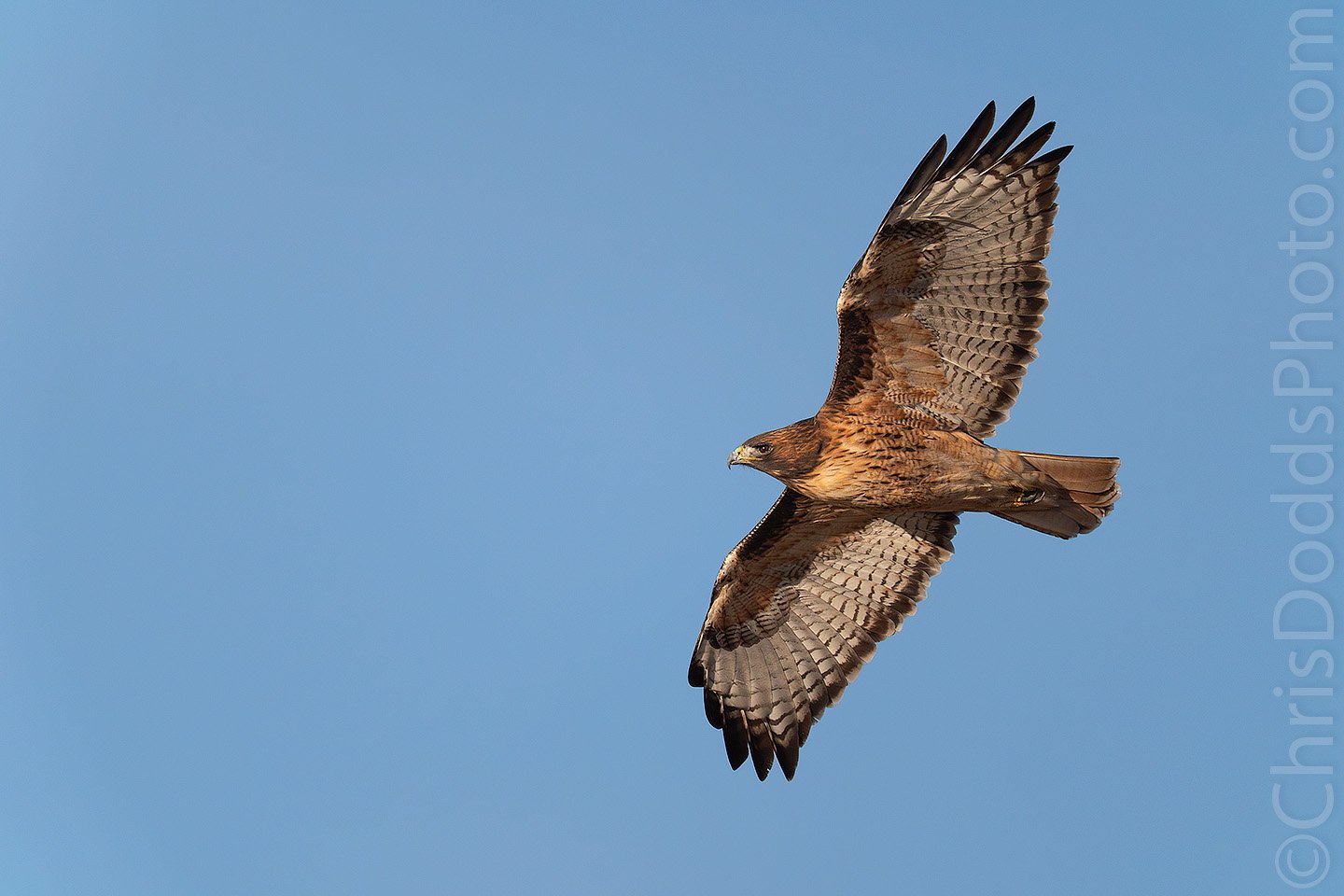
Red-tailed Hawk gliding in flight in soft morning light during the Better than Bosque photography workshop in New Mexico

Red-tailed Hawk in flight (Buteo jamaicensis, Buse à queue rousse, Busardo colirrojo, RTHA) from my Better than Bosque workshop. Bernardo Wildlife Area, Bernardo, New Mexico, USA. Image Copyright ©Christopher Dodds. Sony a9 III Mirrorless camera & Sony FE 600mm f/4 G Master OSS Lens with Sony FE 2X Teleconverter @1,200mm ISO 2,000, f/8 @ 1/5,000s. Manual exposure. Full frame image.

Dear Bird Photographer: On the Images That Matter More Than Likes

Christopher Dodds January 2, 2026

Dear Bird Photographer,

While everyone is filling their feeds with carefully curated “Best of 2025” collections, I wanted to pause and share something a little quieter.

This image—a Red-tailed Hawk in flight—was made during my recent Better than Bosque workshop. No drama. No explosive sky. No once-in-a-lifetime chaos unfolding in the frame. Just a wild bird doing what it has always done, moving effortlessly through clean New Mexico air in honest, early light.

And yet, this photograph represents more than it might appear at first glance.

You know the investment that goes into images like this. The early mornings. The cold hands. The long stretches of waiting. The years spent learning light, behaviour, timing, and restraint. When it finally comes together, the result is often something beautifully simple: sharp, well composed, and true.

But here’s the strange part—we hesitate to celebrate these photographs.

Why?

Because we already know how they’ll land online. They won’t trigger an epic response. They won’t stop thumbs mid-scroll. They don’t shock, exaggerate, or rely on spectacle. And in a world overflowing with astonishingly capable cameras and millions of people making technically solid bird images every day, work like this can start to feel… ordinary.

It isn’t.

Look a little closer.

The wing position is classic red-tail—broad, powerful, unhurried. The light slips gently through the primaries, revealing just enough translucence to show that the sun angle was correct. The warm tones in the tail and upperwing are present but restrained. The head is sharp, the eye alert. There’s space to fly. Nothing is forced. Nothing clipped. Nothing is screaming for attention.

This is the kind of image that comes from understanding birds, respecting light, and trusting patience. It’s what happens when experience quietly does its work.

Social media rewards novelty and extremes. Photography—real photography—rewards consistency, restraint, and the ability to recognize a good moment even when it doesn’t shout.

So here’s my invitation to you.

Instead of asking which image performed best this year, ask yourself which photograph still carries a story only you remember. The cold morning. The quiet drive. The bird you didn’t expect. The moment that made you pause and smile behind the camera. The image that may never go viral, but still feels right every time you return to it.

If you’re inclined, take a moment to revisit that photograph. Recount the story behind it—to yourself, to a friend, or in a few quiet words shared somewhere meaningful. Those are the images that remind us why we show up in the first place.

Sometimes, a simple, honest photograph of a beautiful bird in good light is more than enough.

And sometimes, that’s precisely the point.

—Chris

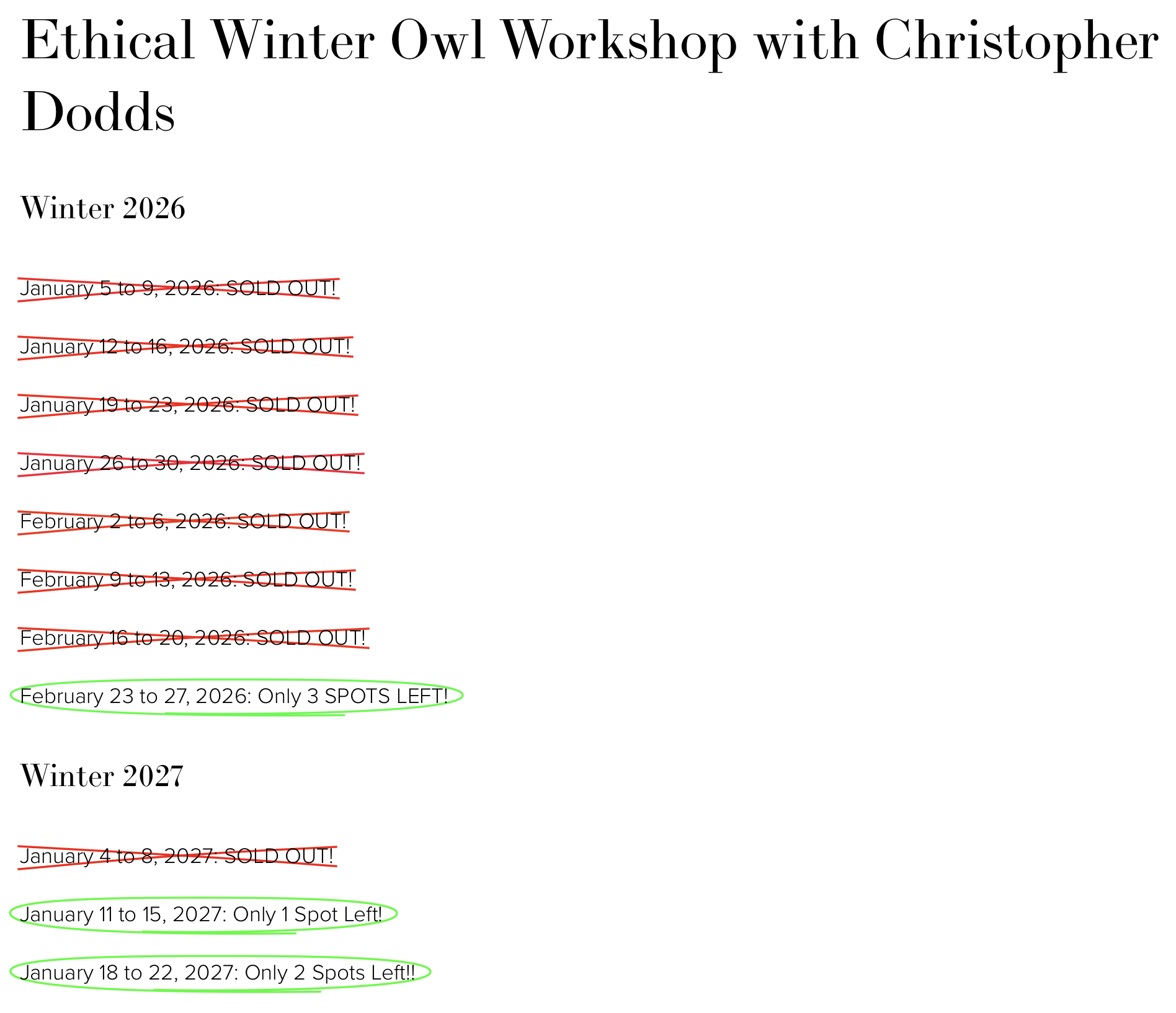
Ethical Winter Snowy Owl Great Grey Owl Great Gray Owl Workshop Chris Dodds

Subscribe

Sign up with your email address to receive news and updates.

We respect your privacy.

Thank you!
In Bird Photography, Workshop Report Tags bird photography, wildlife photography, red-tailed hawk, hawk in flight, bird photographers, Better than Bosque, photography reflection, photography mindset, nature photography, wildlife art, birds in flight, ethical wildlife photography, photography process, quiet moments, meaningful images
2 Comments
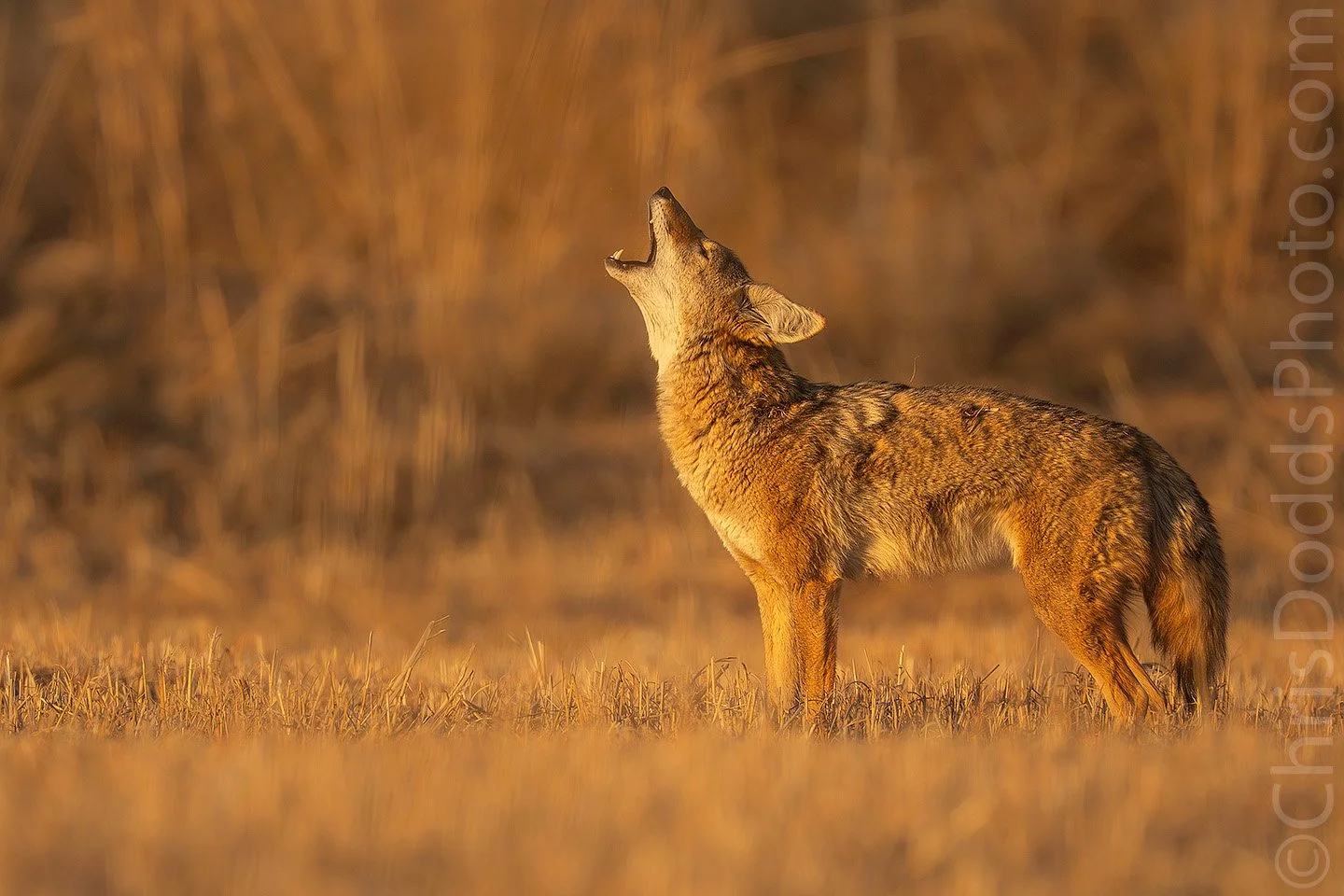
Female coyote standing in golden evening light at Bosque del Apache, calling to her mate near the end of the Better Than Bosque Workshop, December 2025.

Coyote Last Call (Canis latrans) from my Better than Bosque workshop. Albuquerque, New Mexico, USA. Image Copyright ©Christopher Dodds. Sony a9 III Mirrorless camera & Sony FE 600mm f/4 G Master OSS Lens with Sony FE 2X Teleconverter @1,200mm ISO 3,200, f/8 @ 1/5,000s. Manual exposure. Full frame image.

A Coyote’s Call: A Perfect Ending to the 2025 Better Than Bosque Workshop

Christopher Dodds December 30, 2025

There are moments in the field that feel less like photography and more like being quietly invited into another world. This was one of them.

It happened near the very end of our final session of the 2025 Better Than Bosque Workshop, earlier this December. The light was already sliding toward evening, that soft, honey-warm glow that Bosque does so well when the day begins to exhale. We were just starting to think about wrapping things up when this female coyote stepped into view.

She stood tall in the grass, bathed in that last, low sunlight, lifted her head—and called.

Not a quick yip or passing note, but a long, soulful call that carried across the landscape. It stopped all of us in our tracks. Cameras came up, then slowly lowered again. This wasn’t just about the image anymore.

Coyotes are deeply family-oriented animals. They live in tight-knit family groups—often a bonded pair with offspring from one or more years—and cooperation is at the heart of their survival. Both parents help raise and protect the pups, hunt together, and maintain their territory. That bond was on full display here.

She didn’t sound casual. She sounded anxious.

Her calls had urgency, as if she were checking in, making sure her mate knew where home was, where the family waited. We watched and listened in silence, fully aware we were witnessing something intimate and real. There was a collective sense among the group that this was special—one of those rare moments you don’t plan for, can’t script, and never forget.

Then the light finally faded. We stayed a little longer, just soaking it in.

About twenty minutes later—after sunset, when cameras were mostly away—we saw movement again. Her mate appeared in the distance, slowly making his way back toward her… with a noticeable limp. Suddenly, everything made sense. Her concern. The calling. The waiting.

No drama. No spectacle. Just a family reconnecting at the end of the day.

It was a magical way to close out this year’s workshop—quiet, emotional, and deeply grounding. Moments like this are why I keep coming back, year after year. And sharing it with such an incredible group of people—patient, respectful, fully present—was truly the icing on the cake.

Some images stay with you because they’re beautiful. Others stay with you because of what they mean.

This one will stay with me for a long time.

In Workshop Report Tags Better Than Bosque Workshop, Best of Bosque 2025, Bosque del Apache, Bosque del Apache wildlife photography, coyote, coyotes, coyote behavior, coyote family pack, photographing coyotes, New Mexico wildlife photography, wildlife photography workshop, predator photography, golden hour wildlife photography, storytelling in wildlife photography, nature photography, emotional wildlife moments
Comment

Subscribe

Sign up with your email address to receive news and updates.

We respect your privacy.

Thank you!

All content (including text, design, photos, layout, and graphics) are copyright ©Christopher Dodds www.ChrisDoddsPhoto.com