• Christopher Dodds LIVE in Public
  • Workshops
  • About Me
  • Portfolio
  • Blog
  • Testimonials
Menu

Nature Photography Blog

  • Christopher Dodds LIVE in Public
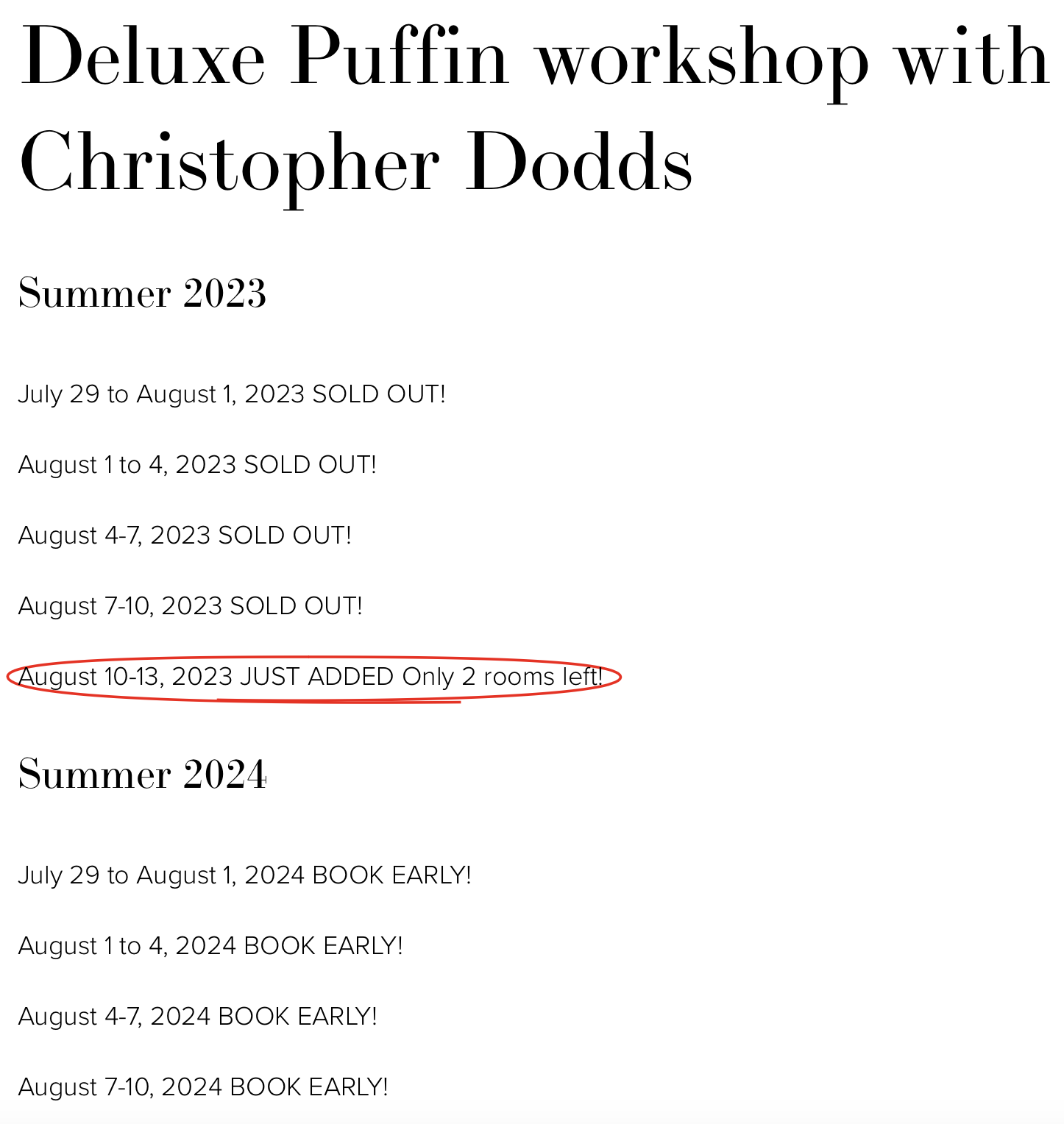
  • Workshops
  • About Me
  • Portfolio
  • Blog
  • Testimonials
×
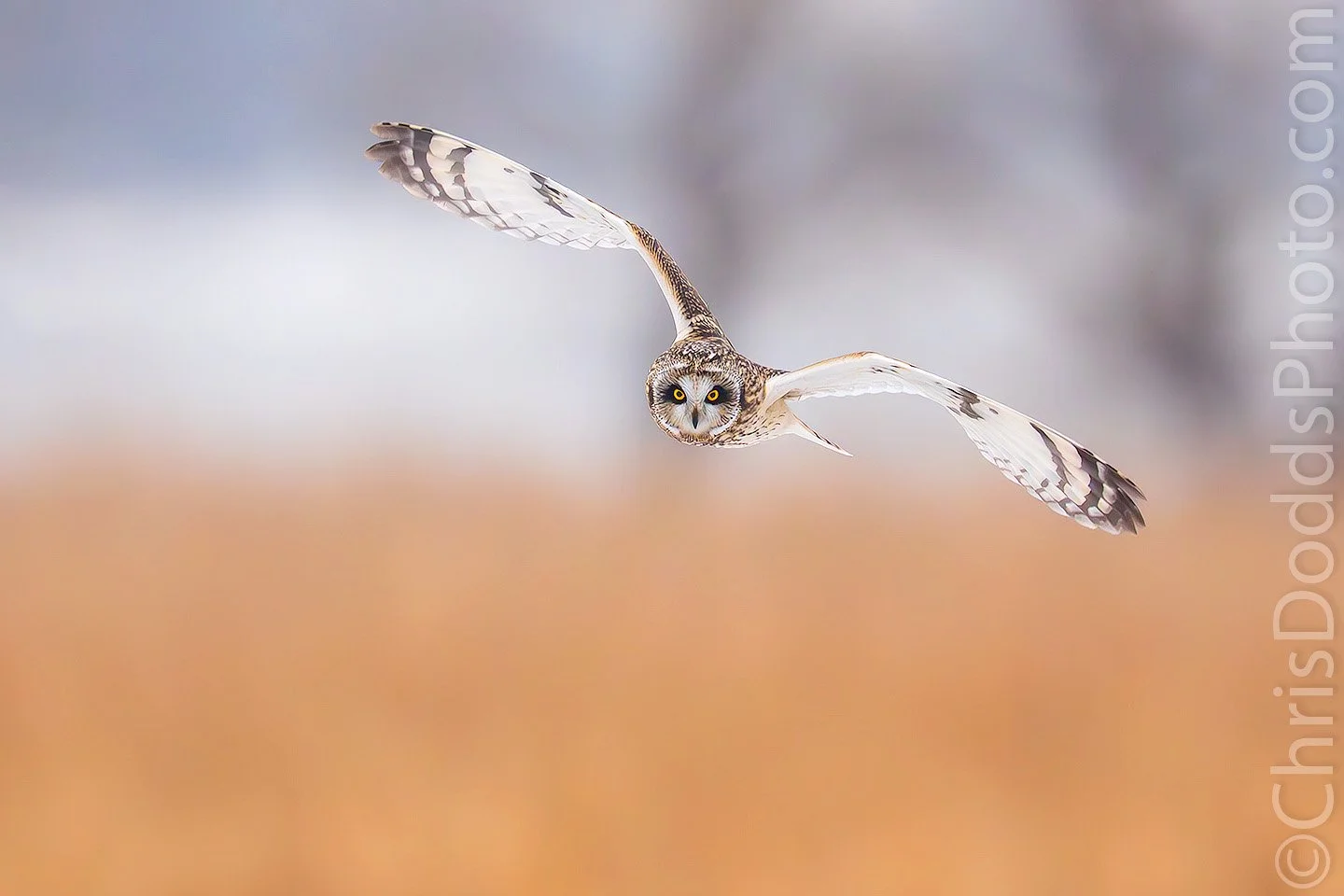
Short-eared Owl flying straight toward the camera with wings fully outstretched, yellow eyes bright, over a soft, blurred winter landscape with warm golden tones below and cool gray sky above.

Short-eared Owl — Silent Glide in Winter Light (Asio flammeus, Hibou des marais, Búho campestre, SEOW) Image Copyright ©Christopher Dodds All Rights Reserved. January 8, 2025, during week 1/8 of my Snowy Owl Workshops in Ontario, Canada. Sony a9 Mark III mirrorless camera body & Sony FE 600mm f/4 G Master OSS Lens with Sony FE 2X Teleconverter @1,200mm ISO 12,500, f/8 @ 1/5,000s. Manual exposure. Full frame image.

Why I Don’t Use Flash on Birds and Owls (and Why We Used To)

Christopher Dodds January 11, 2026

Why I Don’t Use Flash on Birds and Owls (and why we used to)

I’m occasionally asked why I don’t use flash for birds—especially owls. My answer is pretty practical: with modern cameras, I don’t need it, and it’s one more factor that can influence a bird’s behaviour.

That wasn’t always true.

A quick bit of history: film days, slow light, and the “Better Beamer”

In the film era, low light was a wall. Film was slow, usable shutter speeds were hard to come by, and you didn’t have today’s clean high-ISO files or low-light autofocus.

Flash became a solution—sometimes for exposure, and sometimes for aesthetics. A small catchlight can make a bird feel “alive” in the frame; without it, subjects photographed in flat light can look oddly lifeless.

That’s where the Fresnel flash extender came in: a simple lens that concentrates the flash beam so more of the light lands on the bird instead of being wasted across the whole scene. One of the best-known versions is the Better Beamer, which uses a Fresnel lens to narrow and concentrate the flash output.

And the Better Beamer has a name attached to it that matters to me personally.

Walt Anderson (RIP) and real innovation

My friend Walt Anderson (RIP) was the inventor/creator of the Visual Echoes Flash Extender—widely known as the Better Beamer.
He began exploring the then-new TTL flash systems in the early 1990s and founded Visual Echoes to produce and market the product.

It was a smart, practical innovation for the realities of that time. It helped many bird photographers produce better images when the tools simply weren’t what they are today.

What changed: modern cameras changed the need

Fast forward to now: modern sensors can handle ISO levels we wouldn’t have dreamed of in the film days, and autofocus can lock onto a subject in very low light. For most bird photography situations, I can make the image with ambient light and good technique—without introducing artificial light into the encounter.

So for me, flash has shifted from “useful tool” to “unnecessary tool” for bird photography.

Owls in particular

Most Owls are highly adapted to low-light environments. Their hunting and movement patterns are built around darkness and subtle contrast. Even if long-term effects of flash are debated in different contexts, the short-term reality in the field is that some birds react—blinking, flinching, shifting posture, or leaving a perch. If I can avoid introducing that variable, I will.

What the research says (a simple, measurable point)

There’s also a research-backed reason to be cautious with anything that increases disturbance.

A 2019 study in Biological Conservation looked at bird photography and quantified escape responses (flight-initiation distance). One of the headline findings: for most species, photographers triggered escape at greater distances than walkers, suggesting that photography can be a stronger disturbance stimulus than a normal passerby.

That doesn’t “prove” flash is always harmful—but it does reinforce a basic idea: our choices and behaviours around birds matter, and it’s worth minimizing anything that can add pressure.

The ethical baseline I follow

I try to keep my approach simple and consistent with widely shared best practices. NANPA’s Principles of Ethical Field Practices puts it plainly:

“If an animal shows stress, move back and use a longer lens.”

That line is easy to apply, and it works.

Where I land

I’m not interested in turning this into a debate. I’m interested in stacking the odds in favour of the bird.

So I work with available light, modern sensor performance, and field craft. And when the light isn’t there, I’d rather miss a frame than add a variable that I don’t need.

References
  • NANPA — Principles of Ethical Field Practices (Revised March 2018).

  • Slater et al. (2019) — “Camera shy? … avian responses to [bird photographers]” Biological Conservation(highlights include longer escape distances to photographers than walkers).

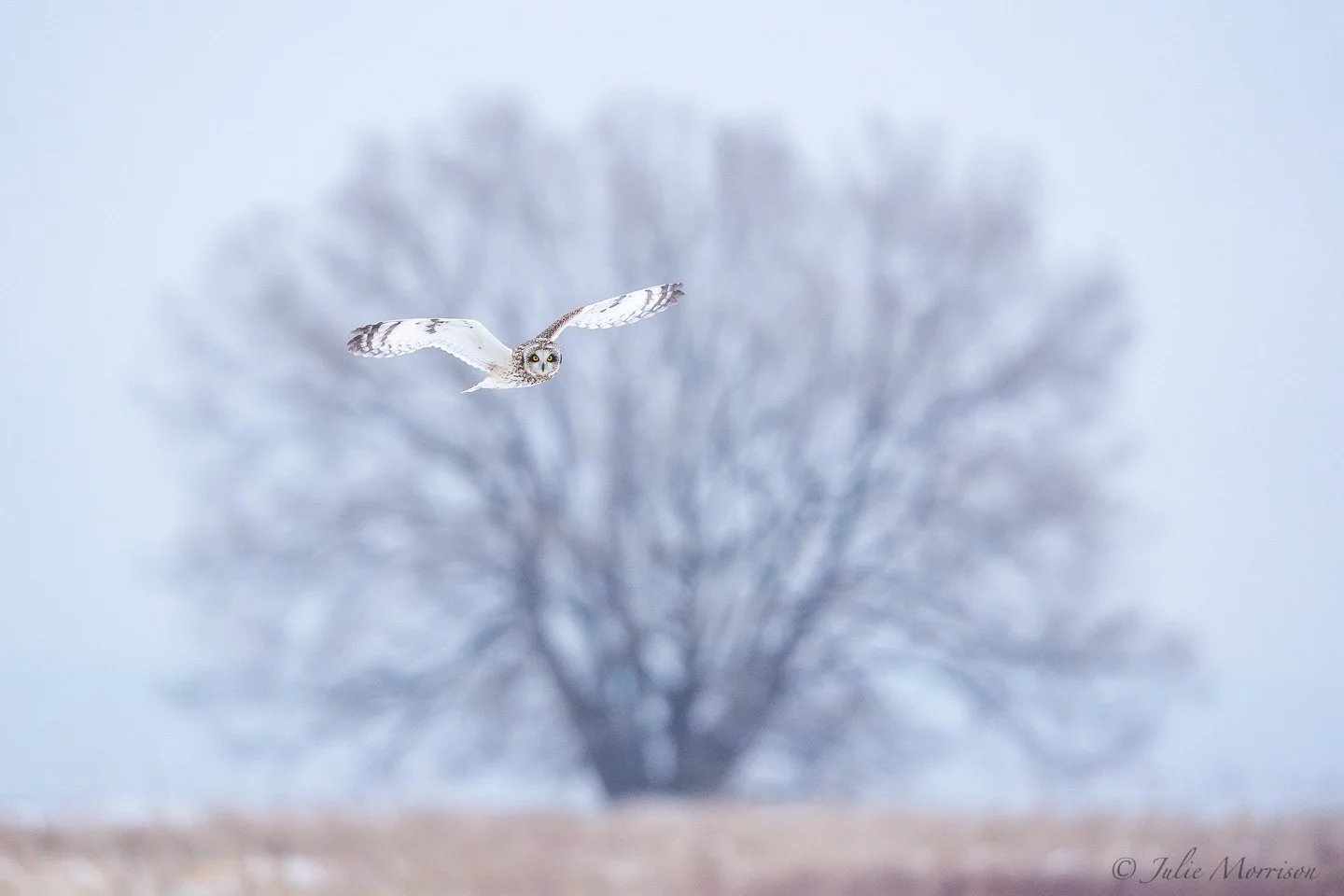
Short-eared Owl flying toward the camera in a pale winter sky, wings raised, with a large blurred leafless tree in the background and soft golden-brown fields below.

Short-eared Owl — Winter Flight with Lone Tree by Julie Morrison (Asio flammeus, Hibou des marais, Búho campestre, SEOW) January 8, 2025, during week 1/8 of the Snowy Owl Workshops in Ontario, Canada. Sony a9 Mark III mirrorless camera body & Sony SEL FE 200-600mm f/5.6-6.3 G OSS Lens @600mm. ISO 5,000, f/6.3 @ 1/5,000s Manual exposure.

That same afternoon—the very one that gave me the image at the top of this post—also produced a milestone I’m genuinely proud of: my wife, Julie Morrison, made an image that’s now being published here on the blog for the first time. If you’ve spent any time with us in the field, you already know she’s a gifted photographer with a calm, confident eye and a knack for timing. But what really makes my wife a force to be reckoned with on workshops is her owl-spotting superpower: she’ll pick up a shape, a posture, a blink of movement in the grass that most people would drive right past. I love watching her work, and I’m thrilled to share her first blog-published image—made on the same afternoon as mine.

In Bird Photography Tags bird photography, owl photography, wildlife photography, nature photography, ethical wildlife photography, wildlife photography ethics, NANPA, NANPA ethics, birding photography, bird photographer, owl photographer, flash photography, photography flash, Better Beamer, Fresnel flash extender, Walt Anderson, low light photography, natural light photography, high ISO, wildlife behavior, responsible photography, Julie Morrison
Comment

Razorbill in flight (Alca torda, Petit Pingouin, RAZO) from my Deluxe Puffins Galore Lighthouse Island Workshop Adventure. Mingan Archipelago National Park Reserve, Quebec, Canada. Image Copyright ©Christopher Dodds. Sony Alpha a1 Mirrorless camera & Sony FE 200-600mm f/5.6-6.3 G OSS Lens @600mm. ISO 8,000, f/6.3 @ 1/5,000s Manual exposure. Full frame image.

Razorbill in flight

Christopher Dodds August 26, 2023

A Razorbill in flight from my recent Deluxe Atlantic Puffins and so much more workshops. It was a dark and rainy day at low tide when this Razorbill flew over the seaweed-covered rocks as it returned to its nest on the cliff.

Razorbills, also known as razor-billed auks or lesser auks, are a unique species of seabird known for their sharp, hatchet-shaped bills and strong swimming abilities. With their sleek black-and-white plumage and distinctive bills, razorbills are a striking sight.

In Workshop Report Tags Alca torda, Petit Pingouin, RAZO, Razorbill, birds in flight, workshop, photo tour, high ISO, Mingan Archipelago National Park Reserve of Canada
Comment

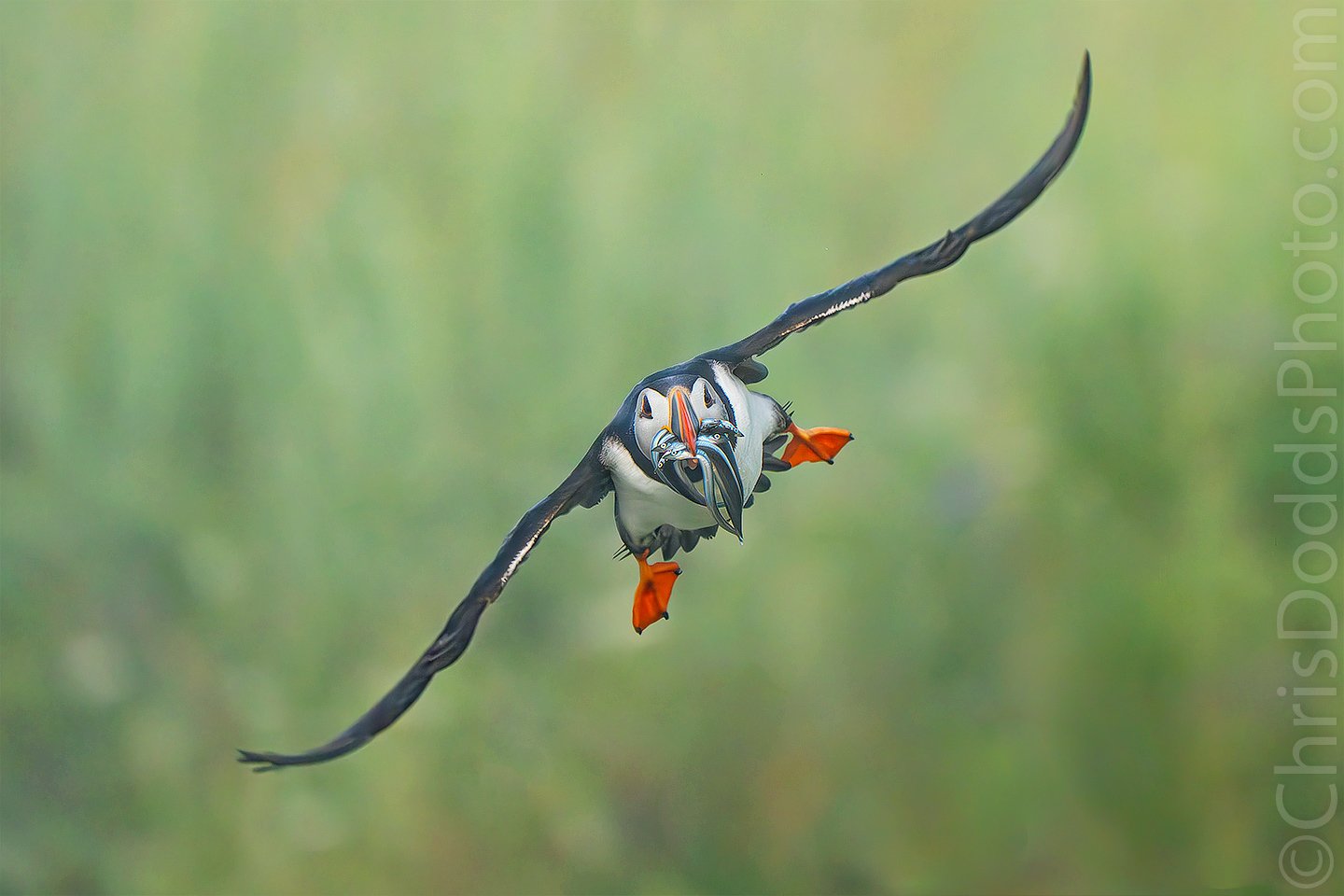
Atlantic Puffin in flight with fish (Capelin) in light fog (Fratercula arctica, Macareux moine, ATPU) from my Deluxe Puffins Galore Lighthouse Island Workshop Adventure. Mingan Archipelago National Park Reserve, Quebec, Canada. Image Copyright ©Christopher Dodds. Sony Alpha 1 Mirrorless camera & Sony 200-600mm Lens (@382mm) ISO 800, f/6.3 @ 1/5,000s Manual exposure.

Atlantic Puffin in flight with fish and Deluxe Puffins Galore Workshop Update

Christopher Dodds July 1, 2023

I love the painterly quality of this image captured before sunrise in light fog during my Deluxe Puffins Galore Workshop last August 11 (2022). I processed another version with more contrast, virtually eliminating the fog, but I prefer this version. Notice that I chose to use 10,000 ISO to properly expose the image while using an action-stopping 1/5,000s shutter speed. My Sony 200-600mm has become my most used and much-loved lens :)

This is a dream deluxe photography tour: Dreamlike accommodations in a newly restored lighthouse just feet away from nesting Atlantic Puffins and Razorbills on a small island in the Gulf of Saint Lawrence, Quebec, Canada, with gourmet food.

  • Timed to coincide with the very best time to be at the colony with the Puffins returning with fish to feed their young.

  • Group size limited to 5-8 photographers (price is per person in single or double occupancy as desired, with only five rooms available).

  • Exclusive use of the lighthouse and accommodations mean that we will be the island’s only inhabitants.

  • The small group size means more assistance and one-on-one guidance and coaching for every participant.

  • Long lenses are not mandatory for this tour; 200-600mm reach is adequate for an impressive portfolio.

  • Photographers of all levels are welcome, the tour pace will suit everyone’s needs and skill level.

  • Owners of all camera brands are welcome; my 40 years of professional photography include the last five years as a Sony ambassador, 16 years using Canon as a Canon Northern Explorer of Light and 16 years using Nikon before that. I can help anyone with any brand improve their photography.

  • Christopher Dodds has over 39 years of experience in the great Canadian outdoors with the Puffins.

In Workshop Tags Fratercula arctica, Macareux moine, ATPU, Atlantic Puffin, Fish, Fishing, birds in flight, fog, mist, high ISO, Quebec, Workshop, Photo tour
Comment
American Bald Eagle fishing in golden light EYE SPY (Hailiaeetus leucocephalus, Pygarge a tete blanche, BAEA) from my BALD EAGLE WORKSHOP in Kachemak Bay (near Homer), Alaska. Image Copyright ©Christopher Dodds. Sony Alpha a9 II Mirrorless camera &a…

American Bald Eagle fishing in golden light EYE SPY (Hailiaeetus leucocephalus, Pygarge a tete blanche, BAEA) from my BALD EAGLE WORKSHOP in Kachemak Bay (near Homer), Alaska. Image Copyright ©Christopher Dodds. Sony Alpha a9 II Mirrorless camera & Sony FE 200-600mm f/5.6-6.3 G OSS Lens @478mm ISO 1,2500, f/6.3 @ 1/6,400s Manual exposure.

Bald Eagle Fishing in golden light EYE SPY

Christopher Dodds April 30, 2020
“Hey Chris, yesterday you recommended a very high shutterspeed to capture ultra sharp images. I was wondering what trade off in iso there would be. I try not to go above 1600 but my shutter speeds are 1/2000 to 1/4000. Are you suggesting higher iso to get higher shutter speeds? Thanks, Rob”
— Rob Palmer

You can read my blog post that Rob refers to here: Top birds in flight settings for Sony a9II

Hey Rob,

Absolutely, yes! I set my desired aperture and target shutter speed in manual mode and then use whatever ISO that I need to get there. There are many examples in this blog of images made using a higher ISO than the 1,600 that you limit yourself to.

UNCOMPRESSED RAW AT HIGHER ISO

One consideration when photographing action at high ISO with a Sony a9 or a9II is to consider lowering your capture rate and switching to uncompressed raw images to lower the noise in the dark portions of the image. I usually switch to uncompressed raw at 6,400 ISO.

Tags Bald Eagle, Hailiaeetus leucocephalus, Pygarge a tete blanche, BAEA, uncompressed raw, golden light, fishing, photo tour, workshop, IPT, high ISO, Sony a9II, Sony 200-600mm
Comment

Subscribe

Sign up with your email address to receive news and updates.

We respect your privacy.

Thank you!

All content (including text, design, photos, layout, and graphics) are copyright ©Christopher Dodds www.ChrisDoddsPhoto.com