• Christopher Dodds LIVE in Public
  • Workshops
  • About Me
  • Portfolio
  • Blog
  • Testimonials
Menu

Nature Photography Blog

  • Christopher Dodds LIVE in Public
  • Workshops
  • About Me
  • Portfolio
  • Blog
  • Testimonials
×
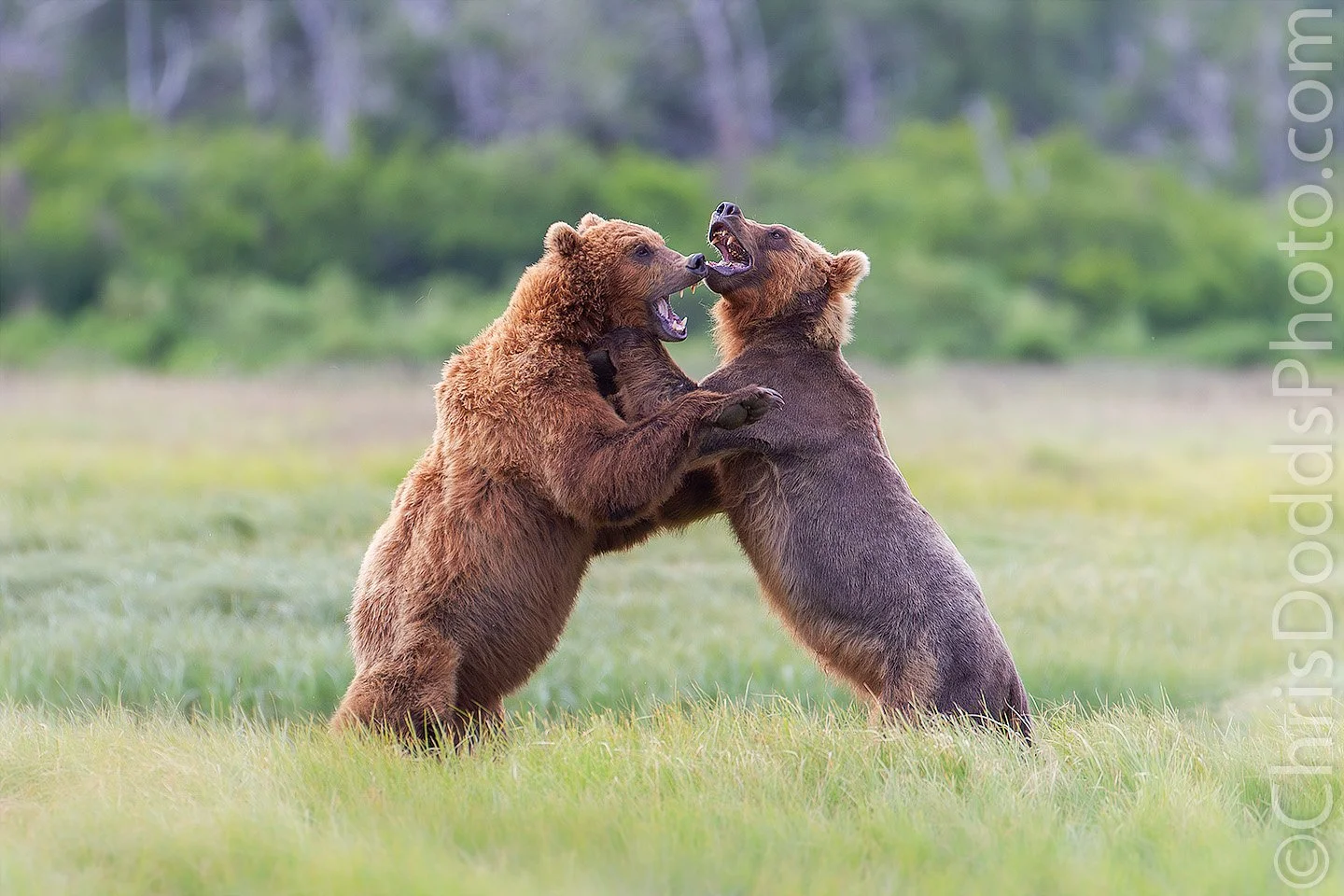
Coastal brown bears fighting in Katmai Alaska, two large bears standing upright and sparring in grassy meadow ditch, wildlife behaviour photography

Young Brown Bears Play Fighting After Rain (Ursus arctos) Hallo Bay, Katmai National Park, Alaska. From my Ultimate Alaska Bear Boat Trip. Image Copyright ©Christopher Dodds. Sony Alpha a1 II Mirrorless camera & Sony FE 400mm f/2.8 G Master OSS Lens with Sony FE 400-800mm f/6.3-8 G OSS Lens @507mm ISO 10,000, f/8 @ 1/2,500s Manual exposure. Full frame image. Join me in Alaska for the Ultimate Brown Bears Galore Workshop Adventure. LEARN MORE HERE.

Coastal Brown Bears Fighting in Katmai Alaska | Ultimate Brown Bear Photography Workshop

Christopher Dodds March 27, 2026

There is nothing quite like the adrenaline of being close to two coastal brown bears when they start to get rowdy.

We had been observing their behaviour from a safe distance and weren’t taking many photos at first because they were pointed away from us. Then everything changed. As they shifted and moved closer, their energy escalated — bringing the action right into range.

What looked intense never became dangerous. No injuries — just natural play fighting and strength testing. They stayed mostly within a small ditch, which helped contain the interaction but also hid much of it from view. We were ecstatic when everything lined up, and they engaged parallel to us, giving everyone the images they had been hoping for.

Moments like this aren’t rare in early June on the Katmai coast — but they’re never guaranteed. That’s the reality of working with truly wild animals, and part of what makes experiences like this so rewarding when it all comes together.

If this is the kind of behaviour you’ve been hoping to photograph, my June Ultimate Brown Bear workshop is timed specifically for it — before the sedge grass grows tall, when visibility is still excellent and interactions like this are at their peak.

👉 Details and availability:
https://www.chrisdoddsphoto.com/bear-boat-coastal-brown-bears-of-alaska

Photograph Coastal Brown Bears in Peak Behaviour — Join My June Katmai Workshop

🐻

Photograph Coastal Brown Bears in Peak Behaviour — Join My June Katmai Workshop 🐻 Photograph Coastal Brown Bears in Peak Behaviour — Join My June Katmai Workshop 🐻

In Workshop Tags coastal brown bears, brown bears Katmai, Katmai National Park, bear photography, wildlife photography, Alaska wildlife, bear behaviour, bears fighting, grizzly bears Alaska, nature photography workshop, Alaska photography tour, bear photo tour, wildlife photo workshop, June bear photography, Chris Dodds workshops, photographing bears, wild bear behaviour, Katmai coast, Alaska photo trip, bear sparring behaviour
Comment
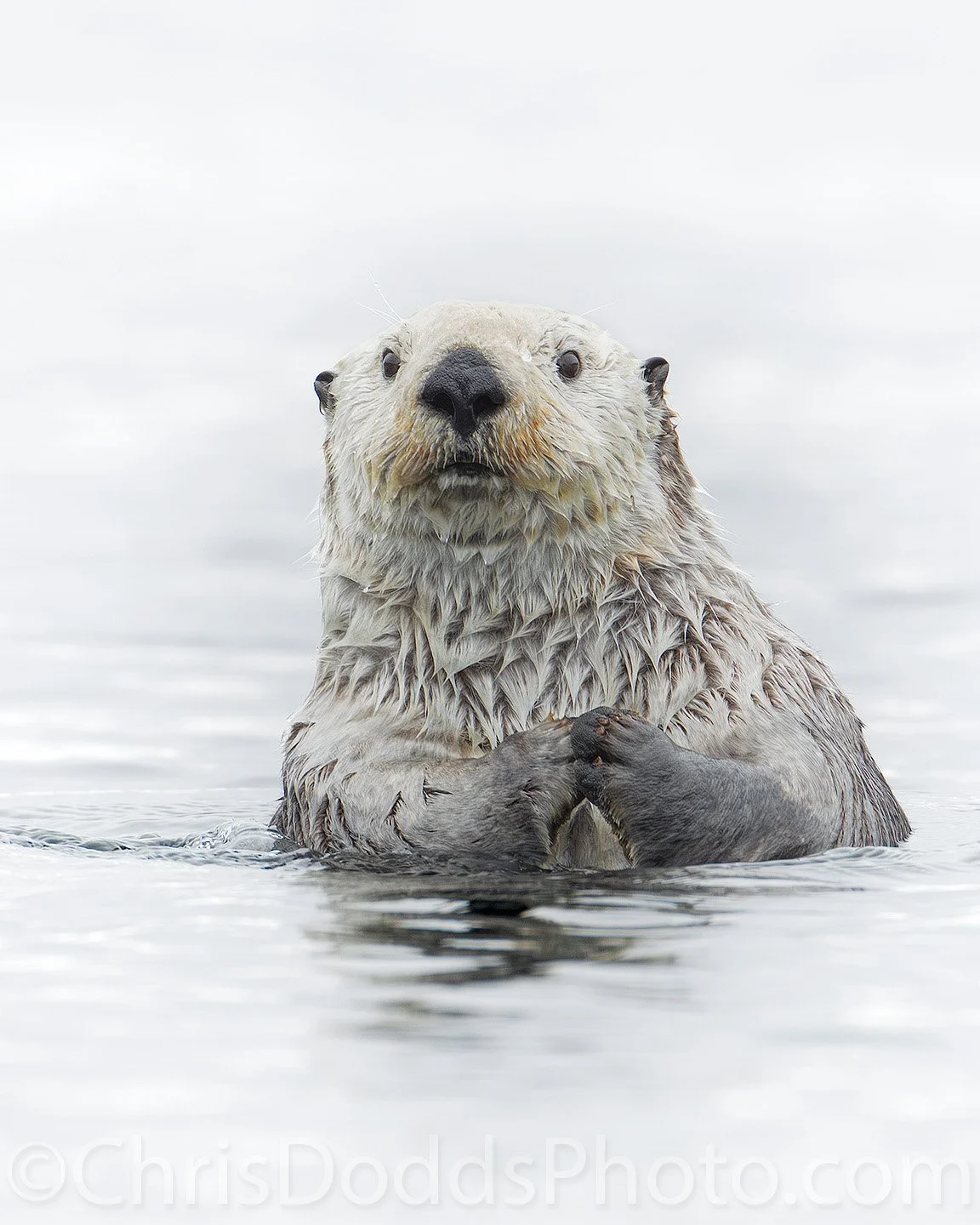
Grizzled sea otter floating on calm water along the Katmai Coast, Alaska, with pale fur showing age-related lightening and paws held together in a relaxed posture

Old Man of the Sea — Grizzled Sea Otter Portrait, Katmai Coast, Alaska (Enhydra lutris) From my Ultimate Alaska Bear Boat Trip. Image Copyright ©Christopher Dodds. Sony Alpha 1 Mark II Mirrorless camera & Sony FE 400-800mm f/6.3-8 G OSS Lens @800mm ISO 10,000, f/8 @ 1/5,000s Manual exposure. Full frame image. Join me in Alaska for the Ultimate Brown Bears Galore Workshop Adventure. LEARN MORE HERE.

Old Man of the Sea — Grizzled Sea Otter Portrait | Katmai Coast Alaska Wildlife Photography

Christopher Dodds March 25, 2026

There’s no mistaking an older sea otter when you see one.

This individual caught my attention immediately — that pale, weathered face rising out of calm water, front paws tucked in, completely at ease.

This isn’t albinism. What you’re seeing is age.

Sea otters (Enhydra lutris) often develop what’s known as “grizzling” — a gradual lightening of the fur as pigment fades over time. It typically starts on the head and can spread into the neck and chest. Some individuals, like this one, become almost entirely pale through the face, giving them a very distinctive look.

We photographed this otter along the Katmai Coast during my June Ultimate Brown Bears of Alaska workshop. While most people come for the bears, the strength of this trip is really the ecosystem as a whole. On any given day, you can move from photographing coastal brown bears to moments like this — quiet water, soft light, and a subject that simply lets you in.

Life for a sea otter here isn’t easy. Predation by killer whales has impacted some populations, and in rare cases, coastal brown bears have been known to take otters. Even in a place that feels calm, survival is never guaranteed.

From a photographic standpoint, this is exactly what I look for. Clean, uncluttered, and intimate. Shooting at water level removes everything but the subject.

In Nature Photography, Workshop Tags sea otter, sea otter portrait, grizzled sea otter, Enhydra lutris, Alaska wildlife, Katmai Coast, Alaska photography, wildlife photography, animal portrait, marine mammals, North Pacific wildlife, otter behaviour, nature photography, bear workshop Alaska, coastal Alaska, wildlife workshop, photography workshop Alaska, Chris Dodds, Dodds Visuals, wildlife portrait
Comment
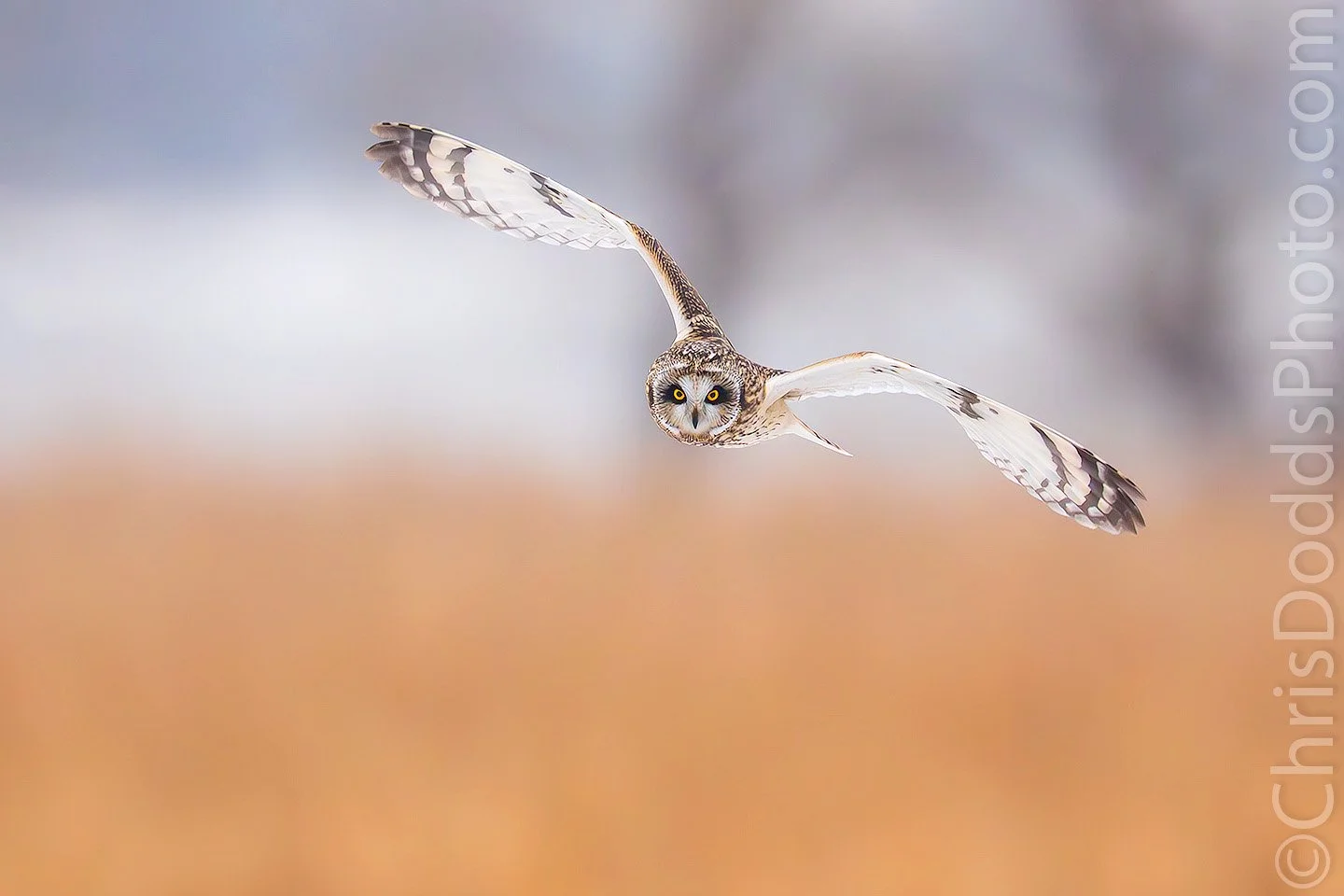
Short-eared Owl flying straight toward the camera with wings fully outstretched, yellow eyes bright, over a soft, blurred winter landscape with warm golden tones below and cool gray sky above.

Short-eared Owl — Silent Glide in Winter Light (Asio flammeus, Hibou des marais, Búho campestre, SEOW) Image Copyright ©Christopher Dodds All Rights Reserved. January 8, 2025, during week 1/8 of my Snowy Owl Workshops in Ontario, Canada. Sony a9 Mark III mirrorless camera body & Sony FE 600mm f/4 G Master OSS Lens with Sony FE 2X Teleconverter @1,200mm ISO 12,500, f/8 @ 1/5,000s. Manual exposure. Full frame image.

Why I Don’t Use Flash on Birds and Owls (and Why We Used To)

Christopher Dodds January 11, 2026

Why I Don’t Use Flash on Birds and Owls (and why we used to)

I’m occasionally asked why I don’t use flash for birds—especially owls. My answer is pretty practical: with modern cameras, I don’t need it, and it’s one more factor that can influence a bird’s behaviour.

That wasn’t always true.

A quick bit of history: film days, slow light, and the “Better Beamer”

In the film era, low light was a wall. Film was slow, usable shutter speeds were hard to come by, and you didn’t have today’s clean high-ISO files or low-light autofocus.

Flash became a solution—sometimes for exposure, and sometimes for aesthetics. A small catchlight can make a bird feel “alive” in the frame; without it, subjects photographed in flat light can look oddly lifeless.

That’s where the Fresnel flash extender came in: a simple lens that concentrates the flash beam so more of the light lands on the bird instead of being wasted across the whole scene. One of the best-known versions is the Better Beamer, which uses a Fresnel lens to narrow and concentrate the flash output.

And the Better Beamer has a name attached to it that matters to me personally.

Walt Anderson (RIP) and real innovation

My friend Walt Anderson (RIP) was the inventor/creator of the Visual Echoes Flash Extender—widely known as the Better Beamer.
He began exploring the then-new TTL flash systems in the early 1990s and founded Visual Echoes to produce and market the product.

It was a smart, practical innovation for the realities of that time. It helped many bird photographers produce better images when the tools simply weren’t what they are today.

What changed: modern cameras changed the need

Fast forward to now: modern sensors can handle ISO levels we wouldn’t have dreamed of in the film days, and autofocus can lock onto a subject in very low light. For most bird photography situations, I can make the image with ambient light and good technique—without introducing artificial light into the encounter.

So for me, flash has shifted from “useful tool” to “unnecessary tool” for bird photography.

Owls in particular

Most Owls are highly adapted to low-light environments. Their hunting and movement patterns are built around darkness and subtle contrast. Even if long-term effects of flash are debated in different contexts, the short-term reality in the field is that some birds react—blinking, flinching, shifting posture, or leaving a perch. If I can avoid introducing that variable, I will.

What the research says (a simple, measurable point)

There’s also a research-backed reason to be cautious with anything that increases disturbance.

A 2019 study in Biological Conservation looked at bird photography and quantified escape responses (flight-initiation distance). One of the headline findings: for most species, photographers triggered escape at greater distances than walkers, suggesting that photography can be a stronger disturbance stimulus than a normal passerby.

That doesn’t “prove” flash is always harmful—but it does reinforce a basic idea: our choices and behaviours around birds matter, and it’s worth minimizing anything that can add pressure.

The ethical baseline I follow

I try to keep my approach simple and consistent with widely shared best practices. NANPA’s Principles of Ethical Field Practices puts it plainly:

“If an animal shows stress, move back and use a longer lens.”

That line is easy to apply, and it works.

Where I land

I’m not interested in turning this into a debate. I’m interested in stacking the odds in favour of the bird.

So I work with available light, modern sensor performance, and field craft. And when the light isn’t there, I’d rather miss a frame than add a variable that I don’t need.

References

  • NANPA — Principles of Ethical Field Practices (Revised March 2018).

  • Slater et al. (2019) — “Camera shy? … avian responses to [bird photographers]” Biological Conservation(highlights include longer escape distances to photographers than walkers).

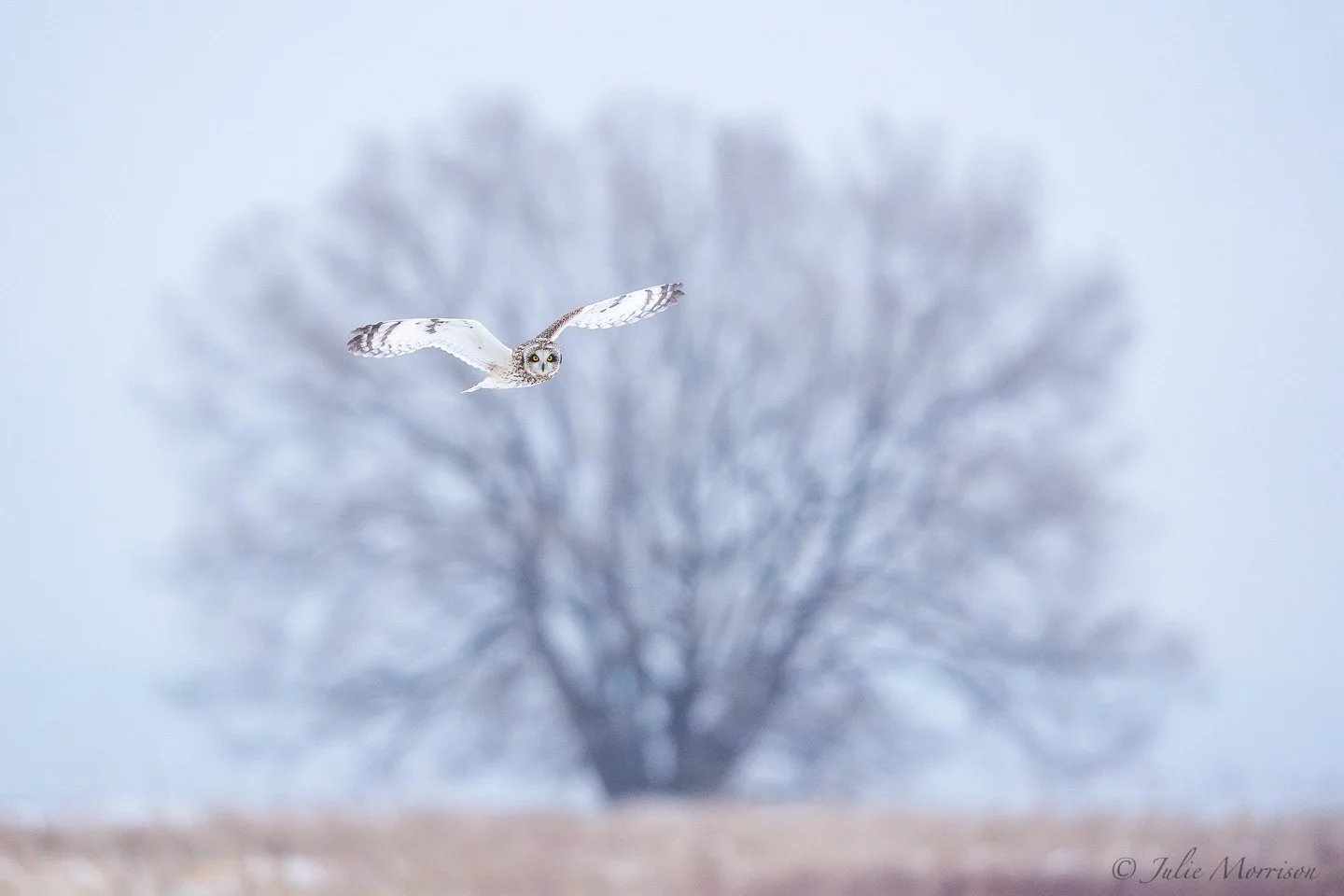
Short-eared Owl flying toward the camera in a pale winter sky, wings raised, with a large blurred leafless tree in the background and soft golden-brown fields below.

Short-eared Owl — Winter Flight with Lone Tree by Julie Morrison (Asio flammeus, Hibou des marais, Búho campestre, SEOW) January 8, 2025, during week 1/8 of the Snowy Owl Workshops in Ontario, Canada. Sony a9 Mark III mirrorless camera body & Sony SEL FE 200-600mm f/5.6-6.3 G OSS Lens @600mm. ISO 5,000, f/6.3 @ 1/5,000s Manual exposure.

That same afternoon—the very one that gave me the image at the top of this post—also produced a milestone I’m genuinely proud of: my wife, Julie Morrison, made an image that’s now being published here on the blog for the first time. If you’ve spent any time with us in the field, you already know she’s a gifted photographer with a calm, confident eye and a knack for timing. But what really makes my wife a force to be reckoned with on workshops is her owl-spotting superpower: she’ll pick up a shape, a posture, a blink of movement in the grass that most people would drive right past. I love watching her work, and I’m thrilled to share her first blog-published image—made on the same afternoon as mine.

In Bird Photography Tags bird photography, owl photography, wildlife photography, nature photography, ethical wildlife photography, wildlife photography ethics, NANPA, NANPA ethics, birding photography, bird photographer, owl photographer, flash photography, photography flash, Better Beamer, Fresnel flash extender, Walt Anderson, low light photography, natural light photography, high ISO, wildlife behavior, responsible photography, Julie Morrison
Comment
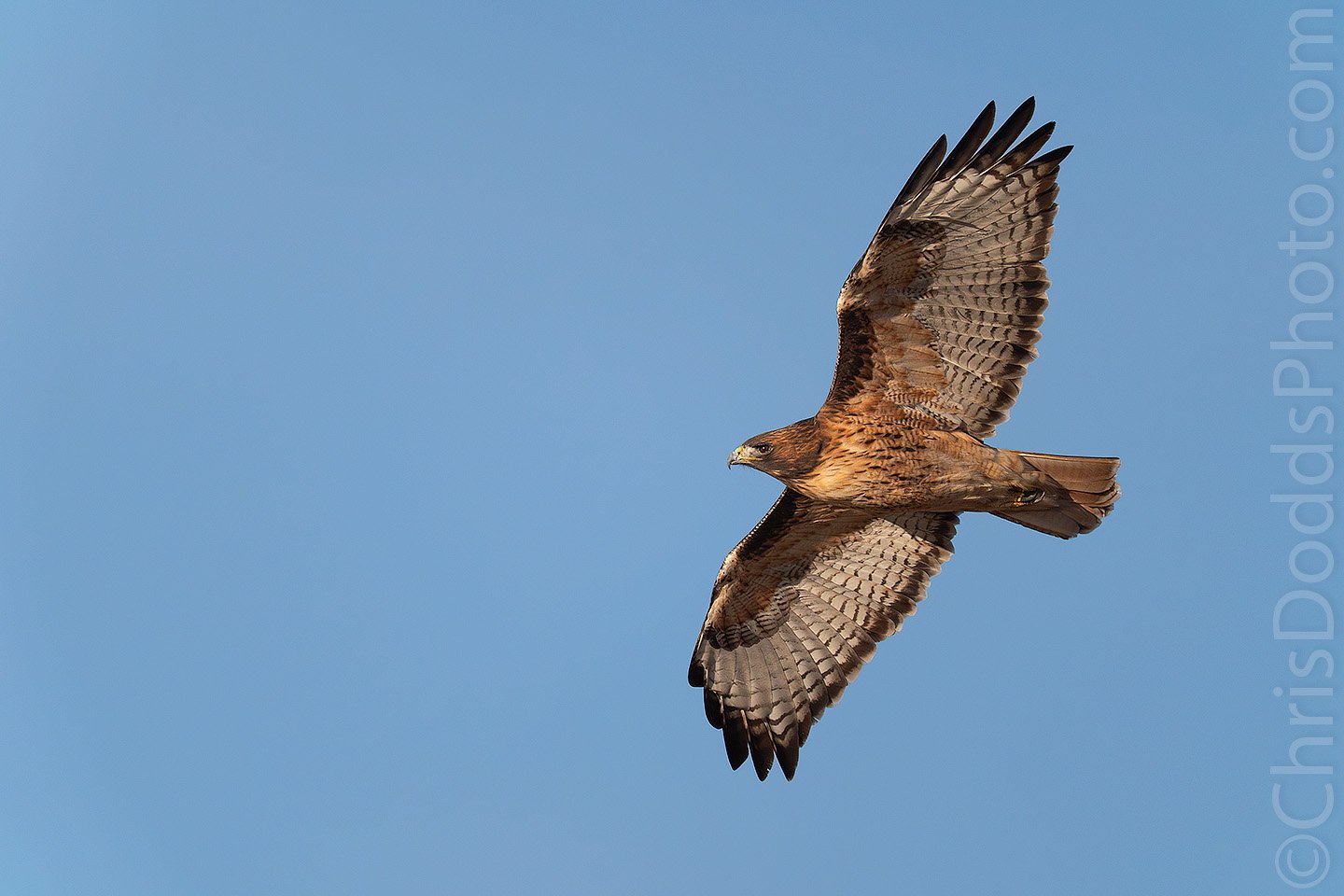
Red-tailed Hawk gliding in flight in soft morning light during the Better than Bosque photography workshop in New Mexico

Red-tailed Hawk in flight (Buteo jamaicensis, Buse à queue rousse, Busardo colirrojo, RTHA) from my Better than Bosque workshop. Bernardo Wildlife Area, Bernardo, New Mexico, USA. Image Copyright ©Christopher Dodds. Sony a9 III Mirrorless camera & Sony FE 600mm f/4 G Master OSS Lens with Sony FE 2X Teleconverter @1,200mm ISO 2,000, f/8 @ 1/5,000s. Manual exposure. Full frame image.

Dear Bird Photographer: On the Images That Matter More Than Likes

Christopher Dodds January 2, 2026

Dear Bird Photographer,

While everyone is filling their feeds with carefully curated “Best of 2025” collections, I wanted to pause and share something a little quieter.

This image—a Red-tailed Hawk in flight—was made during my recent Better than Bosque workshop. No drama. No explosive sky. No once-in-a-lifetime chaos unfolding in the frame. Just a wild bird doing what it has always done, moving effortlessly through clean New Mexico air in honest, early light.

And yet, this photograph represents more than it might appear at first glance.

You know the investment that goes into images like this. The early mornings. The cold hands. The long stretches of waiting. The years spent learning light, behaviour, timing, and restraint. When it finally comes together, the result is often something beautifully simple: sharp, well composed, and true.

But here’s the strange part—we hesitate to celebrate these photographs.

Why?

Because we already know how they’ll land online. They won’t trigger an epic response. They won’t stop thumbs mid-scroll. They don’t shock, exaggerate, or rely on spectacle. And in a world overflowing with astonishingly capable cameras and millions of people making technically solid bird images every day, work like this can start to feel… ordinary.

It isn’t.

Look a little closer.

The wing position is classic red-tail—broad, powerful, unhurried. The light slips gently through the primaries, revealing just enough translucence to show that the sun angle was correct. The warm tones in the tail and upperwing are present but restrained. The head is sharp, the eye alert. There’s space to fly. Nothing is forced. Nothing clipped. Nothing is screaming for attention.

This is the kind of image that comes from understanding birds, respecting light, and trusting patience. It’s what happens when experience quietly does its work.

Social media rewards novelty and extremes. Photography—real photography—rewards consistency, restraint, and the ability to recognize a good moment even when it doesn’t shout.

So here’s my invitation to you.

Instead of asking which image performed best this year, ask yourself which photograph still carries a story only you remember. The cold morning. The quiet drive. The bird you didn’t expect. The moment that made you pause and smile behind the camera. The image that may never go viral, but still feels right every time you return to it.

If you’re inclined, take a moment to revisit that photograph. Recount the story behind it—to yourself, to a friend, or in a few quiet words shared somewhere meaningful. Those are the images that remind us why we show up in the first place.

Sometimes, a simple, honest photograph of a beautiful bird in good light is more than enough.

And sometimes, that’s precisely the point.

—Chris

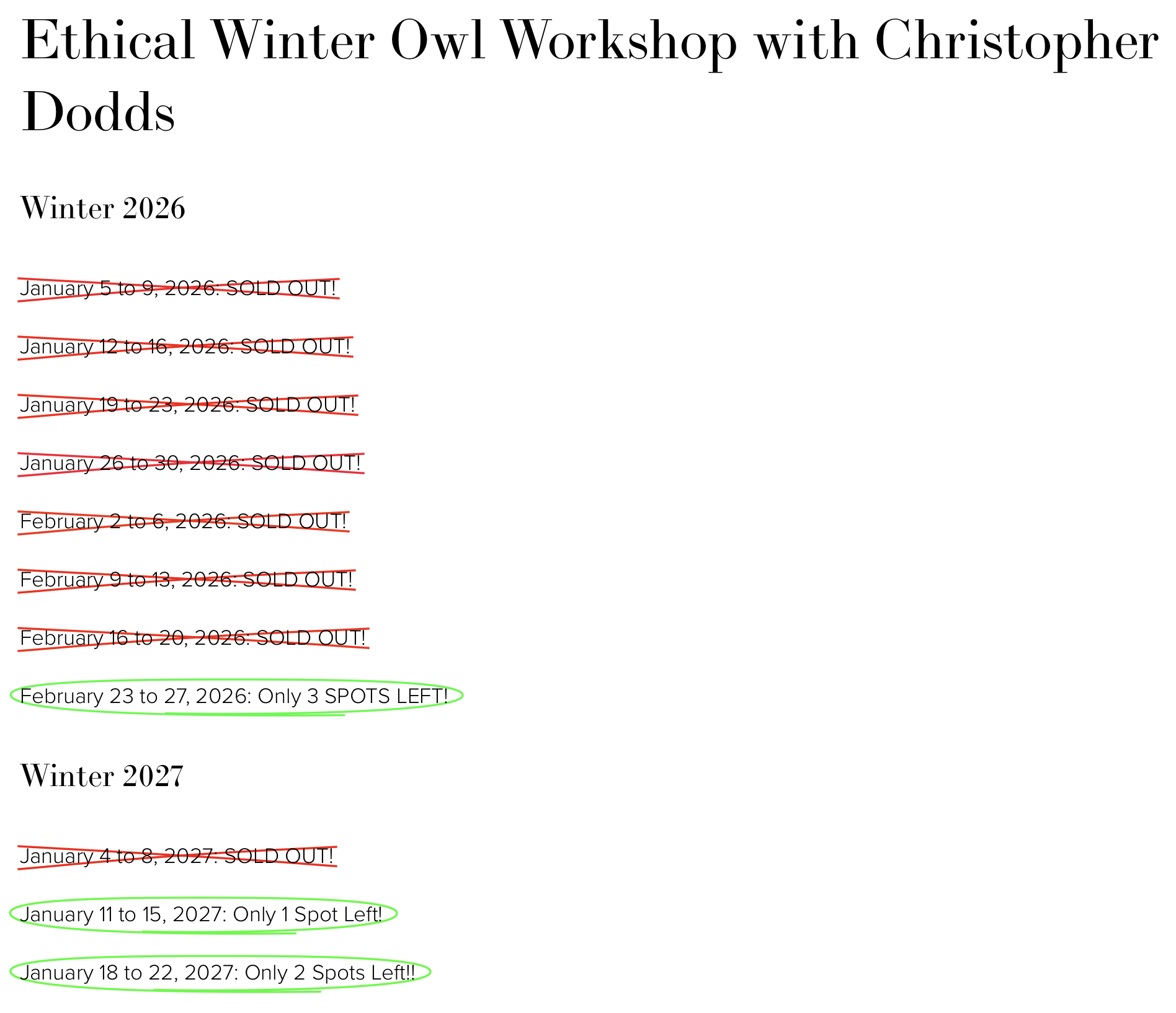
Ethical Winter Snowy Owl Great Grey Owl Great Gray Owl Workshop Chris Dodds

Subscribe

Sign up with your email address to receive news and updates.

We respect your privacy.

Thank you!
In Bird Photography, Workshop Report Tags bird photography, wildlife photography, red-tailed hawk, hawk in flight, bird photographers, Better than Bosque, photography reflection, photography mindset, nature photography, wildlife art, birds in flight, ethical wildlife photography, photography process, quiet moments, meaningful images
2 Comments
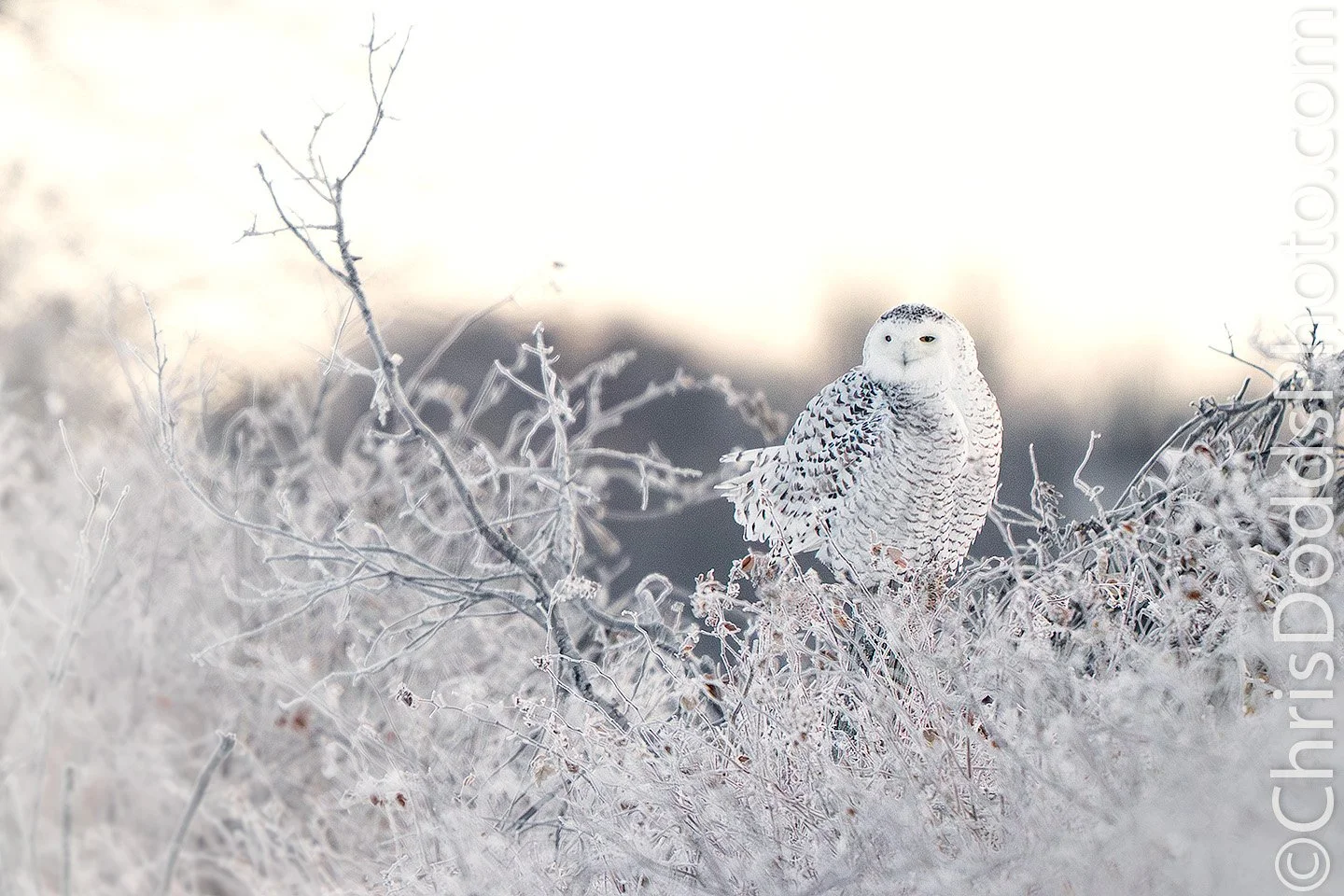
Snowy Owl perched in hoar-frosted grasses before sunrise on a freezing New Year’s morning, softly lit by the first warm light of dawn.

Snowy Owl Hoar Frost (Bubo scandiacus, Harfang des neiges, Búho nival, SNOW) Jan.1, 2025, while scouting my Snowy Owl Workshop in Ontario, Canada. Sony a1 Mark II mirrorless camera body & Sony FE 600mm f/4 G Master OSS Lens with Sony FE 2X Teleconverter @1,200mm ISO 20,000, f/8 @ 1/5,000s. Manual exposure. Full frame image.

Snowy Owl - A Silent Start to the New Year

Christopher Dodds January 1, 2026

There’s a certain kind of quiet that only exists before sunrise on a winter morning. Not the absence of sound, but a deep, enveloping stillness—the kind that makes you slow your breathing without even realizing it.

This image was made before the sun rose on the very first morning of the new year. The world was locked in a hard freeze, every stem and twig coated in hoar frost and fresh snow, the air so cold it felt brittle. No wind. No voices. Just that hushed, almost sacred calm that settles in when nature is completely at rest.

The Snowy Owl sat patiently, perfectly at home in this frozen landscape, its white plumage echoing the frost-covered branches around it. Then, quietly, the first hint of warm light began to build behind the clouds—subtle and fleeting, but enough to soften the scene and add a gentle glow to an otherwise icy morning. That contrast between biting cold and emerging warmth is something I never get tired of witnessing.

Photographing in conditions like this is always a balance between respect for the subject and respect for the moment. The light was barely there, long before sunrise, which meant leaning hard on modern tools while staying invisible and quiet. This frame was made with a Sony a1 Mark II, a Sony 600mm f/4 lens, and a 2X teleconverter, at f/8, 1/5,000s, ISO 20,000. Some moments are worth every challenge, every frozen fingertip, and every early morning—this one was so cold my eyelids briefly stuck together when I blinked.

As the new year begins, experiences like this feel especially meaningful. Extraordinary wildlife encounters don’t announce themselves; they reveal themselves slowly, to those willing to stand in the cold, in silence, and pay attention. They remind me why I keep returning to wild places—year after year, before dawn—chasing those brief intersections of light, life, and stillness.

Wishing you a Happy New Year—one filled with warm light, extraordinary wildlife encounters, and the quiet joy that comes from simply being there to witness them.

Ethical Winter Snowy Owl Photography Workshop with Canadian Nature Photographer Christopher Dodds
In Bird Photography Tags snowy owl, winter wildlife photography, hoar frost, dawn light, new year reflection, wildlife photography, canadian winter, cold weather photography, peaceful moments in nature, nature photography blog, bird photography, winter dawn, quiet moments, extraordinary wildlife encounters, sony a1 mark ii, workshop, Photo tour
Comment

Subscribe

Sign up with your email address to receive news and updates.

We respect your privacy.

Thank you!

All content (including text, design, photos, layout, and graphics) are copyright ©Christopher Dodds www.ChrisDoddsPhoto.com