We didn’t have “perfect” weather during my recent Ospreys Galore workshop in Florida — and I wouldn’t change a thing.
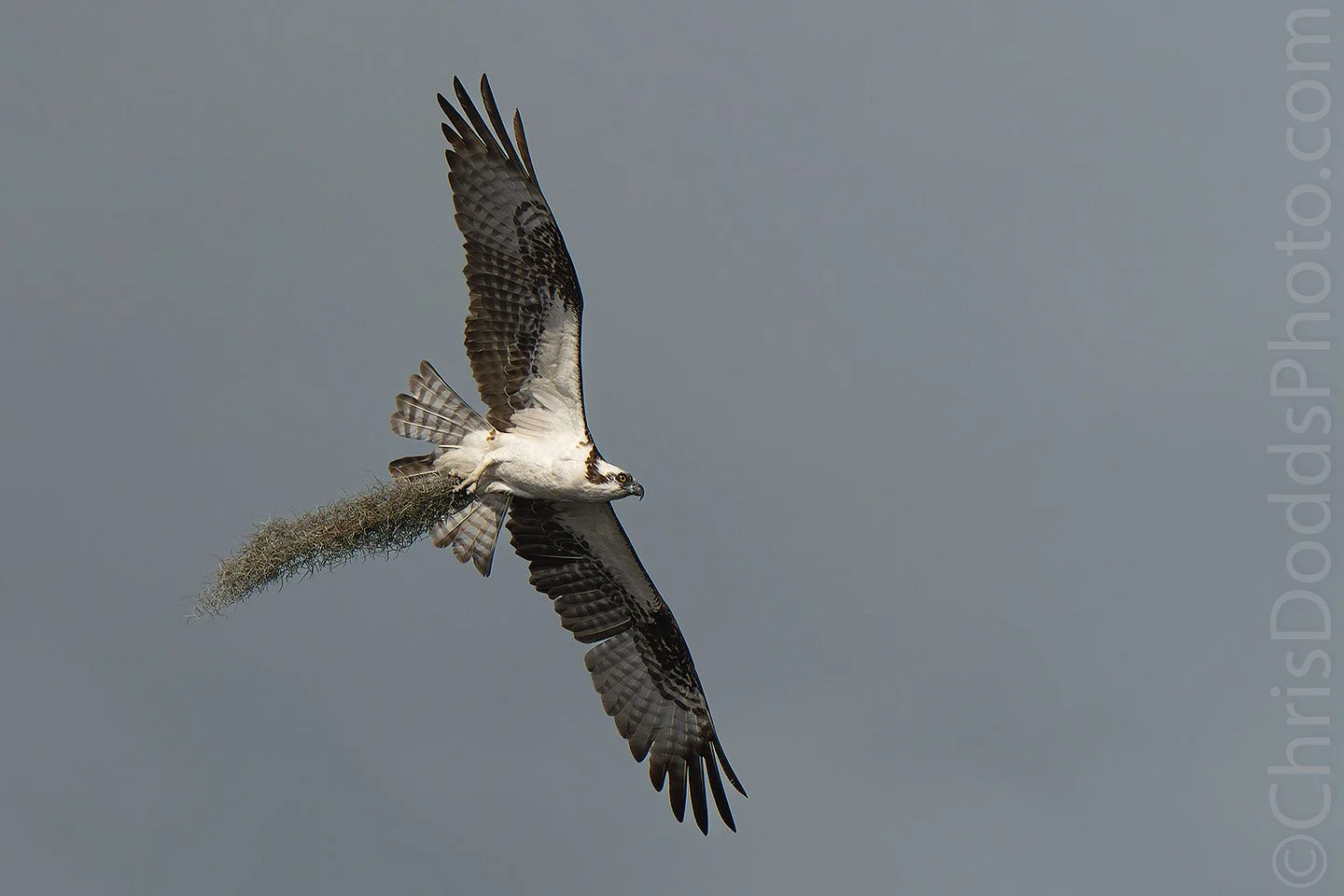
This is a male osprey (no brown necklace) bringing Spanish moss back to the nest. We saw this behaviour repeatedly during the trip. Once chicks hatch, nest maintenance becomes constant — in and out, all day long.
Spanish moss is everywhere in the cypress trees around Lake Blue Cypress, so it’s the go-to material. If you watch long enough, you start to see the pattern — leave the nest, grab moss, straight back in.
And there’s a reason for the urgency.
Before the chicks learn to back up and send everything over the edge, the nest gets messy fast. Fresh material helps keep things under control, and the adults stay on top of it.
What I like here is the background.
Most people chase a blue sky. I’ll take this “battleship grey” every time. It isolates the bird, shows the shape, and lets the detail in the wings — and that trailing moss — stand on their own without distraction.
Lake Blue Cypress holds one of the highest densities of nesting ospreys in Florida — hundreds of active pairs in a relatively tight area — which is what makes behaviour like this so repeatable if you put the time in.
No tricks. Just set your manual exposure for the light falling on the subject, pay attention, and be ready when it happens.
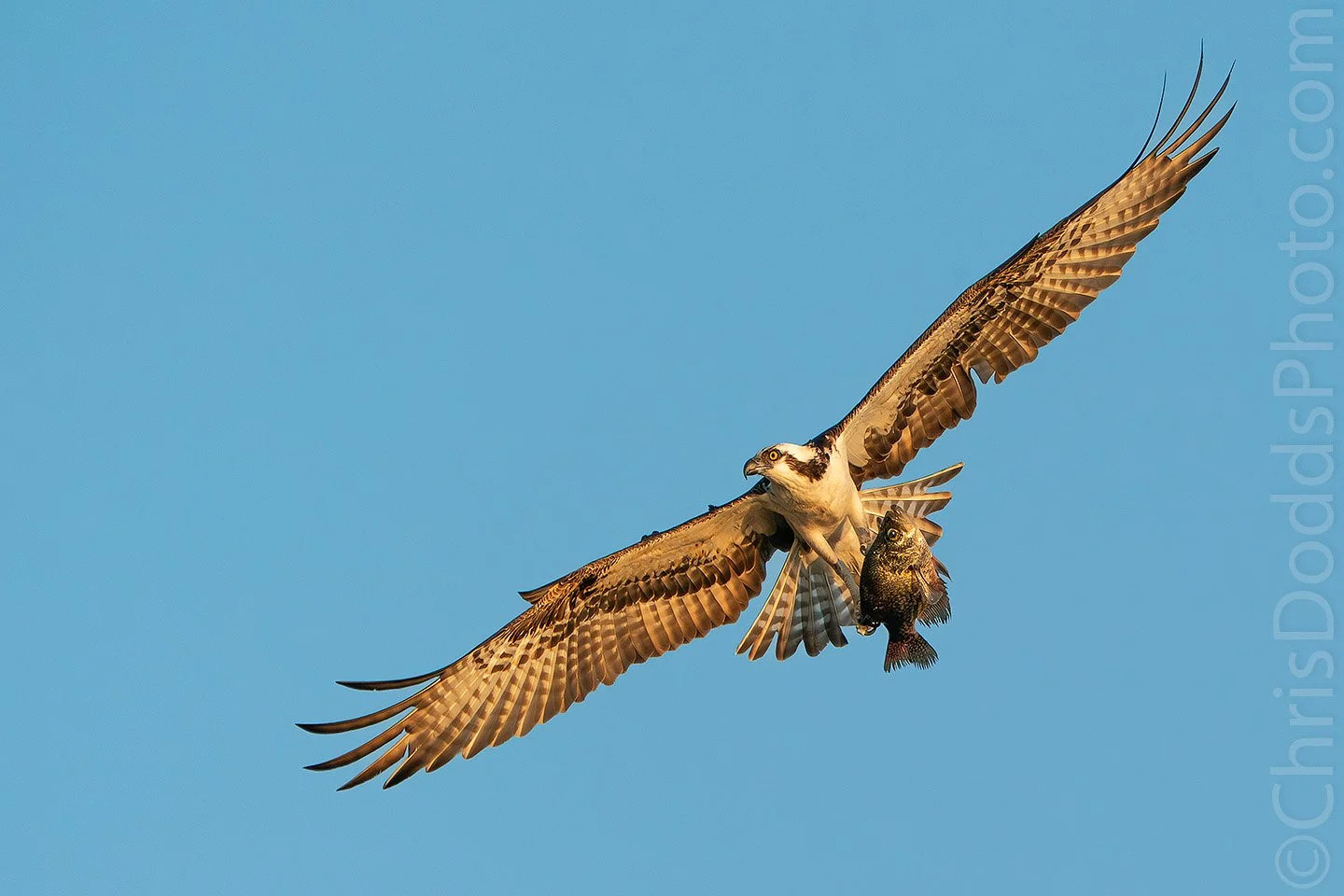
Osprey displaying with Catch in Golden Light (Pandion haliaetus, Balbuzard pêcheur, Águila pescadora, OSPR) from my Ospreys Galore Workshop at Lake Blue Cypress near Vero Beach, Florida, USA. Image copyright ©Christopher Dodds. Sony a1 Mark II Mirrorless camera & Sony FE 400-800mm f/6.3-8 G OSS Lens @610mm ISO 1,000, f/8 @ 1/5,000s. Manual Exposure mode. Full frame image. Join me for my Ospreys Galore workshop every April. To learn more, CLICK HERE.
Testimonial
“This was my 3rd workshop with Chris and as always Chris improvised to make it happen for us. Anyone who photographs outdoors and especially wildlife knows that weather and lighting are key to having good results. We can’t control the weather but we can adjust to the lighting we’re given. What Chris did on all three of my trips is adjust to both of these for every morning and afternoon shoot. The Osprey trip was a perfect challenge - the first two days wind and storms prevented us from being on the lake to photograph the ospreys so Chris shifted our location for both the morning and afternoon shoots to minimize the weather impact of rain and wind. Not to say we didn’t have to wait out a deluge of rain for an hour but 20 minutes after it blew by we were back out for the last 45 minutes of perfect light. For the first two days we got to shoot a wide variety of cranes, spoonbills, egrets, storks, anhingas, limpkins, ibis, hawks, swamp hens, terns and stilts. Both days we were treated with the brilliant roseate spoonbills flying in towards us to pick up nesting material. But then the prize for me was Friday morning on the lake at sunrise for the osprey. In a mile and a half stretch we saw over 100 nests and at least 150 osprey. Between Chris and the boat owner they held the boat at the best angle for the osprey to be lit perfectly. After filling 2-1/2 128GB cards it was time to leave the perfect osprey shoot. In the last 20 years of my photography this was by far the most photos I’ve taken over a three day period. If you want to get your absolute best excellent bird photography opportunities I highly recommend the Birds of Pelee and Ospreys of Florida. I own the 300,400 and 600mm lenses but I used the Sony 400-800mm lens for both trips and the zoom capability, excellent stabilization and weight make it the perfect lens for both these workshops. Thanks Chris!”
- Tony Pianalto Kansas | USA