
There are already plenty of reviews that cover MTF charts, autofocus tests, and every specification Sony publishes. That's not what this is.
If you've followed my work for any length of time, you'll know I don't write reviews after an afternoon in the backyard. I prefer to let the field decide.
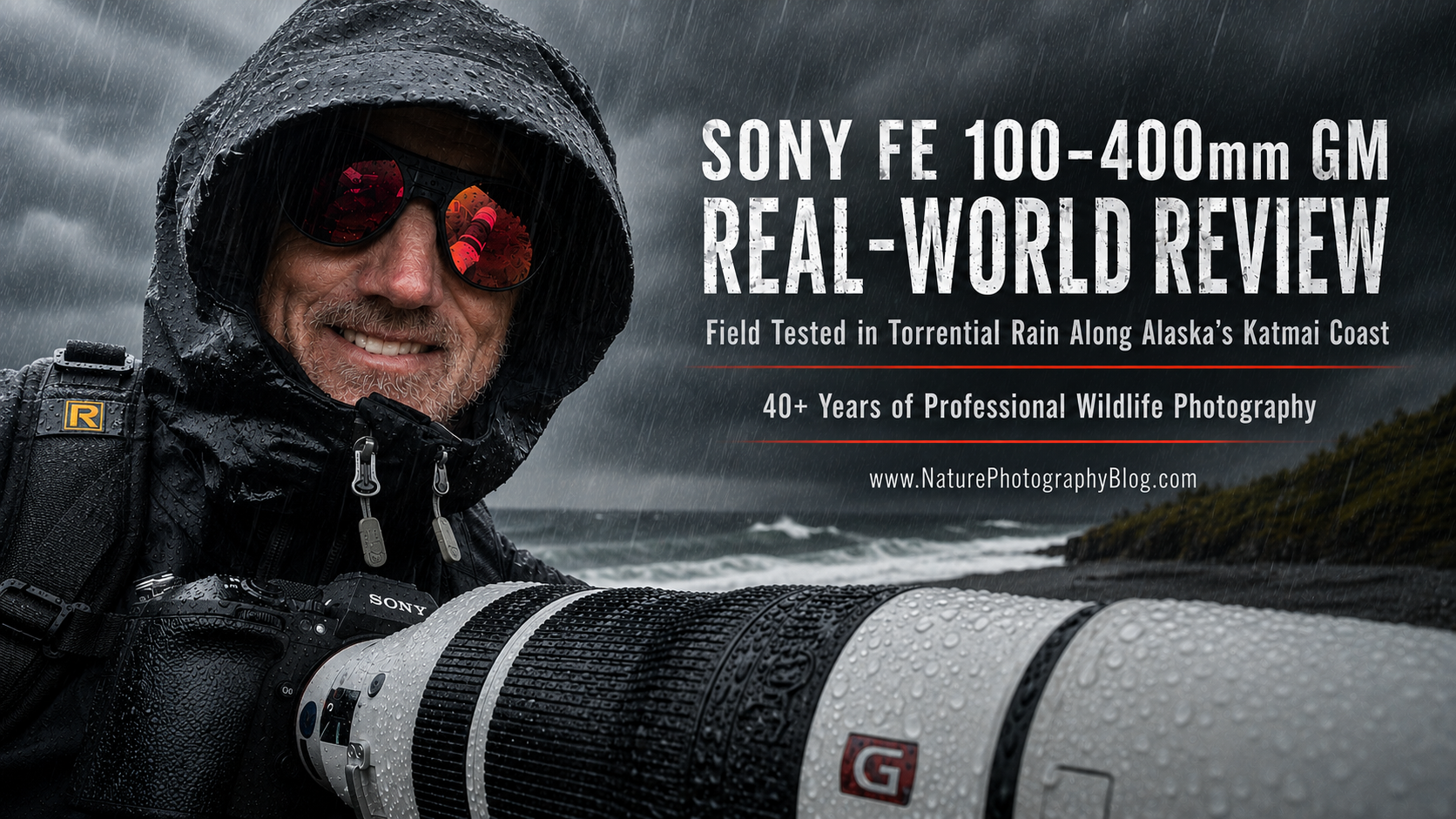
To evaluate Sony's new FE 100–400mm GM, I took it where my equipment earns its keep—photographing wildlife along Alaska's Katmai Coast. Over several days it faced birds, bears, salt spray, and persistent torrential rain. I wasn't looking for perfect conditions. I wanted to know how it would perform when the weather turned ugly and failure simply wasn't an option.
It didn't disappoint.
Despite spending hours in soaking rain, the weather sealing inspired confidence throughout the trip. The lens never missed a beat, allowing me to concentrate on photography instead of worrying about my equipment.
The first thing that impressed me was the image quality. Sharpness is exceptional throughout the zoom range, contrast is excellent, and the files have that polished "G Master look" that is difficult to describe until you see it for yourself. Colours are rich without appearing over-processed, and images have a crisp, three-dimensional quality that requires very little effort in post-processing.
The build quality is exactly what I expect from a professional wildlife lens. Everything feels solid, well thought out, and built for years of hard use. The zoom ring is smooth, controls fall naturally under your fingers, and the lens balances beautifully on my Sony a1 II.
Autofocus has received widespread praise from reviewers, and my experience generally agrees with that consensus. In normal use the autofocus is fast, decisive, and extremely accurate. Birds in flight, mammals, and rapidly changing wildlife situations were handled with confidence, and I rarely found myself waiting for the lens to catch up.
Where I noticed a difference was when using the Sony 2× Teleconverter. Autofocus remained perfectly usable, but I consistently found my native Sony 400–800mm to acquire focus faster and track distant wildlife more confidently at 800mm. That isn't particularly surprising. The 400–800 is working at its native focal length and maximum aperture of f/8, while the 100–400 with the 2× Teleconverter is operating at approximately f/9 while asking the autofocus system to look through additional optics. For photographers who spend most of their time at maximum reach, the native 400–800 still has the edge.
That observation shouldn't be interpreted as criticism of the 100–400. On the contrary, I believe it's one of the finest telephoto zooms Sony has produced.
The versatility of beginning at 100mm cannot be overstated. One moment I was photographing expansive coastal landscapes; the next I was filling the frame with distant wildlife. That flexibility means fewer missed opportunities and fewer lens changes in challenging conditions.
Would I replace my 400–800 with it?
No.
Would I happily own both?
Absolutely.
For my style of wildlife photography, the 400–800 remains my first choice when maximum reach is the priority. But if I were heading out with only one telephoto lens and expected everything from landscapes and environmental wildlife portraits to larger mammals and birds, the Sony FE 100–400mm GM would be extraordinarily difficult to leave behind.
Sony didn't simply update a popular lens—they refined an already excellent design into one that inspires confidence every time you raise it to your eye.
What I Loved
Outstanding image quality throughout the zoom range.
Excellent contrast, colour, and overall rendering.
Fast, accurate autofocus in real-world wildlife situations.
Confidence-inspiring weather sealing that performed flawlessly in torrential rain.
Professional ergonomics and superb handling.
Remarkably versatile focal length range.
What to Consider
If your photography is almost exclusively at 800mm, the native Sony 400–800mm focuses a little faster and more confidently than the 100–400 paired with the 2× Teleconverter.
Premium performance comes with a premium price.
Final Thoughts
This isn't a lens that spends its life on a shelf or in a camera bag. It's built to be used, and after field testing it in some of Alaska's wettest conditions, I wouldn't hesitate to take it anywhere.
Rating: 9.8/10
Highly Recommended.
See the Lens in Action
A review is one thing, but photographs are what really matter. During my time field testing the Sony FE 100–400mm GM along Alaska's Katmai Coast, Kodiak Island, and around Anchorage, Alaska, I photographed everything from bears and songbirds to coastal landscapes in persistent rain and challenging conditions. Rather than simply taking my word for it, I invite you to judge the lens by the photographs it produced. Here are a few recent posts featuring images made during this review.
Golden-crowned Sparrow Stretching After a Shake on Kodiak Island (Sony FE 100–400mm GM with the 2× Teleconverter)
Pacific Wren Singing in the Cold Morning Air on Kodiak Island (Sony FE 100–400mm GM with the 2× Teleconverter)
Photographing a Townsend's Warbler Near Anchorage, Alaska in Early June (Sony FE 100–400mm GM with the 2× Teleconverter)
Orange-crowned Warbler in Flight on Kodiak Island, Alaska (Sony FE 100–400mm GM with the 2× Teleconverter)
Photographing Sea Otters in Antoine Larson Bay, Kodiak Island, Alaska (Sony FE 100–400mm GM)
Support Nature Photography Blog
If you enjoy the photographs, stories and free photography articles I share here, I'd appreciate your support. Purchasing through the affiliate links below costs you nothing extra, but it helps offset the considerable time and expense of travelling to wild places, creating new content and maintaining this site—all without subscriptions or paywalls.
Thank you for helping keep Nature Photography Blog free for everyone.
Gear featured in this post:
Sony FE 400–800 mm F6.3-8 G OSS
Sony α1 II Mirrorless Camera Body