Point Pelee Black-Throated Blue Warbler

The first Christopher Dodds X Sony of Canada photo walk at Point Pelee National Park was a massive success with a great group of keen photographers. Birding started a bit slow in the fog, but thankfully, the rain held off, and we had a busy afternoon with some fantastic birds. We saw many Black-throated Blue Warblers among the mix, and while they were pretty active, they did settle down and pose for pictures occasionally.

This particular Black-throated Blue Warbler paused briefly behind some thick vegetation. I quickly shifted my position to get the right light angle, pre-visualizing the perch and the light. Sure enough, the warbler landed just as I brought my camera up to my eye. Fun fact: the Black-throated Blue Warbler has a distinctive, buzzy song that some people describe as sounding like "I am so la-zee."

Black-throated Blue Warbler (Setophaga caerulescens, Paruline bleue, Reinita azulada, BTBW). From my Songbirds of Pelee Workshop on May 5, 2025, at Point Pelee National Park of Canada. Image Copyright ©Christopher Dodds. Sony a9 III Mirrorless camera & Sony FE 400-800mm f/6.3-8 G OSS Lens @710mm ISO 2,500, f/8 @ 1/5,000s. Manual exposure. Full frame image.

Point Pelee Surprise: Hooded Warbler Magic and Workshop Prep

Yesterday's uneventful nine-hour pre-dawn drive delivered me to Point Pelee, where a quick scouting mission for the upcoming "Songbirds of Pelee" Workshop turned into a surprisingly fantastic afternoon despite the cloudy skies.

While the park isn't teeming with birds, the quality of species encountered was exceptional. My walk began with a Prothonotary Warbler and Northern and Louisiana Waterthrushes showcasing their distinct plumages that even ended up on the same log at one point – a photographic challenge thanks to the many obstructing branches. However, the true highlight for me was a beautiful male Hooded Warbler in fresh breeding plumage. For a full twenty minutes, I had this gem all to myself. Lost in its post-migration feeding frenzy, it remained completely oblivious to my presence. After spending most of its time amidst dense vegetation, it briefly hopped onto a characterful perch with a clean background and offered a fleeting pose. My heart skipped a beat as I gently pressed the shutter, and thanks to pre-capture, I managed a few frames as it took flight. While I prefer smaller perches for warblers, this one has enough character to work - smile!

I chose the Sony a9 mark III paired with the brand new 400-800mm Zoom, and it proved to be a perfectly portable and capable setup for wandering trails looking for migrants; I can't think of a good reason to choose to haul the 600mm around :)

Along the trails, I also enjoyed reconnecting with some old friends: great warblers and good company. The anticipation for the workshop is building! More updates from this incredible birding hotspot will follow soon.

Hooded Warbler (Setophaga citrina, Paruline à capuchon, Reinita encapuchada, HOWA). While scouting for my Songbirds of Pelee Workshop on May 3, 2025 at Point Pelee National Park of Canadaa. Image Copyright ©Christopher Dodds. Sony a9 III Mirrorless camera & Sony FE 400-800mm f/6.3-8 G OSS Lens @800mm ISO 10,000, f/11 @ 1/2,500s. Manual exposure.

Deluxe Puffins Galore: A Photography Workshop on L' île aux Perroquets

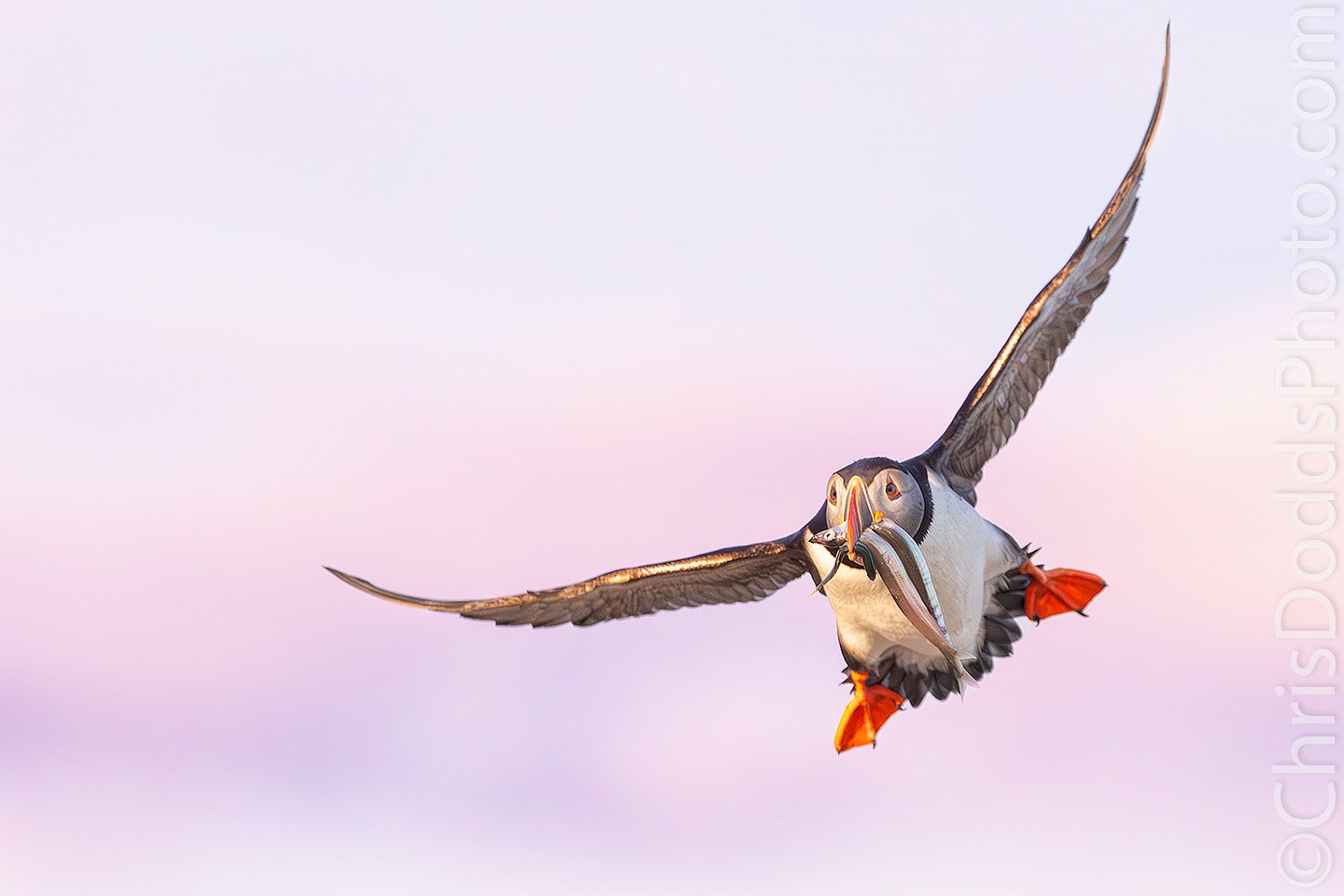
Imagine a place where the only sounds at first and last light are the gentle lapping of waves and the calls of seabirds. A place where the sky explodes in a brilliant pink as the sun dips below the horizon, painting a breathtaking backdrop for nature's most charming spectacle: puffins returning to their nests with fish for their young.

This magic awaits you at our Deluxe Puffins Galore workshop on the Lighthouse Island called L'île aux perroquets. You'll have the unparalleled opportunity to photograph these charming seabirds in their element, often only a short distance away. No need to worry about heights – our prime photography locations are easily accessible and not at the top of cliffs.

Picture yourself, camera in hand, immortalizing these captivating creatures as they land with their precious cargo, the picturesque lighthouse standing sentinel in the background. Create a stunning portfolio of seabird images, including Puffins, Razorbills, Guillemots and more.

Join us for an unforgettable experience where nature's beauty unfolds before your lens. Gourmet food and comfortable lighthouse accommodations are just a short, scenic 200-meter (220-yard) stroll away. Don't just dream about this – live it! Book your spot today and let the puffins and Lighthouse Island magic capture your heart and your camera.

CLICK HERE Learn more and sign up CLICK HERE

|

CLICK HERE Learn more and sign up CLICK HERE |

Atlantic Puffin in flight with fish at sunset (Fratercula arctica, Macareux moine, Frailecillo atlántico, ATPU) from my Deluxe Puffins Galore Lighthouse Island Workshop Adventure. Mingan Archipelago National Park Reserve, Quebec, Canada. Image Copyright ©Christopher Dodds. Sony Alpha 1 Mirrorless camera & Sony 200-600mm Lens (@406mm) ISO 5,000, f/6.3 @ 1/5,000s Manual exposure. Full frame image.

“My friends and I are nearly full-time workshop participants. We love being guided around the world, photographing wildlife with experts and other like-minded people. Finding and travelling with Chris Dodds, however, was a special gift. He TRULY knows the areas in which his workshops are held. He knows the people, the wildlife, and their behaviour. And, of course, he knows photography and how to teach. Now when I’m shooting, I’m channelling Chris and what he’s taught me.”

- Linda Scher - Minneapolis, Minnesota, USA (Winter Snowy Owls 2023, Songbirds of Pelee 2023 & Deluxe Atlantic Puffins 2023)

Black Guillemot with fresh fish breakfast

The cool, salty air whipped around us on the beach of the enchanting lighthouse island, and a symphony of seabird calls echoed as we listened to the distant blow of a Minke whale during the Deluxe Atlantic Puffin Workshop. Our group of delighted photographers, already buzzing from close encounters with those charismatic clowns of the sea, the Atlantic puffins, were about to witness another of nature's little dramas unfold. As the tide gently rose, the Black Guillemots, initially perched on seaweed-covered rocks, began to seek higher ground. One particular guillemot, a stunning specimen with its sleek black plumage, striking white wing patches, and vibrant red feet, decided to grace us with its presence for a full half-hour.

This Black Guillemot had a successful hunt; It proudly displayed an Arctic Shanny, the small fish appearing somewhat defeated in the bird's grasp. The guillemot, with its alert, dark eyes, seemed to exude a sense of triumph, a stark contrast to the seemingly hopeless and certainly final expression on the face of the Arctic Shanny. Interestingly, the image shows the guillemot holding the fish in a specific direction, a behaviour noted in Black Guillemots; this preference is more common among adult birds, with some individuals consistently carrying prey with the fish head on the same side of their bill. Studies have shown that many Black Guillemots exhibit this "handedness."

Investing time with our subject and studying its behaviour created a genuinely captivating photographic opportunity. It was a moment where nature, in all its beauty and drama – and the sometimes stark reality of the food chain – unfolded right before our eyes (and lenses!).

Black Guillemot Displaying (Cepphus grylle, Guillemot à miroir, Arao aliblanco, BLGU) from my DELUXE ATLANTIC PUFFIN TOUR (and so much more) Mingan Archipelago National Park Reserve, Quebec, Canada. Image Copyright ©Christopher Dodds All Rights Reserved. Sony Alpha a9 Mirrorless, Sony 600mm f/4 GM OSS Lens, Sony FE 2X Teleconverter @ 1,200mm. f/8 ISO 4,000 @ 1/4,000s. Full Frame image.

Savannah Sparrow

Continuing on the diverse avian life theme that can surprise and delight during my "Deluxe puffins galore and so much more" workshop, I wanted to share this image of a beautiful Savannah Sparrow. Imagine capturing moments like these – the soft, overcast light on Lighthouse Island and wide open aperture were absolutely key to achieving the dreamy, painterly background you see here. It gently diffused across the scene, enriching the subtle hues and allowing the vibrant colours to blend seamlessly into a wash of breathtaking tones. By paying particular attention to this backdrop, I aimed to create a composition where the sparrow truly sings against its environment.

This stunning Savannah Sparrow is just a taste of the "so much more" that awaits you beyond the star puffins on Lighthouse Island. Our workshop offers unparalleled opportunities to photograph a variety of captivating species in their natural habitat, all while basking in the stunning coastal scenery of the Gulf of the Saint Lawrence. Join me for an unforgettable experience where "puffins galore" is just the beginning of the photographic adventures that unfold!

Fun Fact: Savannah Sparrows have regional "dialects" in their songs, with variations in trills and buzzes that differ between populations.

Savannah Sparrow (Passerculus sandwichensis, Bruant des prés, Chingolo sabanero, SASP) from my DELUXE ATLANTIC PUFFIN TOUR (and so much more) Mingan Archipelago National Park Reserve, Quebec, Canada. Image Copyright ©Christopher Dodds All Rights Reserved. Sony Alpha a1 Mirrorless, Sony 600mm f/4 GM OSS Lens, Sony FE 2X Teleconverter @ 1,200mm. f/8 ISO 5,000 @ 1/5,000s. Full Frame image.

Beyond the Puffins: Discovering the Elegant Black Guillemot

The Deluxe Puffins Galore workshop truly lives up to its name, offering incredible opportunities to photograph the charismatic clowns of the sea that everyone adores; I dare say the best in the world. But amidst the flurry of orange feet and comical dives, another seabird nests among the rocks: the elegant Black Guillemot.

While the puffins understandably command attention with their vibrant plumage and playful antics, the Black Guillemot offers a different kind of beauty – a sleek, understated sophistication. In their breeding plumage, they are a striking study in contrasts: velvety black feathers offset by brilliant white wing patches and startlingly red-orange legs and feet.

One stormy afternoon, the Black Guillemots came into their own as the tide receded, revealing swathes of glistening seaweed draped over the flat rocks. The overcast sky diffused the light beautifully, creating a soft, even illumination that brought out the subtle textures in their feathers and the rich hues of their legs.

It was a lesson in patience and observation. While the puffins often provided instant action, photographing the Black Guillemots required a more contemplative approach. It was about waiting for the right moment, the perfect pose, the subtle shift in light that would reveal their quiet beauty. As we lay there in the seaweed, more Black Guillemots flew in, and as time passed, they ignored us and kept getting closer.

The experience underscored the richness of the seabird ecosystem. The Deluxe Puffins Galore workshop wasn't just about one star species; it is a deep dive into the interconnected lives of numerous fascinating birds. The Black Guillemots, with their understated elegance and captivating presence, were a powerful reminder of the diverse wonders that coastal habitats hold. They proved that the most rewarding photographic moments sometimes come when you slow down, lie low, and appreciate the subtle beauty surrounding you. And yes, even a bit of seaweed-induced dampness is a small price for such an intimate encounter with these magnificent birds.

Black Guillemot Displaying (Cepphus grylle, Guillemot à miroir, Arao aliblanco, BLGU) from my DELUXE ATLANTIC PUFFIN TOUR (and so much more) Mingan Archipelago National Park Reserve, Quebec, Canada. Image Copyright ©Christopher Dodds All Rights Reserved. Sony Alpha a1 Mirrorless, Sony 600mm f/4 GM OSS Lens, Sony FE 2X Teleconverter @ 1,200mm. f/8 ISO 6,400 @ 1/5,000s. Full Frame image.

Dorsal View of Razorbill in Flight with Fish

There are moments in nature that etch themselves into your memory. One such moment unfolded during my Deluxe Puffins Galore and so much more workshop last summer, with my small group of photographers perched on a beach at the base of the seabird nesting colony. The tide was changing, and with it came a spectacle of thousands of Razorbills and Atlantic Puffins circling as they returned from a successful fishing expedition; they created a dynamic scene against the backdrop of an incoming heavy fog. While presenting a photographic challenge, the fog added an element of magic to the encounter. Birds would materialize out of the mist with mouthfuls of fish, their dark silhouettes contrasting against the ethereal backdrop.

We were particularly captivated by the Razorbills with their beaks laden with fish. I captured this dorsal view as it banked in flight using my Sony 100-400mm zoom lens at 400mm and my Sony a1. The details recorded in its dark feathers are remarkable.

The scene on the beach was equally captivating. My fellow photographers, focused and determined, worked to capture the fleeting moments. The interplay of the fog, the waves crashing on the shore, and the cries of the seabirds created an atmosphere of awe-inspiring wilderness.

Razorbill in flight with Fish Close Encounter (Alca torda, Petit Pingouin, Alca común, RAZO) from my Deluxe Puffins Galore Lighthouse Island Workshop Adventure. Mingan Archipelago National Park Reserve, Quebec, Canada. Image Copyright ©Christopher Dodds. Sony Alpha a1 Mirrorless camera & Sony FE 100-400mm f/4.5-5.6 G Master OSS Lens @400mm. ISO 800, f/5.6 @ 1/5,000s Manual exposure. Full frame image.

“Witnessing puffins is a truly magical experience that stays with you forever. My time at your workshop on Île aux Perroquets was unforgettable! Nestled on a tiny island off the stunning, rugged coast of northeastern Canada, the entire experience felt like stepping into another world. The lighthouse keeper’s house—beautifully restored and full of character—was warm, inviting, and cozy, the perfect retreat after long days in the field. The food was simply incredible—each meal lovingly prepared by the kindest women, and honestly, some of the best I’ve had in years.

The puffin photography workshop itself was deeply immersive. Being completely unplugged from the rat race allowed me to slow down, reconnect with nature, and truly live in the moment. Each outing was filled with anticipation and awe. You were incredibly hands-on, always making sure we were in the right place at the right time to get the shot. I’ll never forget the thrill of hearing you shout “FISH! FISH! FISH!” as a puffin swooped in, beak brimming with its catch—it was pure, childlike joy every single time.

This wasn’t just a photography trip—it was a soulful adventure, one that left me inspired, grounded, and endlessly grateful. A trip of a lifetime that I will never forget.”

- Lisa-Ashley Smith | Wisconsin | USA

The Art of the Tight Composition: Capturing the Razorbill in Flight with fish

As nature photographers, we're always chasing that perfect shot. Sometimes, the most powerful images come from what we choose to leave out. Take this tightly composed image of a razorbill in flight. Notice how parts of the wings are intentionally cut off? This isn't an accidental clipping; it's a deliberate choice that amplifies the sense of motion and focuses the viewer's eye on the bird's powerful form and the fish it clutches.

Razorbills, those sleek, black and white seabirds, are truly remarkable creatures. Did you know they can dive up to 120 meters deep in search of food? Their streamlined bodies and powerful wings make them perfectly adapted to life both above and below the waves.

Capture Your Razorbill and Puffin Moments!

Are you ready to elevate your nature photography skills? Join my "Deluxe Puffins Galore and so much more" workshop! This immersive experience offers:

  • Lighthouse Accommodations: Stay in unique and inspiring accommodations.

  • Gourmet Food: Enjoy delicious meals that will fuel your photographic adventures.

  • Puffin Proximity: We'll be only 200 meters (220 yards) from thriving puffin colonies, offering unparalleled photo opportunities.

You will master the art of birds in flight photography, composition, and exposure, as well as capture a stunning portfolio of images that tell a story. Don't miss this chance to photograph puffins and other seabirds in their natural habitat.

Razorbill in flight with Fish Close Encounter (Alca torda, Petit Pingouin, Alca común, RAZO) from my Deluxe Puffins Galore Lighthouse Island Workshop Adventure. Mingan Archipelago National Park Reserve, Quebec, Canada. Image Copyright ©Christopher Dodds. Sony Alpha a1 Mirrorless camera & Sony FE 600mm f/4 G Master OSS Lens with Sony FE 1.4X Teleconverter @840mm. ISO 2,500, f/5.6 @ 1/5,000s Manual exposure.

Razorbill flying with a fish in light fog

During my Deluxe Puffins Galore and so much more workshop, the air on the lighthouse Island in Quebec was electric as the light fog began to lift. Imagine a constant flurry of wings as countless Atlantic Puffins returned from their fishing expeditions, vibrant orange beaks crammed full of silvery treasures for their young. It was a spectacle that truly lived up to its "Galore" billing!

But amidst this charming chaos, another fascinating seabird diligently did its parental duties: the sleek and elegant Razorbills, clutching Capeline in their dark bills. Like Puffins, they are true masters of their marine environment; you can't help but admire their dual expertise. Those seemingly short wings, so efficient for powerful flight across the waves, transform into incredibly effective flippers underwater. They become agile pursuit predators, expertly chasing down fish, shrimp, and delectable morsels.

Like the puffins, the Razorbills often encounter obstacles on the final approach to their burrows. A sudden shift in the air current and the unexpected intrusion of another bird are enough to cause them to abort their carefully planned descent, circle again and make another determined attempt to enter their rocky crevice; this particular Razorbill made nine circuits before finally landing.

The light fog diffused the light to subdue the highlights in the background and reveal all of the details in the black feathers without harsh contrast; perfect conditions for photography!

Razorbill in flight with Fish in light fog (Alca torda, Petit Pingouin, Alca común, RAZO) from my Deluxe Puffins Galore Lighthouse Island Workshop Adventure. Mingan Archipelago National Park Reserve, Quebec, Canada. Image Copyright ©Christopher Dodds. Sony Alpha a1 Mirrorless camera & Sony FE 600mm f/4 G Master OSS Lens with Sony FE 1.4X Teleconverter @840mm. ISO 2,500, f/6.3 @ 1/5,000s Manual exposure. Full frame image.

Atlantic Puffin with Fresh Catch for Breakfast

Join me, Canadian Wildlife Photographer Christopher Dodds, on an exclusive Puffin photography escape. Limited to an intimate group, this is your invitation to a once-in-a-lifetime immersion. Picture this: newly renovated lighthouse accommodations a stone's throw away – less than 200 meters (220 yards)! – from the nesting birds. Indulge in gourmet meals surrounded by the symphony of seabirds, dedicating our days from dawn till dusk to capturing their captivating lives. Our focus extends beyond the stars of the show, the Atlantic Puffins. Prepare to photograph a rich tapestry of wildlife, including Razorbills, Common Murres, Savannah Sparrows, Semipalmated Plovers and Sandpipers, White-rumped Sandpipers, Black Guillemots, Common Eiders, various gulls, Grey Seals, and even the possibility of Minke Whales.

These meticulously timed expeditions coincide with the peak season, ensuring we witness the heartwarming spectacle of puffins returning with precious catches to feed their young. Having grown to the size of an adult, they need a lot of nutrition to bulk up an extra 20% before they leave the warmth and safety of their burrow.

It's not just a workshop; it's an intimate and luxurious encounter at Puffin Paradise. Secure your place for an unforgettable photographic journey.

Atlantic Puffin Fresh Catch (Fratercula arctica, Macareux moine, Frailecillo atlántico, ATPU) Mingan Archipelago National Park Reserve, Quebec, Canada. Image Copyright ©Christopher Dodds. Sony Alpha 1 Mirrorless camera & Sony FE 600mm f/4 G Master OSS Lens with Sony FE 2X Teleconverter @1,200mm ISO 6,400, f/8 @ 1/5,000s Manual exposure. Full frame image.

Happy Earth Day & High Visual Impact Imagery

HIGH VISUAL IMPACT IMAGERY

Yes, I did get hit in the head a fraction of a second after making this image during my Deluxe Atlantic Puffin Workshop with Lighthouse Accommodation and Gourmet Food!

That iconic, brightly coloured beak, bursting with a precise stack of glistening fish, becomes the undeniable focal point. By composing the shot so intimately, we bypass the broader scene and plunge directly into the heart of the action. The texture of the feathers, the glint in the eye, the sheer abundance held within that small beak – every detail amplifies the wonder of this creature's life. It's a reminder that sometimes, getting impossibly close to our subject unlocks a visual story far more compelling than a wider view ever could, igniting our creative vision to seek those impactful, detail-rich perspectives.

Atlantic Puffin CLOSE ENCOUNTER (Fratercula arctica, Macareux moine, Frailecillo atlántico, ATPU) Mingan Archipelago National Park Reserve, Quebec, Canada. Image Copyright ©Christopher Dodds. Sony Alpha 1 Mirrorless camera & Sony FE 600mm f/4 G Master OSS Lens with Sony FE 2X Teleconverter @1,200mm ISO 3,200, f/8 @ 1/5,000s Manual exposure.

HAPPY EARTH DAY

For more than four decades, my life has revolved around the dance between light, shadow, and the breathtaking beauty of the natural world. As Earth Day rolls around again, I reflect on the powerful connection between my passion – nature photography – and this crucial annual reminder of our planet's preciousness.

For me, photographing nature isn't just about capturing a pretty picture; It's about witnessing, about truly seeing the intricate details, the raw power, and the delicate balance of the ecosystems around us. It's about freezing a fleeting moment – the intense gaze of a snowy owl, the vibrant hues of a Wood Duck with the brilliant colours of autumn leaves reflected in the water it is floating on, the gentle interaction of a pair of Northern Gannets Preening, or a Puffin bringing a mouthful of fish to its pufflings in the golden first light – and sharing that vision with the world.

Earth Day serves as a vital catalyst, urging us to consider our impact and to appreciate the incredible gift we have. Nature photography plays a significant role in fostering that appreciation. A compelling image can bypass intellectual arguments and connect directly with our emotions. It can evoke a sense of wonder, a feeling of responsibility, and a deep desire to protect what we see.

Think about it: how often has a stunning photograph of a threatened species or a pristine landscape moved you? How frequently has it sparked a conversation or inspired you to learn more? That's the power we, as nature photographers, hold. We are visual storytellers documenting our planet's grandeur and fragility.

And sometimes, the most striking images come from the most unexpected subjects. Take, for instance, the Atlantic Puffin, a bird I've photographed extensively. A puffin in flight, with its colourful beak stuffed with fish, is a sight to see. The sheer determination in its eyes and the understanding that this small creature is working tirelessly to feed its young – it's a powerful narrative condensed into a single frame. It speaks volumes about resilience, dedication, and the interconnectedness of life.

On this Earth Day, I encourage you not just to admire the beauty captured in photographs, but to step outside and experience it firsthand. Please take a moment to truly observe the world around you, whether it's a sprawling wilderness or a tiny patch of green in your neighbourhood. Bring your camera along, if you like, and try to capture the essence of what you see and feel.

Ultimately, the more we connect with nature, the more likely we are to care for it. And that is the most important picture of all.

Happy Earth Day, everyone. Let's continue to capture and cherish the wild heart of our planet.

Adding drama: Puffin in flight with fish against a dramatic, dark background.

Sometimes the easy shot is hard to resist. Picture this: a steady drizzle, a uniformly white sky, and a charming puffin flying in stark relief. Easy to see and focus on – a photographer's dream for a quick capture, right?

But on days like these, there's a different kind of magic to be found, a deeper story waiting to be told. On this tiny island, a jewel of rugged beauty crowned with a solitary lighthouse, the overcast skies and soft rain become an opportunity, not an obstacle.

I know a few spots here, tucked away where the dark, dramatic cliffs plunge into the churning sea. On a "white sky" day, these shadowed rock faces become the perfect canvas. Imagine a flash of the bright bill and vibrant orange feet against the deep, textured darkness as a puffin zips by. The contrast is breathtaking, the image imbued with a sense of place and wildness that a simple puffin-against-white shot can't quite capture.

And oh, the puffins! This island teems with them. The air is alive with their whirring wings and comical landings. It's almost impossible to leave without mastering the art of capturing birds in flight. Your memory cards and hard drives will overflow with an incredible and diverse portfolio of these avian acrobats.

But this adventure is about more than just photography. It's about immersing yourself in the raw beauty of this remote island. Imagine cozy evenings in lighthouse accommodations, the rhythmic sweep of the lamp comforting. And the food? Prepare for a culinary experience that belies our isolated location – think gourmet meals that warm you from the inside out after a day spent braving the elements.

We've timed this trip perfectly. It's that magical window when the pufflings—the adorable baby puffins—have reached their most demanding stage. Parent birds constantly return to their burrows with beaks full of silvery fish, creating an unparalleled spectacle of avian activity. The dedication of these parents and the sheer number of puffins in the air are a truly unforgettable sight.

I invite you to join me in chasing something profound. Let's embrace the dramatic beauty of an overcast day, harness the power of contrast, and witness the incredible energy of a puffin colony at its peak. Experience the magic of this tiny island, where every click of the shutter tells a story.

Atlantic Puffin  (Fratercula arctica, Macareux moine,Frailecillo atlántico, ATPU) Mingan Archipelago National Park Reserve, Quebec, Canada. Image Copyright ©Christopher Dodds. Sony Alpha a1 Mirrorless camera & Sony FE 600mm f/4 G Master OSS Lens with Sony FE 1.4X Teleconverter @840mm ISO 8,000, f/5.6 @ 1/5,000s Manual exposure. Full Frame image.

Mist and Magic: An Intimate Encounter with Atlantic Puffins

The salt-laced air hung heavy with moisture, a thick veil of mist clinging to the tiny island in the Gulf of St. Lawrence. This was day two of my "Deluxe Atlantic Puffins and so much more" workshop, and already it had delivered on its promise. We'd spent the afternoon immersed in the charming, swirling chaos of puffins ferrying beakfuls of glistening fish back to their hidden pufflings – a photographer's dream.

After a productive session, the aroma of a gourmet meal lured us away from the rocky shores. Pan-seared salmon and all the delectable fixings provided the perfect fuel to recount the day's photographic triumphs. As we savoured the last bites, a dense cloud rolled in, shrouding the island in an ethereal grey.

Undeterred, and perhaps fueled by the lingering taste of salmon, we made the short 200-meter trek back down to the beach. The visibility had dropped significantly; the world was reduced to a soft, muted palette. But then, something magical happened.

Suddenly, the puffins out foraging at sea began to fly in. They materialized out of the fog, their vibrant orange feet and beaks stark against the monochrome backdrop, and landed on the rocks around us. They allowed us an incredibly close approach, offering a rare opportunity for intimate portraits.

Seizing the moment, I reached for my Sony 2X teleconverter. With a quick twist, it nestled between my trusty A9 and the powerful reach of my 600mm f/4 super-telephoto lens. The added magnification allowed me to fill the frame with the character of these remarkable birds. I edged closer, carefully navigating the slippery rocks, until I reached the lens's minimum focusing distance.

The silence, broken only by the gentle lapping of waves, was profound. It was a privilege to witness this scene and to capture this intimate glimpse into their lives.

This image serves as a reminder of the unexpected beauty that can emerge from challenging conditions. Initially, a potential disappointment, the heavy mist transformed into the perfect stage for a truly unforgettable encounter. It was a day that underscored the magic of wildlife photography and the incredible rewards of patience and a little gourmet salmon. What a day, indeed.

Atlantic Puffin Portrait in the mist (Fratercula arctica, Macareux moine,Frailecillo atlántico, ATPU) Mingan Archipelago National Park Reserve, Quebec, Canada. Image Copyright ©Christopher Dodds. Sony Alpha a9 Mirrorless camera & Sony FE 600mm f/4 G Master OSS Lens with Sony FE 2X Teleconverter @1,200mm ISO 10,000, f/8 @ 1/125s Manual exposure. Full Frame image.

A Golden Glimpse of Pink Amidst the Storm: Roseate Spoonbill Cover Image

The first day (April 8) of the second Florida Workshop certainly threw us a curveball! Mother Nature decided to put on a dramatic show: It rained, the wind howled, and the sky crackled with thunder and lightning. Not exactly ideal conditions for Osprey photography from an open, aluminum pontoon boat in a lake!

Undeterred, we pivoted and made our way to the Roseate Spoonbill rookery, hoping for a break in the weather. As they say, patience is a virtue, especially for wildlife photographers. For a good portion of our time there, the skies remained stubbornly grey, the air thick with humidity.

But then the clouds parted. A glorious golden light bathed the scene for just a few fleeting moments: The kind of light that transformed the ordinary into the extraordinary, painting the lush green foliage in warm hues and illuminating the delicate pink of the Roseate Spoonbills.

And that's when Mother Nature offered her prize – a reward for those who had braved the weather and remained vigilant. In that brief window of golden light, the rookery came alive. It was a breathtaking spectacle, a reminder that even amidst the harshest conditions, beauty can emerge if you are simply present and ready to witness it.

This image, captured during that precious interlude, serves as a testament to the power of perseverance and the unexpected gifts that nature can bestow. It wasn't the day we had initially envisioned, but it was truly memorable, filled with the raw energy of a storm and the delicate beauty of the Spoonbills bathed in golden light. Sometimes, the most rewarding moments are the ones you least expect.

Roseate Spoonbill landing in Dramatic First Light (Platalea ajaja, Spatule rosée, Espátula rosada, ROSP). Image made April 4, 2025, while scouting for my Ospreys of Florida Workshop. Image Copyright ©Christopher Dodds. Sony a9 III Mirrorless camera & Sony FE 400-800mm f/6.3-8 G OSS Lens @400mm ISO 3,200, f/6.3 @ 1/5,000s. Manual exposure.

Learn more and sign up for April 2026 florida workshop here

Perfect Portraits of Black Vultures on a Stormy Day

Nature photography rarely goes exactly as planned, and the first day of the second workshop (April 8) proved that point! The forecast was a dramatic mix of thunderstorms, lightning, and blustery winds – not the ideal conditions for a peaceful pontoon boat cruise on the lake. Safety first, of course, so we headed off for Spoonbills and kept a close eye on the weather radar, hoping for a break in the weather.

Our patience paid off. Amidst the swirling weather patterns, the radar hinted at a window of opportunity; a hidden surprise awaited us after the first wave of rain! A significant gathering of Black Vultures had congregated around a large puddle. These birds might not be everyone's idea of a glamorous subject, but their dark plumage holds a unique beauty and intricate detail.

This unexpected gathering presented a fantastic opportunity. The low, diffused light following the rain was perfect for photographing their deep black feathers. Forget harsh shadows that can obscure detail; this soft, even illumination allowed us to truly capture the subtle textures and nuances within their dark plumage.

While the vultures were constantly moving, their temporary focus on the puddle allowed for a close approach until a few other photographers decided to approach from different angles, a la stalking wolf pack and scared them off. This proximity and the exceptional lighting conditions yielded a few precious moments to capture striking portraits. It was a masterclass in seizing the opportunity and understanding how specific weather conditions can dramatically enhance the final image, revealing the often-overlooked beauty in even the darkest subjects. Sometimes, the most rewarding shots come when you least expect them!

Black Vulture Portrait (Dendrocygna autumnalis, Dendrocygne à ventre noir, Suirirí piquirrojo, BLVU). From my recent Ospreys Galore Workshop Lake Blue Cypress on April 8, 2025, at Fellsmere, Florida, USA. Image Copyright ©Christopher Dodds. Sony a9 III Mirrorless camera & Sony FE 400-800mm f/6.3-8 G OSS Lens @790mm. ISO 20,000, f/8 @ 1/2,500s. Manual exposure. Full frame image.

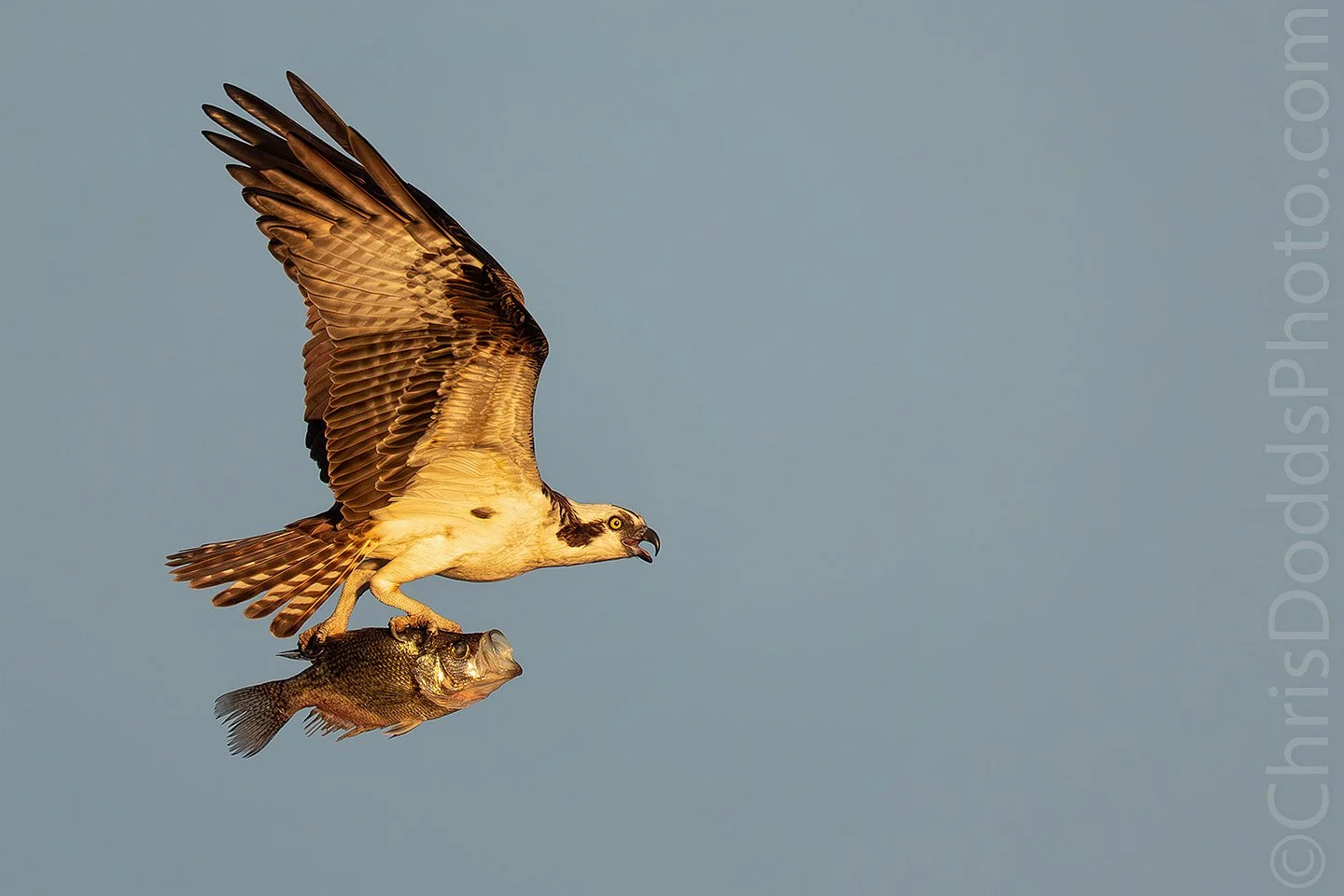
Osprey in flight with Black Crappie in Golden Light

That early morning mist hanging over Lake Blue Cypress, the sun just kissing the tips of the ancient, water-bound cypress trees... there's a magic to it, especially when the air fills with the triumphant cries of Ospreys. One particular moment stands out during my recent "Ospreys Galore & so much more" workshop. Clutching a fresh catch (Black Crappie. Alternate names for the species include calico bass, speck, speckled perch, speckled bass, moonfish, grass bass, strawberry bass, shiner, crawpie, oswego bass, sac-a-lait, and marigane noire). This magnificent bird called out to its mate in the soft, golden light. Our trusty Captain Don maneuvered the pontoon perfectly, allowing us to capture a series of images before letting the Osprey deliver the black crappie to its nest for its chicks to enjoy their breakfast in peace.

Moments like these demand gear that can keep up with the speed and spontaneity of nature, and let me tell you, the new Sony 400-800mm zoom lens paired with the Sony a9 mark III and the Sony 1.4x teleconverter is an absolute game-changer for wildlife photography.

Think about it: a single lens that effortlessly transitions from a generous 400mm reach to a staggering 800mm, and then, with the seamless addition of the 1.4x teleconverter, stretches all the way to 1120mm! This versatility is pure gold in dynamic environments like Blue Cypress. One moment, you're framing a wider scene of the Osprey in its watery habitat; the next, you're zoomed in tight, capturing the intricate details of its plumage or the glint in its eye. No more fumbling with lens swaps and potentially missing that crucial shot.

But reach is only half the story. What truly elevates this combination is the blazing speed and pinpoint accuracy of the a9 III's autofocus system. With its global shutter, the camera locks onto subjects instantaneously, and the Real-time Tracking keeps even erratic flyers like Ospreys locked in focus as they soar and dive. Adding the 1.4x teleconverter introduces more glass into the equation, but I was genuinely impressed by how little it impacted the autofocus performance. The lens and camera communicated flawlessly, delivering sharp, in-focus results even at those extreme focal lengths.

OSPREY in flight with a Black Crappie (Pandion haliaetus, Balbuzard pêcheur, Águila pescadora, OSPR) from my Ospreys Galore Workshop at Lake Blue Cypress near Vero Beach, Florida, USA. Image copyright ©Christopher Dodds Sony a9 III Mirrorless camera & Sony FE 400-800mm f/6.3-8 G OSS Lens with Sony 1.4X Teleconverter @1,120mm ISO 8,000, f/13 @ 1/5,000s. Manual Exposure mode. Join me for my Ospreys Galore workshop every April. To learn more, CLICK HERE.

Dancing with the Wind and a Willet: Willet in flight a la Sony a9 Mark III and the new Sony 400-800mm Zoom Lens

The stage was the wild, windswept beach at Sebastian, Florida, and the star? A stunning willet in striking plumage. If you've ever tried to lock focus on a shorebird in flight, you know they're not exactly known for their predictable flight patterns. Add gale-force wind into the mix, and you've got yourself a real avian acrobat. Tracking that kind of erratic movement, especially when aiming for tack-sharp focus, can sometimes feel impossible.

This is where the magic happened. I had the remarkable Sony a9 Mark III in my hands, paired with the brand-spanking-new Sony 400-800mm zoom, and to reach out and touch those distant subjects, I had the 1.4X teleconverter attached. This combination is a game-changer.

That incredible autofocus system on the a9 III was crucial, with its pre-capture and real-time recognition. It kept me locked onto that willet even as it twisted and turned in the wind. And the 400-800mm zoom, with the added reach of the teleconverter, gave me the flexibility I desperately needed. One moment, the bird was relatively close, buffeting in the wind; the next, it was soaring further out to sea. Instead of fumbling with prime lenses, I could smoothly and quickly adjust my focal length (the lens adjusts from minimum to maximum zoom in 1/4 turn of the zoom ring) while keeping the willet perfectly framed.

The sheer capability of this Sony setup transformed a potentially frustrating experience into an exhilarating one. It allowed me to react instantly to the bird's unpredictable movements, to frame those fleeting moments of beauty against the dramatic backdrop of the windy beach.

Walking away from Sebastian that day, my memory card filled with images that I was truly excited about, I was reminded once again of the incredible advancements in camera technology. This Sony combo isn't just about megapixels or fancy features; it's about empowering photographers to capture the wild beauty of our world, even when nature throws us a curveball – or in this case, a gale-force gust!

Willet in Flight Dorsal View (Tringa semipalmata, Chevalier semipalmé, Playero aliblanco, WILL). From my recent Ospreys Galore Workshop Lake Blue Cypress on April 9, 2025 at Sebastien, Florida, USA. Image Copyright ©Christopher Dodds. Sony a9 III Mirrorless camera & Sony FE 400-800mm f/6.3-8 G OSS Lens with Sony 1.4X Teleconverter @770mm ISO 3,200, f/11 @ 1/5,000s. Manual exposure.

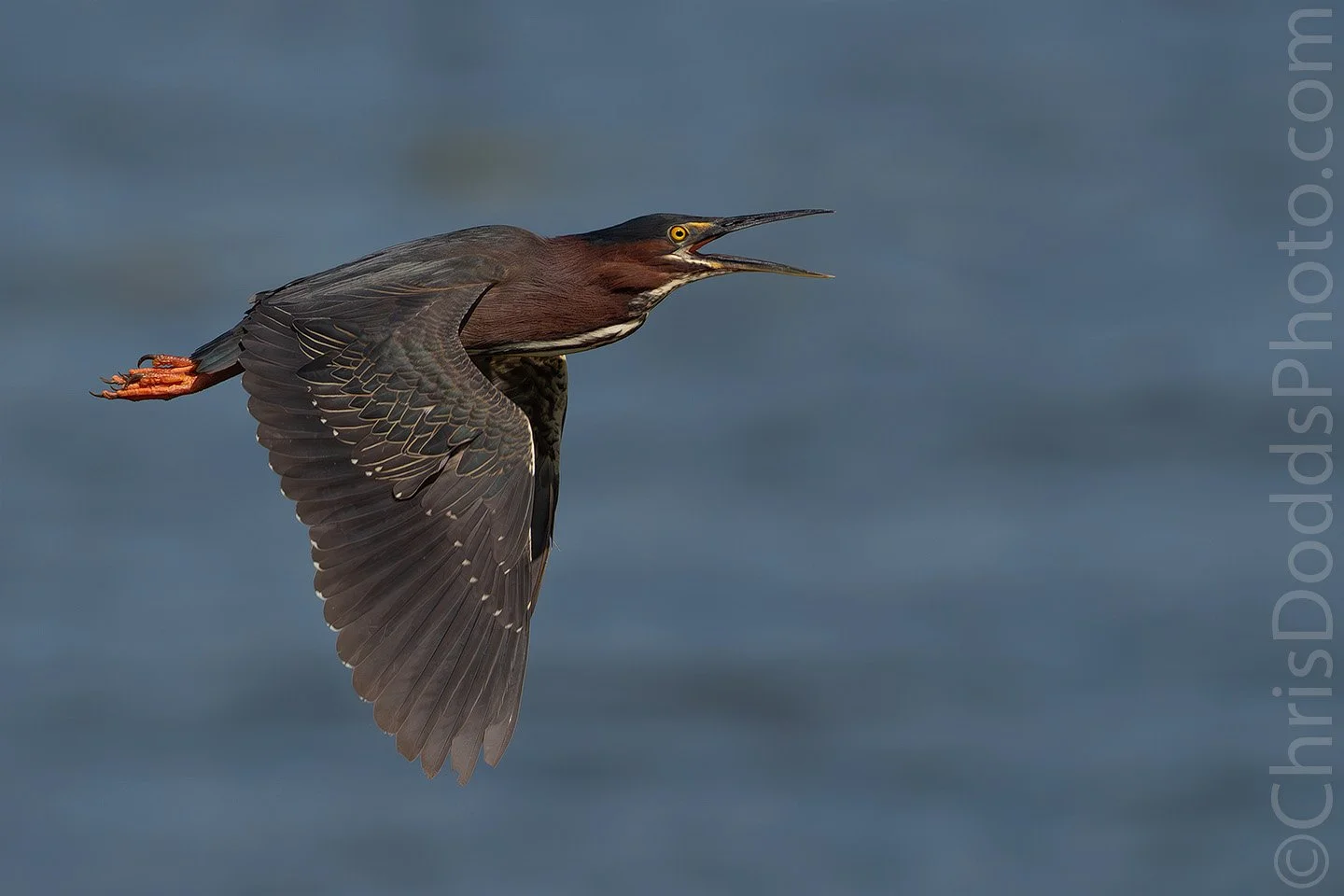
Green Heron Calling in Flight Sony 400-800 with Sony 1.4X Tele-converter

A distinct, loud guttural "skeow" broke the silence as we waited for this Green Heron to take flight from a perch it landed on in front of us a few moments earlier. I tracked it flying directly across my frame as it took flight and called—the fleeting moment when you get the shot or don't. Thankfully, the new Sony 400-800mm with the 1.4x teleconverter attached to the Sony a9 mark III was already poised and ready.

What struck me immediately was the sheer versatility of this setup. Going from 560mm to 1,120mm with a 1/4 turn of the zoom ring while maintaining exceptional image quality is a game-changer. There was no time to swap lenses; frankly, I wouldn't have wanted to. The integrated zoom allowed me to track the heron smoothly as it flew, adjusting my composition on the fly.

And the autofocus? Absolutely tenacious. Even with the added magnification of the teleconverter, the focus locked onto the heron's eye instantly and held firm as it zipped past: crucial for capturing birds in flight, where even the slightest hesitation can mean a missed opportunity. The resulting images are tack sharp, revealing the intricate details of its plumage. The detail retention and auto-focus speed are remarkable.

This encounter perfectly illustrates the power and flexibility of the Sony 400-800mm with the 1.4x. It's a setup that allows you to react quickly, achieve incredible reach, and capture breathtaking sharpness, even in challenging situations. This lens is a serious contender for wildlife photographers who demand the best and need to be ready for anything. It's not just about getting closer; it's about capturing the moment with stunning clarity.

Be sure to take a look at my other blog posts from my trip to Florida with only a Sony a9 mark III, the new Sony 400-800 and both teleconverters (1.4X and 2X):

FE 400–800 mm F6.3–8 G OSS Mini-review. Is this the "Holy Grail" for bird photography? by Christopher Dodds

Less is More: Finding Freedom with only the Sony a9 III and 400-800mm in Florida

Red-shouldered Hawk and the freedom of the new Sony 400-800mm Zoom lens

Green Heron Calling in Flight (Butorides virescens, Héron vert, Garcilla Verde, GRHE). From my recent Ospreys Galore Workshop Lake Blue Cypress near Vero Beach, Florida, USA. Image Copyright ©Christopher Dodds. Sony a9 III Mirrorless camera & Sony FE 400-800mm f/6.3-8 G OSS Lens with Sony 1.4X Teleconverter @1,036mm ISO 3,200, f/13 @ 1/5,000s. Manual exposure.

Red-shouldered Hawk and the freedom of the new Sony 400-800mm Zoom lens

Huge thanks to my eagle-eyed friend and workshop regular, Susan A., for spotting this magnificent red-shouldered hawk! Her sharp observation made this incredible shot possible.

As I mentioned in my last blog post (Less is More: Finding Freedom with only the Sony a9 III and 400-800mm in Florida), I've been rocking a minimalist setup during my Florida workshops: the ever-reliable Sony α9 Mark III and the seriously impressive new Sony 400-800 mm zoom. Let me tell you, this duo is a dream!

What truly impresses me is the seamless transition it allows – from capturing the wider environment to a tight, detailed portrait while maintaining exceptional balance in hand and, most importantly, uncompromising sharpness. This adaptability transforms challenges into opportunities in the unpredictable world of avian photography.

When it comes down to it, the ultimate test is sharpness. The Sony Zoom has genuinely blown me away. The exquisite detail in the hawk's plumage and the raw power in its gaze are testaments to the optical mastery within this lens.

Read my mini-review of the new zoom lens here: FE 400–800 mm F6.3–8 G OSS Mini-review. Is this the "Holy Grail" for bird photography? by Christopher Dodds

Red-shouldered Hawk (Buteo lineatus, Buse à épaulettes, Busardo de hombro rojo, RSHA). April 5, 2025, during my Ospreys Galore Workshop Lake Blue Cypress near Vero Beach, Florida, USA. Image Copyright ©Christopher Dodds. Sony a9 III Mirrorless camera & Sony FE 400-800mm f/6.3-8 G OSS Lens @800mm ISO 1,600, f/8 @ 1/5,000s. Manual exposure.

Less is More: Finding Freedom with only the Sony a9 III and 400-800mm in Florida

I am live and buzzing in the Florida sunshine, ready for the start of my Ospreys Galore Workshop tomorrow! I just landed yesterday, and this morning, I was out before the sun rose and the dew fully lifted. And let me tell you, the light? Absolutely glorious. The wind? Just a whisper, and in the perfect direction. And the subjects? Spectacular roseate spoonbills. Pink perfection against the early morning glow.

Roseate Spoonbill landing in spectacular first light (Platalea ajaja, Spatule rosée, Espátula rosada, ROSP). Image made April 4, 2025, while scouting for my Ospreys of Florida Workshop. Image Copyright ©Christopher Dodds. Sony a9 III Mirrorless camera & Sony FE 400-800mm f/6.3-8 G OSS Lens @400mm ISO 4,000, f/6.3 @ 1/5,000s. Manual exposure. Full frame image

I made a rather deliberate choice for this trip: JUST the revolutionary Sony a9 III and the brand-spankin'-new Sony FE 400–800 mm F6.3–8 G OSS. Just one incredible camera body and one incredible zoom lens. And after this morning’s session, any lingering doubt I might have had has completely vanished.

Getting here was a breeze, literally. Travelling with a single, lightweight, small camera bag (an 18-litre bag with room to spare) felt unbelievably liberating. No more juggling multiple cases, no more strategic repacking in airport security. It was a refreshing reminder that less truly can be more, even before you click the shutter.

But this morning… this morning was the real confirmation. Those spoonbills, with their vibrant plumage and elegant movements, were simply breathtaking. And having the reach and versatility of that 400-800mm lens allowed me to capture them in ways I could only have dreamed of with a more restrictive setup. Whether I was framing a tight portrait of their unique bill or capturing a closer scene of them landing directly toward me, the camera and lens delivered. And the a9 III’s speed and responsiveness? It’s like the camera anticipates the action.

There’s a certain joy in simplifying your tools. You become more attuned to your surroundings and more focused on the moment. You’re not fumbling through a bag of lenses, second-guessing your choices. You’re present, you’re ready, and you’re making the most of the gear you have.

Seeing those spoonbills in that perfect light, knowing I had the right tool for the job, was pure magic. This single-lens approach isn’t a limitation; it’s a focused freedom. And after such a spectacular start, I’m even more excited to see what the rest of my Florida adventure holds. Stay tuned!