
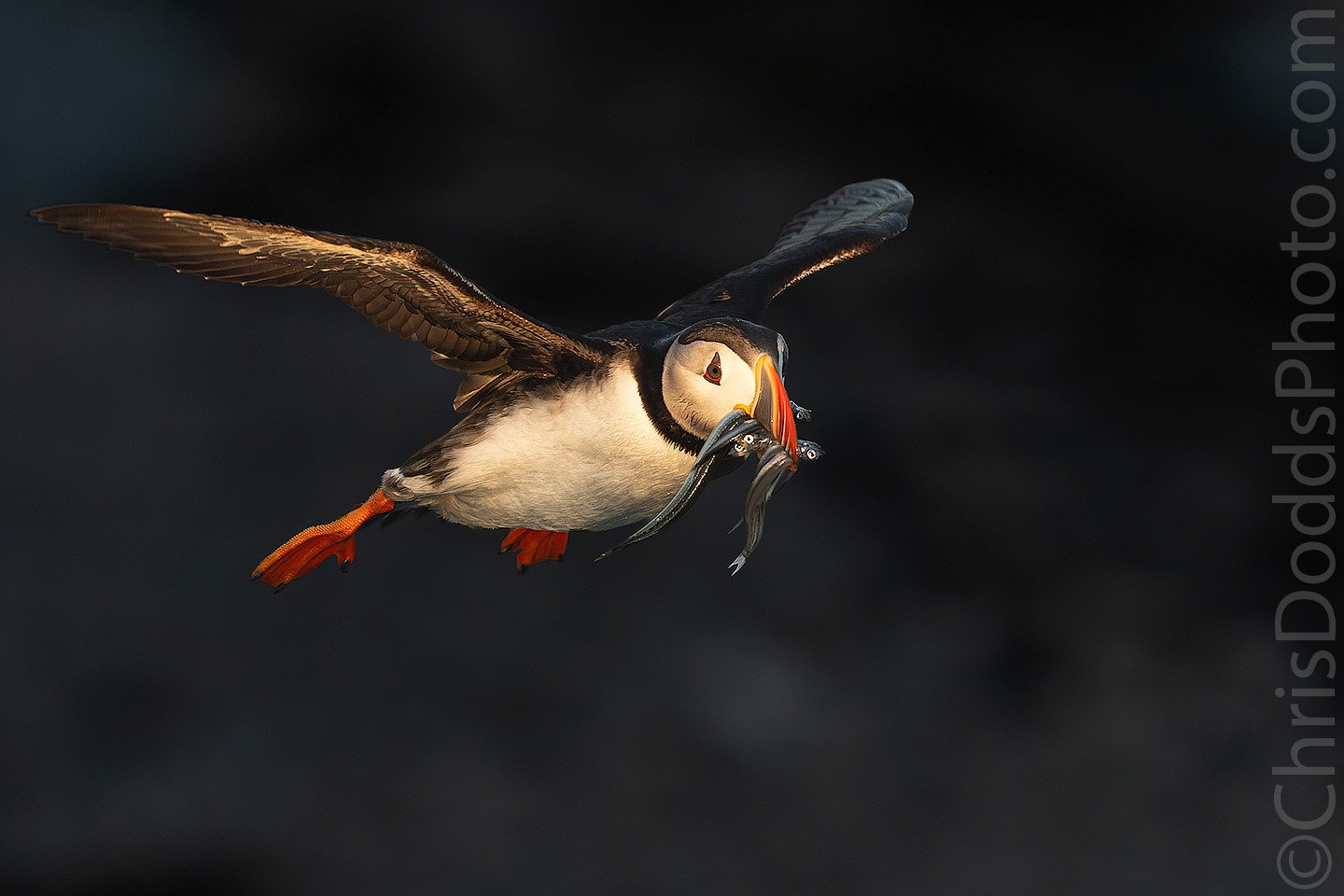
In my last Puffin of the season post, I wrote about previsualizing a photograph and then working backwards to make it happen. I found a small window along a busy Atlantic Puffin flight path where the right trajectory would place an incoming bird, hopefully carrying fish, inside a beautifully out-of-focus frame of grasses as it returned to its burrow.
This photograph came from exactly the same way of thinking — but instead of looking for a window through the grass, I was looking for a tunnel of light.
Finding the Right Light for Atlantic Puffin Photography
I had noticed a narrow section of the Puffins' flight path where the warm light reached the birds while the background remained deep in shadow.
Most of the flight path wasn't particularly interesting photographically. But when an Atlantic Puffin crossed that small illuminated zone, the transformation was remarkable.
The warm light illuminated the Puffin while the distant, shaded background remained almost black.
I knew there was a photograph there.
So rather than simply following every Puffin that flew past, I positioned myself for that specific combination of light, background and flight path — and waited.
Eventually, this Atlantic Puffin came racing through exactly where I hoped it would — wings beautifully spread, feet trailing behind and a bill overflowing with fish.
For an instant, the warm light caught the Puffin's face, bill, breast and upper surface of its outstretched wing while the distant background remained deep in shadow.
That was the frame I had been waiting for.
Previsualization in Wildlife Photography
The photograph wasn't simply a lucky encounter with beautiful light. The Puffin certainly had to cooperate — wildlife always gets the final vote — but I had already chosen where I wanted the photograph to happen.
That's an important distinction.
One of the biggest advances we can make as wildlife photographers comes when we stop simply following our subjects around and start looking for the photograph before the subject arrives.
Sometimes that means finding the right background.
Sometimes it's finding a foreground that will frame the subject.
Sometimes it's predicting behaviour and being ready before it happens.
And sometimes, as it was here, it's discovering a tiny tunnel of extraordinary light along an otherwise ordinary flight path — and waiting for nature to fly through it.
Atlantic Puffin in Flight — Camera Settings
Camera: Sony a9 III
Lens: Sony FE 400–800mm F6.3–8 G OSS
Focal Length: 553mm
Aperture: f/7.1
Shutter Speed: 1/5,000 second
ISO: 3,200
Exposure Mode: Manual
Framing: Full frame
Subject: Atlantic Puffin (Fratercula arctica)
My exposure was already locked in manually for the Puffins flying through that patch of light. That meant when the right bird entered the narrow window, I didn't have to worry about the dark background influencing the camera's meter and changing my exposure. I could concentrate entirely on acquiring the bird, tracking it and keeping it in the frame.
The dark background wasn't created in post-processing. It was simply receiving dramatically less light than the Puffin. By setting my manual exposure for the illuminated bird rather than allowing the camera to react to the changing background, the Puffin remained correctly exposed while that natural difference between light and shadow created the drama.
The darkness wasn't the trick. Finding the light was.
Look for the Photograph Before the Bird Arrives
Wildlife photography will always involve luck. We can't control where a wild bird flies, whether its wings will be in the perfect position or whether an Atlantic Puffin will arrive carrying a spectacular mouthful of fish.
But we can study the light.
We can watch the flight paths.
We can choose our backgrounds.
And we can put ourselves in the best possible position before the action happens.
The more time you spend observing instead of simply reacting, the more often you begin to recognize where a great wildlife photograph could happen.
Then you wait.
Sometimes nothing happens.
Sometimes the bird misses your carefully chosen spot by a few feet.
And sometimes an Atlantic Puffin carrying a mouthful of fish flies straight through the photograph you've already imagined.
That's worth waiting for.
Photograph Atlantic Puffins With Me
Want to put these techniques into practice while photographing Atlantic Puffins?
My Deluxe Atlantic Puffins Galore Photography Workshops put us within a short walk of one of the most extraordinary Puffin photography locations I've experienced, with opportunities to photograph adults returning from the sea carrying fish, Puffins in flight, portraits, behaviour and much more.