
This was supposed to be a short blog post so I could get out for an early run this morning. Smile.
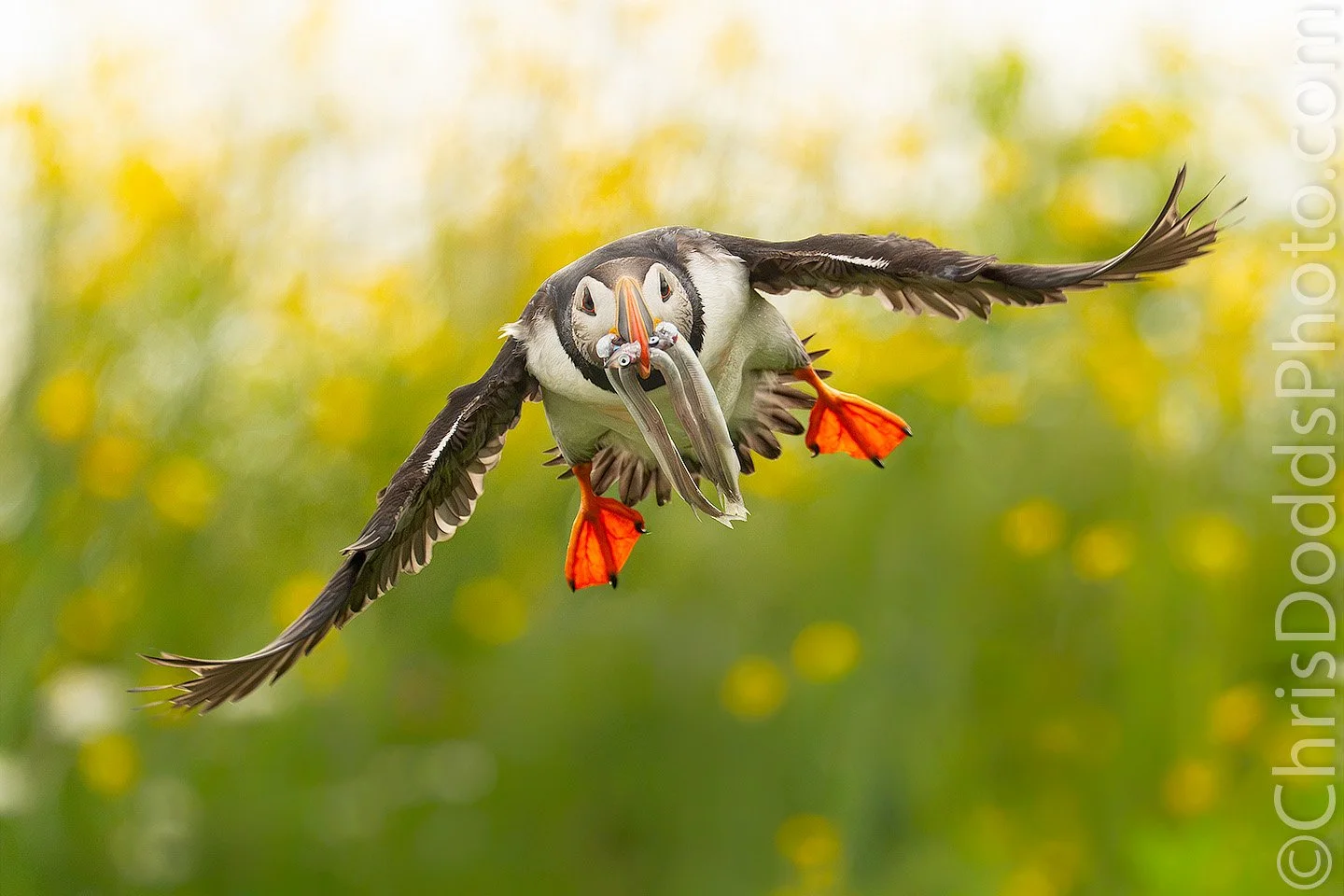
Then I started thinking about everything that had to happen to make this photograph — and, well, so much for the short blog post.
Atlantic Puffins are challenging enough to photograph in flight. When one turns and flies directly toward you at speeds approaching 55 mph (nearly 90 km/h), the challenge goes to another level — especially at 1200mm against a busy, contrasty background.
I made this full-frame, uncropped image during one of my Deluxe Atlantic Puffins Galore Photography Workshops on Île aux Perroquets in Quebec's Mingan Archipelago. The puffin was returning from the Gulf of St. Lawrence with an impressive load of fish for its hungry chick.
The fish, wing position and those brilliant orange feet certainly make the photograph for me, but there's another reason I wanted to share this image: it illustrates just how much has to happen — almost instantaneously — to make a sharp photograph of a small bird flying directly toward the camera.
It's a remarkable collaboration between the photographer, camera, lens, hardware and software.
The Technical Details
Sony a9 III
Sony FE 600mm f/4 GM OSS + 2× Teleconverter
1200mm
1/5,000 second
f/8
ISO 8,000
Full-frame, uncropped image
Yes, 1200mm for a puffin flying directly toward me — and full frame.
That's not exactly stacking the odds in my favour. Smile.
Why Puffins Flying Toward the Camera Are So Difficult
Atlantic Puffins are surprisingly fast. Their short wings beat furiously, and a bird returning with fish doesn't politely follow a predictable flight path designed for photographers.
A puffin crossing from left to right can actually be easier for an autofocus system because its distance from the camera may not be changing dramatically from one instant to the next.
A bird flying straight toward you presents an entirely different autofocus problem.
The camera must first recognize and acquire a relatively tiny bird in the frame, often against a highly detailed and contrasty background. It then has to distinguish the bird — and preferably its head or eye — from all of that competing detail.
Once it locks on, the real race begins.
Every fraction of a second, the puffin is closer.
At 1200mm, the angle of view is extremely narrow. The bird grows rapidly in the frame, and I have to keep that tiny, fast-moving target inside a very small field of view while the autofocus system continually calculates where focus needs to be.
And that brings us to an important part of autofocus that doesn't get nearly enough attention.
Autofocus Doesn't Track the Bird Unless the Photographer Does
We spend an enormous amount of time discussing autofocus systems, subject recognition and bird-eye detection, but there is another essential part of the autofocus system that doesn't appear anywhere on the camera's specification sheet:
The photographer.
The world's best autofocus system can't track a bird that I've lost outside the viewfinder.
At 1200mm, following a small Atlantic Puffin flying directly toward the camera requires precise tracking and anticipation. The field of view is tiny. A small error can put the autofocus system onto the bright flowers or vegetation behind the bird.
The photographer has to acquire the puffin early, match its movement, keep it in the appropriate part of the frame and continue tracking smoothly while the bird becomes larger and larger in the viewfinder.
And because this photograph is full frame and uncropped, there wasn't much room for error.
Successful autofocus is a partnership between camera hardware, camera software and firmware, communication between the camera and lens, the lens's focusing mechanism, the physical mass of the focusing elements that have to move — and the photographer's ability to keep the subject properly tracked within a very small field of view.
Leave any one of those pieces behind and your success rate can fall dramatically.
A Bird at Constant Speed Doesn't Mean Focus Changes at a Constant Speed
Here's something about autofocus that isn't discussed nearly enough.
Imagine a puffin flying directly toward you at a perfectly constant speed.
From the photographer's point of view, the bird isn't accelerating.
But the lens does not simply move its focusing elements at one constant speed to follow it.
The relationship between subject distance and the optical position required for focus is nonlinear. As the subject gets progressively closer, increasingly rapid changes in focus position can be required over the same interval of time.
In practical terms, the autofocus system can be forced to reposition the focusing group progressively faster as that bird approaches.
So although the puffin isn't accelerating, the demands being placed on the focusing mechanism can resemble acceleration.
And the closer that puffin gets, the tougher the job becomes.
That's one reason those final moments of a head-on approach can separate an autofocus system that merely looks impressive on a specification sheet from one that consistently delivers sharp images in the field.
Autofocus Isn't Just About the Camera Body
We tend to talk about autofocus as though it lives entirely inside the camera.
It doesn't.
The camera has to recognize the subject, determine its distance and movement, and predict where it will be next.
Then the lens has to physically put the focusing elements where they need to be — quickly and precisely enough that the subject is actually in focus when the shutter fires.
And then the whole process starts again.
The camera may know exactly where focus should be, but the lens still has to get there.
That makes the design of the lens's autofocus drive extremely important.
Modern Lens Motors Are Changing the Game
This is one area where modern mirrorless lenses have made enormous progress.
The Sony FE 600mm f/4 GM OSS used for this photograph employs two XD (Extreme Dynamic) Linear Motors to rapidly and precisely move its large focusing group.
When a small bird is rapidly approaching the camera, that responsiveness matters.
But this isn't simply a Sony story, nor is a linear motor the only way to achieve outstanding autofocus performance.
Nikon has also made enormous gains. Its professional NIKKOR Z 600mm f/4 TC VR S uses Nikon's Silky Swift VCM (SSVCM) — a voice-coil motor combined with a guide mechanism to achieve high-speed, high-accuracy autofocus.
OM SYSTEM takes another approach with its professional M.Zuiko Digital ED 150–400mm f/4.5 TC1.25× IS PRO, specifying a high-speed MSC inner-focus system. OM SYSTEM describes MSC as a direct, gearless focusing mechanism designed for quiet, high-speed and high-precision AF. Whatever terminology we attach to the motor itself, my experience with OM SYSTEM's best bird-photography combinations has been remarkably good with fast-moving subjects.
Canon takes a somewhat different approach. Professional super-telephotos such as the RF600mm F4 L IS USMuse Canon's proven ring-type Ultrasonic Motor technology rather than the XD linear-motor arrangement in the Sony 600mm f/4 or Nikon's newer SSVCM technology.
That said, my own experience using the RF600mm F4 L IS USM on Canon's flagship EOS R1 has been consistently disappointing when photographing demanding birds in flight, particularly compared with my experience using the latest Sony, Nikon and OM SYSTEM professional bird-photography combinations.
That's my field experience rather than a controlled laboratory measurement, and I think that distinction is important. I'm not claiming that I've measured one focus motor moving a particular number of milliseconds faster than another.
What I can compare is results in the field.
For the kind of photography I do — small, fast birds flying directly toward the camera and often against busy, contrasty backgrounds — I've experienced a significant difference in autofocus acquisition, responsiveness and tracking success.
That doesn't necessarily mean the EOS R1's autofocus system itself is the limiting factor.
The camera can recognize the bird, track it and calculate where focus needs to be — but the lens still has to physically move its focusing group there quickly enough.
That's precisely why I think the focusing motor and the physical design of the lens deserve far more attention when we discuss modern autofocus performance.
Motor technology alone doesn't determine real-world autofocus performance, either. The mass and travel of the focusing group, motor power, lens electronics, communication between camera and lens, subject-recognition and predictive AF algorithms, firmware — and, of course, the photographer keeping the subject in the viewfinder — all contribute to the final result.
Different manufacturers — and even different lenses within the same system — use different engineering solutions.
They're all chasing essentially the same goal:
Move the necessary focusing elements faster and more precisely — and get them exactly where the camera predicts they need to be.
That's great news for bird photographers.
Software and Firmware Are Just as Important
Fast motors alone aren't enough.
Modern autofocus is an incredibly sophisticated feedback loop.
The camera has to determine what the subject is, where it is, how it is moving and where it is likely to be next. The lens has to respond to those instructions quickly enough to put the optical system where the camera expects focus to be.
Subject recognition, tracking algorithms, predictive autofocus calculations, camera-to-lens communication and the control algorithms governing the focus motors all contribute to whether the final photograph is sharp.
That's why autofocus performance today isn't simply a hardware specification.
It's a constantly coordinated conversation between hardware and software.
Firmware is an important part of that equation because it controls how effectively those physical components communicate and work together.
Then There's That Background
Photographing a bird against a clear blue sky is one thing.
Look behind this puffin.
There are bright yellow flowers, green vegetation, highlights, shadows and plenty of high-contrast detail for an autofocus system to become interested in.
When I initially acquire the bird, it occupies a relatively small portion of the frame.
The camera has to recognize that the puffin is the subject, ignore all of that tempting background detail, acquire the bird and continue tracking it as it rapidly becomes larger in the frame.
And I have to do my part by keeping the autofocus system pointed at the puffin rather than the background.
That's a much more meaningful autofocus challenge than photographing a large bird against an empty sky.
Why 1/5,000 Second Is My Minimum
For fast birds in flight, 1/5,000 second is my minimum shutter speed.
Not my preferred shutter speed only when there's lots of light.
My minimum.
Look closely at everything that's moving in this photograph: the wing tips, individual feathers, dangling fish and extended feet.
Even if autofocus puts the eye perfectly in focus, subject motion can destroy the fine detail I'm trying to record.
That's why I was perfectly happy to photograph this puffin at ISO 8,000.
I would much rather have the shutter speed necessary to freeze the action and record real feather detail than reduce the ISO simply because someone decided that lower ISO numbers are always better.
ISO is not the enemy. Motion blur is.
Give me a sharp, properly exposed ISO 8,000 image over a beautifully clean blurry photograph every time.
120 Frames Per Second Doesn't Make the Photograph
The Sony a9 III can photograph at an extraordinary 120 frames per second with continuous autofocus and auto exposure tracking.
I use that capability when the situation warrants it.
But 120 frames per second doesn't find the bird.
It doesn't acquire the puffin at 1200mm.
It doesn't keep a tiny bird inside that narrow field of view.
It doesn't choose the background.
It doesn't recognize which flight path might produce the best image.
And it certainly doesn't keep the bird perfectly positioned while it hurtles directly toward the camera.
What 120 fps does is give me more opportunities to capture the exact fraction of a second when everything I've worked for comes together — the wing position, feet, head angle, fish and composition.
Technology increases opportunity. The photographer still has to be ready for it.
This Is Why We Practise
One of the wonderful things about photographing Atlantic Puffins is that there is always another challenge.
First you learn to acquire them in flight.
Then you start improving your tracking.
Then you begin paying more attention to backgrounds.
Then wing positions.
Then head angles.
Then birds returning with fish.
And eventually you see one coming directly at you with a spectacular mouthful like this and try to keep everything together long enough to make the photograph.
That's also a huge part of what we work on during my Deluxe Atlantic Puffins Galore Photography Workshops.
We're not simply going somewhere where puffins exist.
We spend our time in the field learning how to recognize opportunities, choose the best backgrounds, understand the light, configure the autofocus system, acquire fast-moving birds and — perhaps most importantly — develop the photographer's ability to keep those birds in the viewfinder when things get difficult.
There is no substitute for having puffins flying past with fish again and again while you practise.
And every once in a while, one comes straight at you.
That's when the camera, lens, software, autofocus system and photographer all have to work together.
And that's when all of that practice pays off.
Join Me for Atlantic Puffins Galore 2027
If photographing Atlantic Puffins in flight — with beautiful backgrounds, spectacular fish deliveries and plenty of opportunities to improve your bird-in-flight technique — is on your wish list, I'll be returning to Île aux Perroquets in 2027 for another season of my Deluxe Atlantic Puffins Galore Photography Workshops.
Small groups, extensive time in the field and one extraordinary little island surrounded by Atlantic Puffins.
Come prepared to photograph. The puffins don't slow down for us. Smile.