
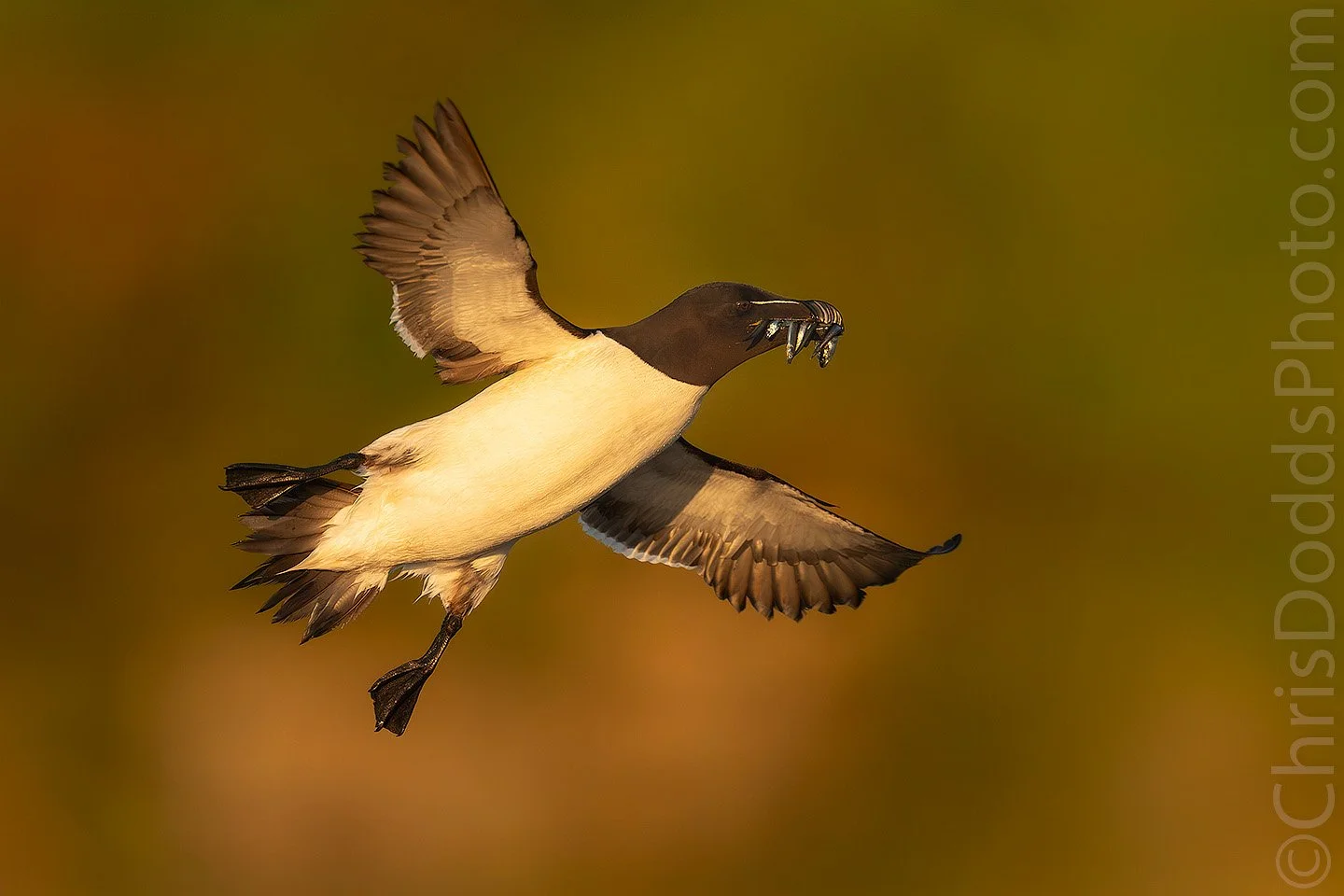
There are few things more rewarding in bird photography than watching a parent return from the sea with a successful catch. During one of my Deluxe Atlantic Puffins Galore Photography Workshops on Île aux Perroquets, Quebec, this Razorbill came racing back toward its waiting chick with a beak absolutely packed with small fish.
And I mean packed.
Razorbills (Alca torda) are members of the auk family, close relatives of Atlantic Puffins and murres. Like puffins, they spend most of their lives at sea and return to rocky islands along the North Atlantic coast to breed. During nesting season, the adults make repeated fishing trips, returning with food for their rapidly growing chicks.
While Atlantic Puffins may be the headline attraction of my Atlantic Puffin Photography Workshops, they are far from the only reason I love photographing on Île aux Perroquets. Razorbills provide some spectacular opportunities — particularly when the adults begin returning from the sea carrying fish.
Photographing a Razorbill in Flight at 1200mm
The trick isn't simply finding a Razorbill carrying fish. You need to recognize what is happening early enough to acquire the bird, lock focus and keep it in the frame as it comes screaming toward the colony.
Everything happens remarkably quickly.
I was using my Sony α9 III with the Sony FE 600mm F4 GM OSS and Sony 2X Teleconverter, giving me an effective focal length of 1200mm at f/8.
That's a lot of focal length for a fast-moving bird in flight.
The narrow field of view at 1200mm makes initially finding and acquiring the bird more difficult, and even a small error in panning is magnified.
This photograph is full frame and completely uncropped. The composition you see here is exactly as I composed it in the camera.
At 1200mm, getting a rapidly approaching Razorbill into the viewfinder is one thing. Keeping it there while watching the wing position, maintaining space in the direction of flight and creating the finished composition in-camera is another challenge altogether.
For me, that's a big part of the fun of photographing birds in flight.
Camera Settings
Camera: Sony α9 III
Lens: Sony FE 600mm F4 GM OSS
Teleconverter: Sony 2X
Focal Length: 1200mm
Shutter Speed: 1/5,000 second
Aperture: f/8
ISO: 2500
Composition: Full frame — composed in-camera, no crop
My priority was the 1/5,000-second shutter speed. I wanted enough speed to freeze the Razorbill's rapid flight while preserving the tiny fish, feather detail and that wonderful split-second wing position.
The α9 III's autofocus certainly helps me stay with a fast-moving bird, but the camera can't compose the photograph for me. At 1200mm, smooth tracking, anticipation and keeping the bird exactly where I want it in the frame are every bit as important as autofocus performance.
It's All About the Light
What really transformed this moment was the light.
The low, warm light illuminated the Razorbill beautifully while the distant vegetation fell into a wonderfully soft wash of gold, green and brown. That separation allowed the bird's black-and-white plumage to stand out dramatically without the background competing for attention.
The warm light also revealed subtle detail in the otherwise dark head and wings while catching the silvery fish in its bill.
And that mouthful of fish is what makes the photograph for me.
Without them, this would still be a pleasing Razorbill-in-flight image. With them, the photograph becomes a story.
This isn't simply a bird flying past.
It's a parent returning from the sea with food for its chick — one tiny moment in the enormous effort required to successfully raise the next generation.
More Than Puffins on Île aux Perroquets
Atlantic Puffins may be the stars of my Deluxe Atlantic Puffins Galore Photography Workshops, but one of the things that makes staying on Île aux Perroquets so special is the variety of photographic opportunities surrounding us.
And Razorbills are certainly among my favourites.
Spending several days on the island gives us something particularly valuable in wildlife photography: time.
Instead of simply reacting to whatever happens, we can observe and learn the birds' routines. We begin to recognize where they tend to approach from, how the light changes throughout the day, which backgrounds work best and when adults are returning from successful fishing trips.
That knowledge lets you prepare for the photograph rather than chase it.
It has always been an important part of my approach to wildlife photography: anticipate the moment, get into position, understand the light and be ready when everything comes together.
For a fraction of a second, this Razorbill, its mouthful of fish, the wing position, the warm light and that beautifully distant background all aligned.
1/5,000 of a second preserved it — composed in-camera, full frame and uncropped.
What Participants Say
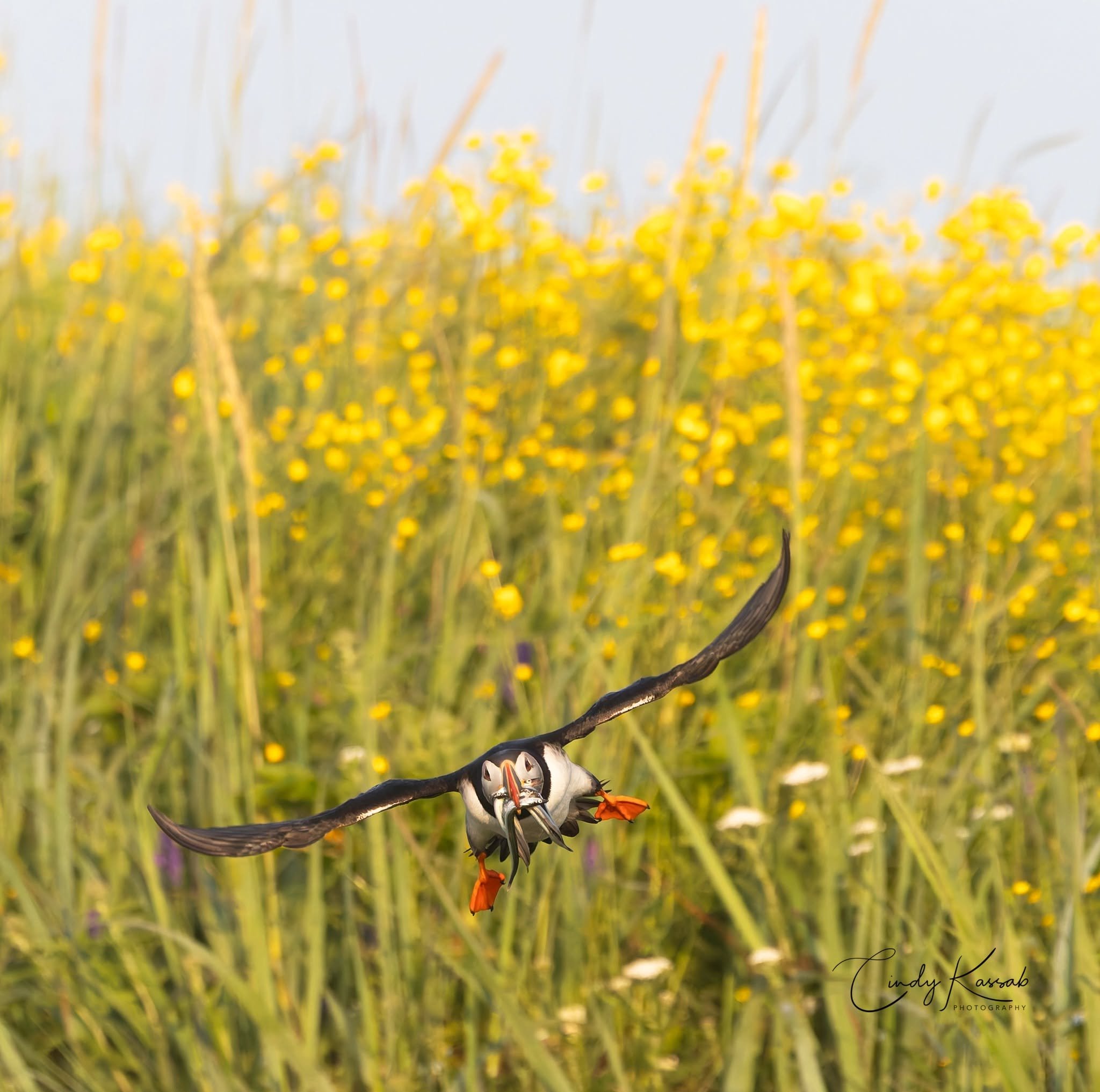
Atlantic Puffin returning with fish for its chick on Île aux Perroquets. Photograph by repeat workshop participant Cindy Kassab during my Deluxe Atlantic Puffins Galore Photography Workshop.
“I'm absolutely thrilled to have joined Christopher Dodds' wonderful Puffins Galore workshop once again. I had such an incredible experience last year that I couldn't resist returning to the beautiful Île-aux-Perroquets Lighthouse in Quebec's Mingan Archipelago.
One of the joys of wildlife photography is that no two trips are ever the same. Even when returning to the very same location, nature always offers something new.
Thank you, Christopher, for another outstanding workshop and for your passion in helping photographers capture moments like this.”
— Cindy Kassab | Vancouver, Washington, USA | Repeat Atlantic Puffins Galore Workshop Participant
Join Me for an Atlantic Puffin Photography Workshop
If photographing Atlantic Puffins, Razorbills and the other seabirds of Quebec's spectacular North Shore is on your wish list, join me for one of my Deluxe Atlantic Puffins Galore Photography Workshops on Île aux Perroquets.
We stay right on the island, surrounded by the sights and sounds of the seabird colony, with extraordinary photographic opportunities only a short walk from our accommodations.
My small groups and our extended time on the island give us the opportunity to concentrate not simply on making photographs, but on learning to recognize behaviour, anticipate action, work with changing light and be ready for moments just like this one.
Because some of the best wildlife photographs aren't simply portraits of an animal.
They tell you what the animal was doing — and why.